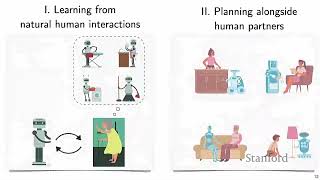
Interactive Imitation Learning: Planning Alongside Humans
Interactive imitation learning for robots: tackling feedback-driven covariate shift and predicting human intent using graph neural networks, with applications in self-driving vehicles.
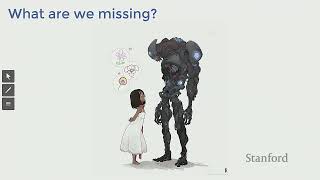
Stanford Seminar - Perceiving, Understanding, and Interacting through Touch
Explore the emerging field of touch processing in AI and robotics, its challenges, and potential applications. Learn about recent advances in tactile sensing hardware and their implications.
Stanford Seminar - Modeling and Interacting with Other Agents, Claire Tomlin
Explores innovative approaches to predicting agent behavior in autonomous systems, combining game theory and behavioral models for improved motion planning and interaction in multi-vehicle scenarios.

Leveraging Human Input to Enable Robust AI Systems
Explores techniques for incorporating human input into AI systems, focusing on maintaining uncertainty over human intent, generating risk-averse behaviors, and efficiently querying for additional input to improve performance.
Incorporating Sample Efficient Monitoring into Learned Autonomy
Explore sample-efficient warning systems for robotics, detecting unsafe situations and distribution shifts with statistical guarantees. Learn about real-time frameworks and faster detection methods.
Why Would We Want a Multi-Agent System Unstable
Explores Control Barrier Function methods for collision avoidance in multi-agent systems, comparing stability and effectiveness of different algorithms through simulations and vehicle experiments.

Humanizing Robot Design - Aaron Edsinger of Hello Robot
Exploring the future of human-robot collaboration, focusing on safe, intuitive, and affordable robots designed to improve quality of life in various sectors, from eldercare to service industries.
Stanford Seminar - Democratizing Robot Learning
Exploring advancements in human-robot interaction, focusing on learning from human decision-makers, explainable AI, and coordinated control of human-robot teams for real-world applications.
Stanford Seminar - Get in Touch: Tactile Perception for Human-Robot Systems
Explore advancements in tactile perception for robots, including sensor technologies, haptic perception, and applications in human-robot interaction and manipulation of deformable objects.
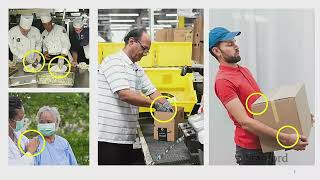
Adaptable Robotic Manipulation Using Tactile Sensors
Explore tactile sensing in robotics for dexterous manipulation and suction cup grasping. Learn about multimodal sensors measuring contact forces, slips, and suction seal formations to enable adaptive robotic control in changing environments.
Towards Generalizable Autonomy - Duality of Discovery & Bias
Exploring generalization in embodied AI, focusing on interactive learning, representational biases, and causal inference for robotics and decision-making in complex environments.
Stanford Seminar - Multi-Sensory Neural Objects: Modeling, Inference, and Applications in Robotics
Exploring multi-sensory neural object representations for robotics, focusing on object-centric modeling, dataset creation, parameter inference, and manipulation applications.
Autonomous Robotic Manipulation - What’s Within Reach? Jeannette Bohg
Explore autonomous robotic manipulation principles, challenges, and innovative approaches with Prof. Bohg. Learn decision-making under uncertainty, multimodal information use, and action representation in robotics.
Stanford Seminar - Re-Imagining Drones Through Open Innovation
Re-imagining drones through open innovation: explore disruptive technologies, community-driven development, and the evolving aerospace industry with insights from 3DR's Chris Anderson.
Interactive Autonomy - A Human-Centered Approach for Safe Interactions
Explore interactive autonomy for safe human-robot collaboration, focusing on algorithms that influence human behavior and efficient active learning methods to model human preferences.
Did You Hear the One About the Engineer That Walked Into an Art Gallery?
Explore the intersection of engineering and art with Mark Pauline, discussing the role of engineers in the art world and showcasing his unique robotic creations for performance art.
Exploring the Implications of Machine Learning for Cognitive Disabilities
Exploring machine learning's potential to enhance cognitive disability support through natural language processing, emotion detection, and autonomous systems for improved understanding and interaction.
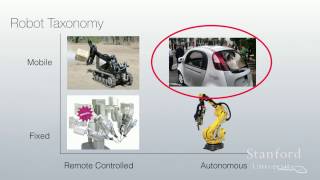
Stanford Seminar - Service Robots Are Here II
Explore the latest advancements in service robotics and their impact on industries like hospitality, healthcare, and restaurants. Learn about recent developments, investment trends, and real-world applications of mobile robots.
Towards Trusted Human-Centric Robot Autonomy - Stanford Seminar
Exploring human-centric robot autonomy: balancing safety and fluency in interactions. Insights on data-driven safety concepts and legible robot behavior for prosocial human-robot engagement.
Towards Safe and Efficient Learning in the Physical World - Stanford Seminar
Exploring safe Bayesian optimization and model-based deep reinforcement learning for efficient, safe online learning in real-world applications like robotics and laser tuning.
Robot Learning in the Era of Large Pretrained Models - Stanford Seminar
Exploring interactive robot learning with large pretrained models, focusing on visual representations, data collection strategies, and leveraging language models for robotics applications.