
From the Surface of Mars to the Ocean of Enceladus - EELS Robot and Risk-Aware Adaptive Autonomy
Exploring extreme environments with EELS robot: From Mars rovers to searching for alien life in Enceladus' ocean using risk-aware adaptive autonomy and versatile robotic hardware.
Building Safe and Reliable Autonomous Systems
Explore techniques for developing safe, trustworthy AI systems in critical sectors, focusing on reliability and robustness using advanced machine learning methods.
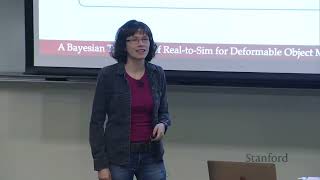
Distributional Representations and Scalable Simulations for Real-to-Sim-to-Real
Explore challenges and solutions in representing deformable objects, using distributional approaches and differentiable simulators for real-to-sim applications in robotics and autonomous systems.
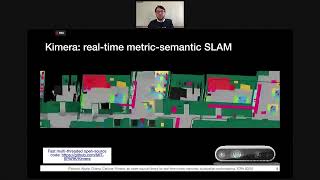
Opening the Doors of Robot Perception - Luca Carlone
Explore cutting-edge spatial perception algorithms for robots, including 3D scene understanding, metric-semantic mapping, and certifiable perception techniques for robust and reliable autonomous systems.
Stanford Seminar - Modeling and Interacting with Other Agents, Claire Tomlin
Explores innovative approaches to predicting agent behavior in autonomous systems, combining game theory and behavioral models for improved motion planning and interaction in multi-vehicle scenarios.
Incorporating Sample Efficient Monitoring into Learned Autonomy
Explore sample-efficient warning systems for robotics, detecting unsafe situations and distribution shifts with statistical guarantees. Learn about real-time frameworks and faster detection methods.
Why Would We Want a Multi-Agent System Unstable
Explores Control Barrier Function methods for collision avoidance in multi-agent systems, comparing stability and effectiveness of different algorithms through simulations and vehicle experiments.
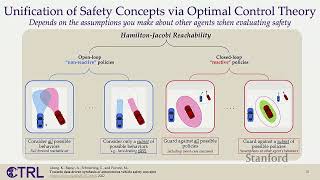
Towards Trusted Human-Centric Robot Autonomy - Stanford Seminar
Exploring human-centric robot autonomy: balancing safety and fluency in interactions. Insights on data-driven safety concepts and legible robot behavior for prosocial human-robot engagement.
Towards Safe and Efficient Learning in the Physical World - Stanford Seminar
Exploring safe Bayesian optimization and model-based deep reinforcement learning for efficient, safe online learning in real-world applications like robotics and laser tuning.
Silicon Valley and the U.S. Government: Shield AI's Innovations in Defense Technology
Explore Shield AI's innovative AI and autonomy technology for defense, featuring insights from co-founder Brandon Tseng on collaborations between Silicon Valley and the U.S. government.
Silicon Valley and U.S. Government Collaboration - Applied Intuition's Qasar Younis
Explore insights on government-industry collaboration in technology innovation, featuring Applied Intuition's CEO discussing challenges and opportunities in vehicle software development and adoption.
Human-Robot Interaction - Enhancing Human Performance with Autonomous Robots
Explore the future of human-robot collaboration with Stanford experts, discussing autonomous robots, enhancing human performance, and understanding human intent in collaborative design.
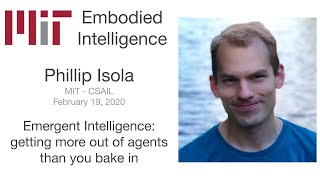
MIT EI Seminar - Phillip Isola - Emergent Intelligence- Getting More Out of Agents Than You Bake In
Explore emergent intelligence in AI through unsupervised learning, generative modeling, and self-assembling agents. Discover surprising outcomes beyond explicit programming in representation, video generation, and creature development.
Modeling Computer Networks from Chips to the Internet
Explore network modeling strategies for the Internet, from chip-level communication to global-scale simulations, examining scaling laws, biological concepts, and socio-economic factors shaping its future.
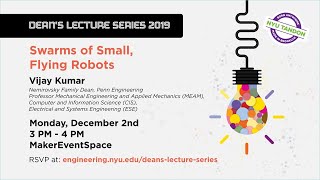
Swarms of Small Flying Robots - Advances in UAV Technology and Applications
Explore the fascinating world of small flying robots and swarms, their applications, and the cutting-edge research behind their development and autonomous capabilities.
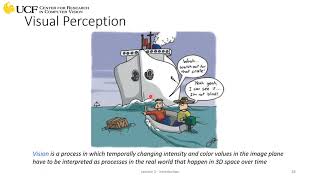
Introduction to Computer Vision - Part I - Lecture 1
Explore computer vision fundamentals, from image processing to deep learning applications. Covers perception, image types, and real-world uses in retail and autonomous vehicles.
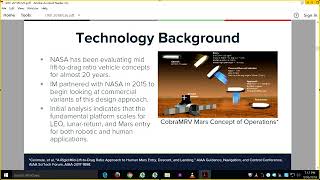
Design of an Automated Re-entry Vehicle for Priority Sample Returns
Innovative design for low-cost cargo return from ISS using modified NASA heat-shield, modern subsystems, and automotive-grade parts. Explores applications beyond ISS payload return.
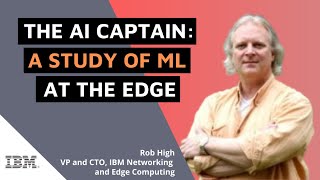
The AI Captain: A Study of Machine Learning at the Edge
Explore the Mayflower project's AI breakthroughs and edge computing applications in maritime technology. Gain insights into cutting-edge AI implementation for autonomous navigation.
Exploring the Impact of Agentic Workflows - MLOps Podcast Episode 268
Dive into the world of AI agents in production with insights on deployment strategies, real-world applications, and practical advice for integrating AI into everyday systems while maintaining human oversight.
LLM Safety, Alignment, and Generalization
Explore the challenges and importance of LLM safety, alignment, and generalization as capabilities rapidly improve across various domains.
弹指千万里 - 无人机的未来形态
探索无人机的智能化未来:从自动充电到AI识别,突破传统操控模式,实现真正的"无人"飞行,为智慧城市管理和环境监测带来革命性变革。