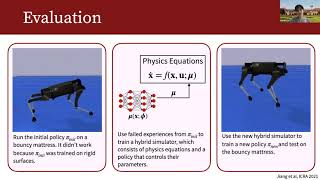
The New Role of Physics Simulation in AI
Explore advancements in physics simulation for AI, focusing on overcoming sim-to-real gaps and improving human-robot interactions through learnable physics engines and efficient training techniques.
Stanford Seminar - On and Out-of-Body Interactions & Experiences
Explore novel interaction techniques for on-body and out-of-body technologies, including wearables, robots, and drones, to enhance human-machine integration and extend physical abilities.
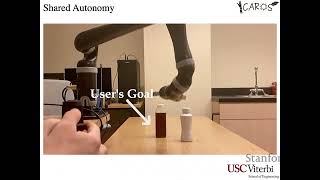
Towards Robust Human-Robot Interaction - A Quality Diversity Approach
Exploring diverse human-robot interaction scenarios using quality diversity algorithms to discover failure cases, improve scenario generation, and enhance understanding of complex systems.
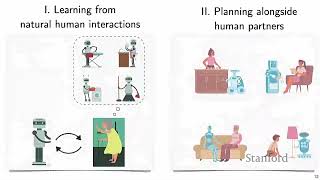
Interactive Imitation Learning: Planning Alongside Humans
Interactive imitation learning for robots: tackling feedback-driven covariate shift and predicting human intent using graph neural networks, with applications in self-driving vehicles.
Stanford Seminar - Democratizing Robot Learning
Exploring advancements in human-robot interaction, focusing on learning from human decision-makers, explainable AI, and coordinated control of human-robot teams for real-world applications.
Stanford Seminar - Get in Touch: Tactile Perception for Human-Robot Systems
Explore advancements in tactile perception for robots, including sensor technologies, haptic perception, and applications in human-robot interaction and manipulation of deformable objects.

Interactive Autonomy - A Human-Centered Approach for Safe Interactions
Explore interactive autonomy for safe human-robot collaboration, focusing on algorithms that influence human behavior and efficient active learning methods to model human preferences.
Exploring the Implications of Machine Learning for Cognitive Disabilities
Exploring machine learning's potential to enhance cognitive disability support through natural language processing, emotion detection, and autonomous systems for improved understanding and interaction.
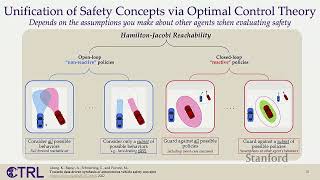
Towards Trusted Human-Centric Robot Autonomy - Stanford Seminar
Exploring human-centric robot autonomy: balancing safety and fluency in interactions. Insights on data-driven safety concepts and legible robot behavior for prosocial human-robot engagement.
Human-Robot Interaction - Enhancing Human Performance with Autonomous Robots
Explore the future of human-robot collaboration with Stanford experts, discussing autonomous robots, enhancing human performance, and understanding human intent in collaborative design.
Robot Learning with Minimal Human Feedback
Explore techniques for training robots with minimal human feedback, including reinforcement learning, language corrections, and leveraging pretrained vision-language models for direct supervision.
AI in Robotics, Manufacturing, and Media - How Good Practices Can Shape the Future
Explore AI's impact on robotics, manufacturing, and media. Learn how to maximize benefits, address challenges, and shape a sustainable future through good practices and ethical considerations.

Common Ground in Cooperative Communication
Explore cooperative communication theory and its application to human-robot interaction. Delve into the concept of common ground and its role in successful communication across various domains.
Robot Learning with Minimal Human Feedback
Explore innovative techniques for training robots with minimal human feedback, from single demonstrations to eye gaze, and learn about leveraging pretrained models for efficient robot learning.
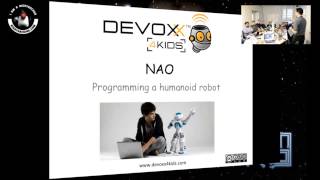
NAO Humanoid Robot App Development - JUG Bodensee Presentation
Explore NAO Humanoid robot app development in this JUG Bodensee session. Learn about IOT challenges, Java One, and witness NAO demonstrations including choreography.
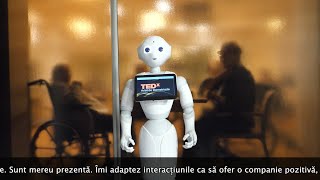
Călătorie în lumea Roboticii Sociale - Puterea și Limitele Roboților Sociali
Explorează puterea și limitele roboticii sociale, rolul fricii în evoluția tehnologiei și impactul roboților precum Juliette în îmbunătățirea vieții vârstnicilor, prin perspectiva unui cercetător român.
İnsanların Robotlara Evrilmesi - Teknolojik Gelişimin Geleceği
Robotların geleceği ve insanlığın evrimine dair öngörüler sunan bu konuşma, teknolojik gelişmelerin toplum üzerindeki potansiyel etkilerini ve insansı robotların rolünü inceliyor.

Creating Artificial Minds: Challenges of Cognitive Developmental Robotics
認知発達ロボティクスの挑戦:人工知能の心を創造する過程と課題を探求。ロボットの認知能力と感情の発達に焦点を当て、人間の心の仕組みへの洞察を提供。
Human-Agent Collaboration: Can an Agent be a Partner?
Exploring the potential and challenges of human-agent collaboration, discussing trust, partnership dynamics, and the future of AI interactions in various contexts.
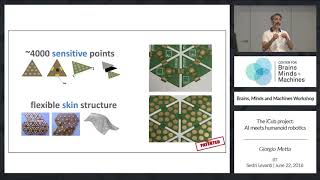
The ICub Project - AI Meets Humanoid Robotics
Explore the iCub humanoid robot project, its design, sensors, and AI applications in vision, speech, and interaction experiments.
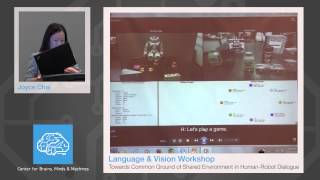
Human-Human Communication
Explore human-human communication principles and their application to human-robot dialogue, focusing on referential grounding, collaborative effort, and empirical studies using NAO robots.