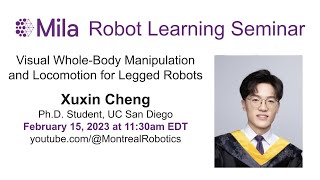
Visual Whole-Body Manipulation and Locomotion for Legged Robots
Explore visual feedback integration for precise legged robot coordination in challenging terrains and manipulation tasks, focusing on dynamic, scalable skills for real-world applications.
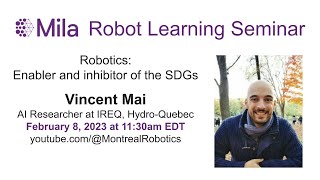
Robotics as an Enabler and Inhibitor of Sustainable Development Goals
Explore robotics' dual role in achieving UN Sustainable Development Goals. Analyze potential to enable 46% of targets while inhibiting 19%, focusing on economic, social, and environmental impacts.
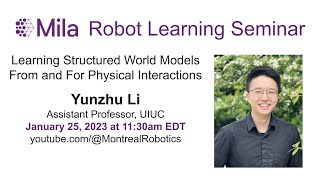
Learning Structured World Models From and For Physical Interactions
Explore structured world models for physical interactions in robotics. Learn novel representations and structural priors for effective model-based planning and complex manipulation tasks.

Sim2Robot - Training Robots for the Real-World with Imperfect Simulators
Explore innovative methods for training robots using imperfect simulators, focusing on navigation and pick-and-place tasks. Learn about leveraging large-scale learning, hierarchical control, and foundation models for real-world deployment.

RoboCat - A Self-Improving Generalist for Robotic Manipulation
Explore RoboCat, a multi-embodiment, multi-task generalist agent for robotic manipulation. Learn about its ability to generalize across tasks and robots, and its potential for autonomous improvement.

Data-Driven Fine Manipulation: Pushing Boundaries in Robotic Precision
Explore data-driven solutions for fine robotic manipulation, enabling low-cost hardware to perform intricate tasks with superhuman precision using imitation and reinforcement learning techniques.
人間と計算機が共存する未来
ロボット開発の最前線から、人間と技術の共生の可能性を探る。未来社会のビジョンと、若き開発者の挑戦を通じて、テクノロジーと人類の調和を考察する。
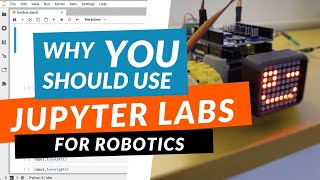
Why You Should Use Jupyter Labs for Robotics
Explore interactive programming for robotics with Jupyter Labs, covering installation, cell types, code execution, and practical applications for SMARS robots.
Sci-fi Destroys the World, Science Builds It - The Influence of Science Fiction on Technology
Explore the interplay between science fiction and real-world technology, examining how they influence each other and shape our future, with insights from roboticist and author Daniel Wilson.

Artificial Intimacy - Solving Loneliness in a Data-Driven World
Explore the impact of AI companions on human connection and loneliness. Interactive discussion on outsourcing emotional needs to technology and its implications for society.

Artificial Intelligence and Machine Learning - Expo Stage Debrief
Explore the latest developments and implications of AI and machine learning in this insightful debrief from the AAAS Annual Meeting.

The Truth About AI: My AI Life - 2023 Christmas Lectures - Lecture 2
Professor Mike Wooldridge explores AI's pervasive role in daily life, revealing its hidden impact and potential. The lecture showcases real-world AI applications, from gaming to healthcare, offering insights into this transformative technology.
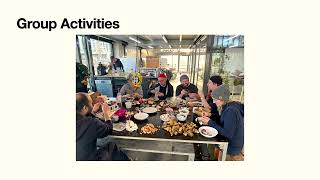
Nerds Touching Grass - Bio-Hackspace Revolution for Environmental Solutions
Explore bio-hackspaces: create sustainable materials, research food production, and develop nature-tech interfaces. Learn how biopunk fosters resilience, creativity, and a deeper connection with nature.

Unlearning and Unleashing - Journey from Self-Doubt to Self-Belief
Inspiring journey from self-doubt to empowerment, encouraging listeners to unlearn limiting beliefs and embrace their true selves for personal growth and freedom.
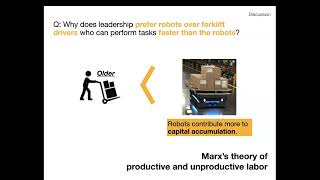
Contrasting Perspectives of Workers: Exploring Labor Relations in Workplace Automation
Explores conflicting worker views on workplace automation, proposing designers as facilitators of inclusive solidarity to shape automation technologies and address power issues.
Zenseact Open Dataset for Advancing Autonomous Driving
Explore the Zenseact Open Dataset's role in advancing autonomous driving technology. Learn about its creation, features, and applications in ongoing research projects.
Everything About the Degrees of Freedom of a Robot - Fundamentals of Robotics
Comprehensive exploration of robot degrees of freedom, covering rigid body motion, joint types, and Grübler's formula for various mechanisms including Stewart platforms and Delta robots.
Topological Complexity of Fibrations and Covering Maps
Explore topological complexity of fibrations and covering maps, examining their homotopy invariance and applications in robotics and mechanical device manipulation.
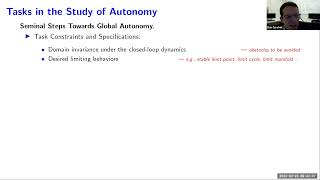
Wanted- Topologists for Autonomous Robots Community
Exploring topological complexity in robotics: from path planning to task spaces. Insights into rigorous formulations for robotic autonomy, emphasizing environment topology and combinatorics in cooperative motion.
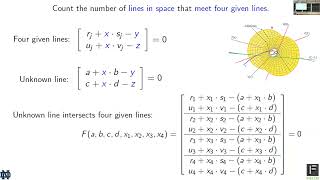
Mechanism Synthesis and Applied Enumerative Geometry
Explore applied enumerative geometry in mechanism synthesis, uncovering innovative approaches to design and optimize mechanical systems for various engineering applications.
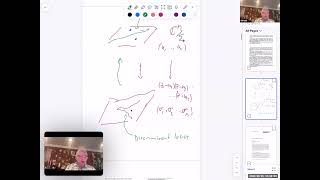
Analog and Universal Complexity in Robotics and Manifolds
Explore analog complexity in robotics, comparing digital and analog approaches. Discover surprising properties of analog category and its implications for finite groups and parametrized complexity.