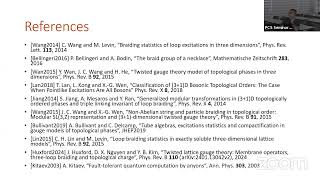
Generalized Loop Braiding Statistics in 3+1D Topological Phases - The Case of Twisted Lattice Gauge
Explore generalized loop braiding statistics in 3+1D topological phases, focusing on twisted lattice gauge theory. Gain insights into advanced concepts in quantum field theory and condensed matter physics.
The Hidden Landscape of Localization - Kirk Lecture
Explore the hidden landscape of localization in complex systems, understanding wave confinement, eigenfunctions, and their implications for various mathematical and physical phenomena.
Mammatus Clouds and Sedimentation Instabilities - Kirk Lecture
Explore the formation of mammatus and asperitas clouds through droplet sedimentation, thermodynamics, and wind shear. Analyze stability and patterns in cloud formations using mathematical models.
The Hawaiian Plume: What Surface Observables Tell Us - Rothschild Lecture
Explore the Hawaiian plume's impact on surface observables through fluid mechanical models, revealing insights into mantle dynamics and intraplate volcanism.
When Data Driven Reduced Order Modeling Meets Full Waveform Inversion - Rothschild Lecture
Explore innovative approaches to velocity estimation in wave equation inverse problems, focusing on data-driven reduced order modeling and its application to full waveform inversion.
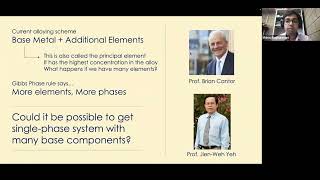
An Introduction to High Entropy Alloys
Explore alloy phases and high entropy alloys in this beginner-friendly introduction, covering fundamental concepts and applications.
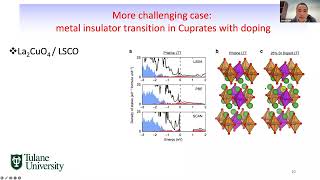
SCAN Functional and DFT Errors for Open-Shell d- and f-Electron Systems
Explore DFT challenges in correlated materials, focusing on SCAN functional's improvements for open-shell d- and f-electron systems. Analyze error sources and symmetry breaking effects.
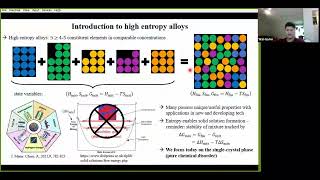
On the Mechanism of Charge Transfer and Electrostatic Field Fluctuations in Disordered Metals
Explore disorder-driven charge distribution fluctuations in metals, examining electrostatic screening, impurity scattering, and linear charge transfer trends in multicomponent alloys.
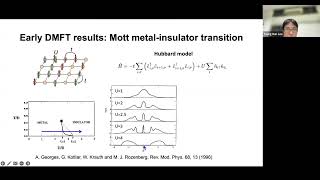
An Efficient and Accurate Approach to Strongly Correlated Materials
Explore an enhanced method for simulating strongly correlated materials using ghost-rotationally-invariant slave-boson (g-RISB) approach, improving accuracy in describing material properties with realistic parameters.
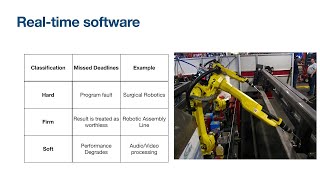
Robotics at Compile Time: Optimizing Robotics Algorithms With C++'s Compile-Time Features - Lecture
Optimize robotics algorithms using C++ compile-time features. Learn to leverage template metaprogramming, constexpr, and concepts for enhanced performance and safety in real-time robotic applications.
Odd Challenges of Using Deep Learning in Designing a Feedback Delay Network Reverb
Explore challenges in optimizing audio effects using deep learning, focusing on Feedback Delay Network reverb design. Gain insights into DSP, machine learning, and innovative approaches to audio processing.

Hardware and its Concurrency Habits - Kernel Recipes 2023
Explore hardware structure, physics limitations, and synchronization mechanisms in modern computer systems for improved concurrent software design.
Probabilistic Inference of the Steady-State Distribution of an Age-Size Structured Population
Explore probabilistic techniques for inferring steady-state distributions of age-size structured populations using single-cell data and stochastic modeling.
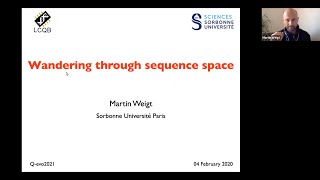
Wandering Through Sequence Space
Explore protein sequence space and its implications for evolution, structure, and function with insights from statistical physics and machine learning.
Thirty-Six Entangled Officers of Euler: Quantum Solution to a Classical Problem
Explore quantum combinatorial designs and their application in solving Euler's 36 officers problem, revealing insights into quantum information processing and error detection.
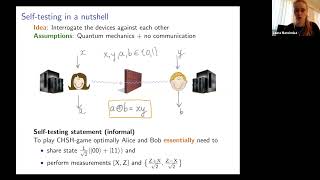
Certification of Quantum Devices via Operator-Algebraic Techniques
Explore quantum device certification through operator-algebraic techniques, focusing on self-testing and its connection to algebraic relation stability.
Quantum Steampunk - Quantum Information Meets Thermodynamics
Explore quantum information's intersection with thermodynamics, blending modern physics with Victorian-era aesthetics in this innovative theoretical framework.
Solving Complex Quantum Chemistry Problems with Amazon Braket
Explore quantum chemistry problem-solving using Amazon Braket with insights from an applied scientist at QHack 2023.

ITensorNetworks.jl - Introduction to Tensor Network Algorithms in Julia
Explore tensor network algorithms and their implementation in Julia using ITensorNetworks.jl for efficient quantum many-body simulations.
Noise Limits in Atomic Qubit Control for Quantum Computing
Explore the impact of laser noise on trapped ion qubit control and learn about new techniques to improve quantum computing performance to fundamental limits.
New Platforms for Two-Dimensional Electron Gases in Quantum Computing - Quantum Today
Explore new platforms for two-dimensional electron gases in quantum computing, focusing on Indium Antimonide's potential for topological quantum computing applications.