Nonequilibrium Physics in Living Systems
Explore the fascinating intersection of physics and biology, uncovering how nonequilibrium principles shape living systems and their complex behaviors.
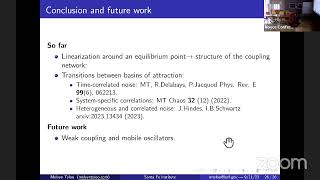
Fluctuations in Complex Network-coupled Oscillators
Explore the dynamics of network-coupled oscillators, examining fluctuations and their impact on complex systems behavior and stability.
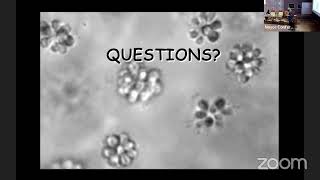
Evolution of Multicellularity in the Ancestors of Animals - Hydrodynamic Performance and Selective Factors
Explore how choanoflagellates provide insights into the evolution of multicellularity in animal ancestors, examining hydrodynamic performance and selective factors affecting colony formation and survival.
Plurality, Governance, and Decentralized Society - EPE 05
Exploring pluralistic approaches to governance and society, discussing links between plurality and quantum mechanics, and examining technological solutions for 21st-century sense-making challenges.
Will Space Limit Human Performance - InterPlanetary 2022 Panel Discussion
Experts discuss human performance limits on Earth to speculate on challenges in space exploration, considering physical, intellectual, and psychological factors for future missions beyond our atmosphere.
Speculative Vision - Exploring Deep Time, Technology, and Representation
Explore unique artistic projects that offer radical perspectives on deep time, technology, and representation, including holographic drawings and unconventional photography techniques.
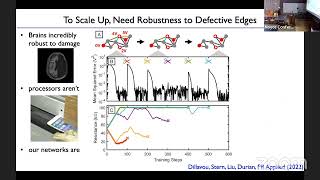
Many More is Different - Scalable Learning in Physical Systems
Exploring how large-scale systems exhibit unique properties, focusing on scalable learning approaches inspired by physics and implemented in energy-efficient physical systems.
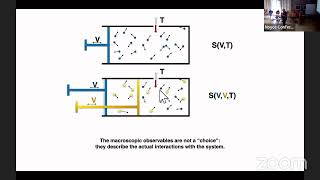
What Makes the Past Different from the Future?
Explore the fundamental differences between past and future, examining scientific concepts and philosophical implications in this thought-provoking lecture on time's arrow.
Balance: Philosophical Implications
Explore the philosophical implications of balance, examining its role in various aspects of life, nature, and society through interdisciplinary perspectives.
What Can Physics Tell Us About Ourselves?
Explore how physics explains human lifespan, brain capacity, and our connection to all life. Discover the physical limits of evolution and why we sleep.
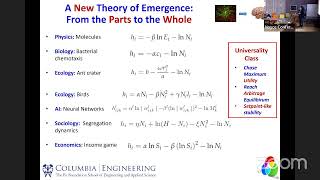
Arbitrage Equilibrium and the Invisible Hand in Self-organizing Dynamics of Biological Systems
Explore how economic concepts like arbitrage apply to biological systems. Learn about a novel game-theoretic framework integrating survival-driven behavior with statistical mechanics in active matter systems.
How Human History Shapes Scientific Inquiry - Episode 5
Exploring how historical context influences scientific priorities, this episode examines the boundaries of academic inquiry and the potential for redefining fundamental concepts to advance complex systems research.
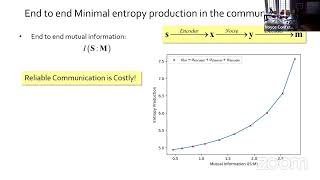
Minimal End-to-end Thermodynamic Costs of Communication Channels
Explore the thermodynamic costs of communication channels, examining minimal end-to-end requirements and their implications for information transfer efficiency.
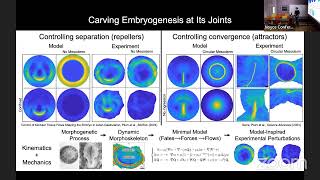
Carving Embryogenesis at Its Joints - Dynamic Morphoskeleton and Modular Development
Explore embryogenesis through quantitative analysis of morphogenetic flows, uncovering fundamental kinematic units and their mechanistic origins in avian gastrulation, with implications for evolution and synthetic morphogenesis.
Death and Resurrection of the Zeroth Principle
Explore the intriguing concept of the Zeroth Principle, its demise, and potential revival in this thought-provoking lecture from the Santa Fe Institute.
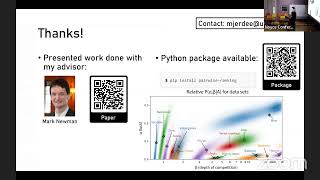
Luck, Skill, and Inequality in Games and Social Hierarchies
Explore the interplay of luck, skill, and inequality in games and societal structures, examining their impact on hierarchies and outcomes.
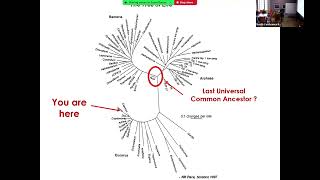
Topological Scaling Laws and the Mathematics of Evolution
Explore topological scaling laws in evolutionary biology, examining phylogenetic tree structures and their implications for understanding large-scale evolutionary patterns and processes.

Quantum Information and Computing
The course is Primarily for Students of Physics and Engineering having exposure to basic quantum mechanics and knowledge of Linear Algebra.
Quantum Information and Computing
The course is Primarily for Students of Physics and Engineering having exposure to basic quantum mechanics and knowledge of Linear Algebra.
Biophysical Chemistry
Explore protein structure, folding mechanisms, and biophysical techniques. Gain insights into forces driving protein stability, denaturation processes, and experimental methods for studying protein dynamics.
Introduction to Robotics
This course is a bridge course for students from various disciplines to get the basic understanding of robotics. The mechanical, electrical, and computer science aspects of robotics is covered in this introductory course.