The Myth of AI Breakthroughs - Cutting Through Hype in Neural Network Research
Explore AI realities, efficient model training, and cutting-edge research with Jonathan Frankle. Gain insights on facial recognition, the lottery ticket hypothesis, and navigating AI hype.
Exascale Computing: From Shared Memory to GPU Architecture
Explore exascale computing, HPC architectures, and GPU programming with Dr. Meifeng Lin from Brookhaven National Laboratory.
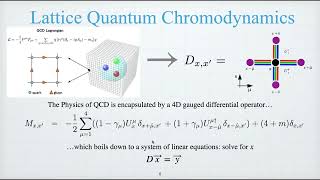
GPU Computing and Krylov Solvers
Explore GPU computing and Krylov solvers for advanced numerical computations, enhancing problem-solving skills in high-performance computing environments.

Our Road to Exascale: Particle Accelerator and Laser-Plasma Modeling
Explore the journey to exascale computing in particle accelerator and laser-plasma modeling, featuring WarpX's development and the 2022 ACM Gordon Bell Prize.
Facilitating Electronic Structure Computations on GPU-based Exascale Platforms
Explore GPU-based electronic structure computations for exascale platforms using PROGRESS and BML libraries. Learn implementation strategies, performance optimization, and scaling techniques.
Modern Fortran - A Contradiction or Future-Proof Language?
Explore modern Fortran's evolution, focusing on program design, parallelism, and interoperability. Discover how this 65-year-old language remains relevant for scientific simulations.
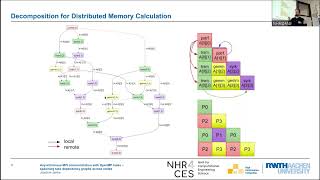
Asynchronous MPI Communication with OpenMP Tasks - Spawning Task Dependency Graphs Across Nodes
Explore asynchronous MPI communication with OpenMP tasks to improve parallel code scalability. Learn to integrate MPI detached communication for real asynchronous execution across processes.
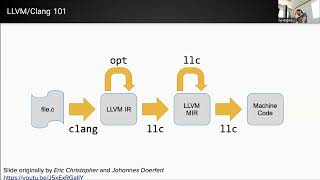
LLVM in HPC - Enabling Performance Portability, Interoperability, and Novel Features - Part 1
Explore LLVM's impact on HPC, covering portable CUDA, debugging at scale, GPU execution of legacy code, and ML in compilers. Learn about efforts to enhance performance, tooling, and development in HPC.
New Algorithms in C++23 - Lecture 1
Explore new C++23 Ranges library algorithms and their types, from C++98 to C++23. Gain insights into advanced programming techniques and language features for efficient coding.
C++ Performance Portability - A Decade of Lessons Learned - Lecture
Explore a decade of C++ performance portability challenges and solutions, focusing on Kokkos ecosystem development for efficient cross-platform scientific computing.
Breaking Enigma With the Power of Modern C++ - CppCon 2022
Explore modern C++ techniques to crack the Enigma code, comparing historical methods with contemporary computing power. Learn cryptography and parallel processing concepts.
GPU Accelerated Computing and Optimizations on Cross-Vendor Graphics Cards with Vulkan and Kompute
Explore GPU acceleration and optimizations for cross-vendor graphics cards using Vulkan & Kompute. Learn to implement GPU-accelerated machine learning algorithms and leverage hardware capabilities for performance improvements.
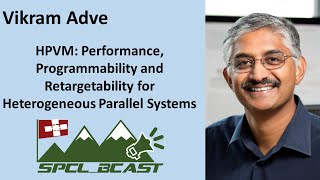
HPVM: Performance, Programmability and Retargetability for Heterogeneous Parallel Systems
Explore HPVM's approach to programming heterogeneous parallel systems, focusing on performance, ease of use, and retargetability across diverse hardware targets.
ML for High-Performance Climate: Data Post Processing, Compression, and Earth Virtualization Engines
Explore advanced ML techniques for climate data processing, compression, and Earth virtualization, enhancing high-performance computing in climate science.
Heterogeneous Multi-Core Systems for Efficient Edge Machine Learning
Explore heterogeneous multi-core systems for efficient embedded ML, addressing challenges in core optimization, workload mapping, and data sharing. Gain insights from KULeuven MICAS research.
Bare Metal Kubernetes with KOps - Gathering Community Wisdom
Explore architectural trade-offs and challenges of deploying Kubernetes on bare metal infrastructure, focusing on node discovery, hardware management, and community-driven solutions using KOps.
Navigating Failures in Pods with Devices: Challenges and Solutions
Explore common challenges and solutions for managing device-enabled pods in Kubernetes, focusing on GPU allocation, network cards, and memory placement for AI/ML workloads.
Solving the Kubernetes Networking API Rubik's Cube - Understanding DRA and KNI
Uncover how AI/ML drives Kubernetes networking evolution, exploring DRA and KNI implementations, hardware allocation for networking, and standardized API developments in this comprehensive technical overview.
All Your GPUs Are Belong to Us: An Inside Look at NVIDIA's Self-Healing GeForce NOW Infrastructure
Discover how NVIDIA manages GeForce NOW's massive GPU infrastructure using Kubernetes, exploring automated maintenance systems and self-healing operators that keep the game streaming platform running for millions of users.
Distributed Cache Empowers AI/ML Workloads on Kubernetes Cluster
Discover how to optimize AI/ML workloads on Kubernetes using distributed cache systems, achieving high-performance data access with 50+ GB/s throughput and sub-2ms latency for large-scale GPU clusters.
Bloomberg's Journey to Manage Multi-Cluster Training Applications with Karmada
Discover how Bloomberg leverages Karmada to manage multi-cluster GPU workloads, optimize resource utilization, and streamline AI model training across data centers with intelligent scheduling and high availability.