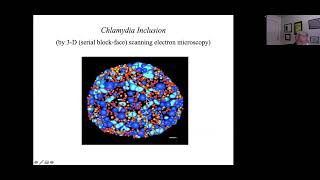
Growth of Reticulate Body (RB) Population in the Conversion Phase of Chlamydia Life Cycle
Explore mathematical modeling of reticulate body population dynamics in Chlamydia's life cycle, focusing on conversion phase analysis and population growth patterns.
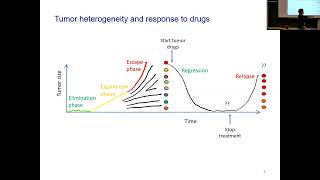
Statistical Dynamics of Tumor Initiation and Progression
Explore the mathematical modeling of tumor development through statistical dynamics, focusing on glioma invasion patterns and microtube-driven cancer progression mechanisms.
Geometry, Arithmetic, and Dynamics of Discrete Groups - Lecture 17
Delve into advanced mathematical concepts exploring discrete groups, focusing on their geometric properties, arithmetic relationships, and dynamic behaviors in mathematical theory.

How to Solve Percent Problems Using the Percent Equation
Master solving percent problems through step-by-step examples covering how to find the whole, part, and percent using clear mathematical equations and practical applications.
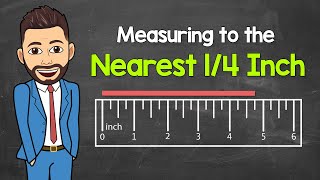
Measuring to the Nearest Quarter Inch Using a Ruler
Master the fundamentals of measuring to the nearest quarter inch with step-by-step guidance through six practical examples using a ruler, perfect for beginners or those needing a quick refresher.

What Do the Folds in Your Brain Say About You? - Understanding Brain Convolutions and Their Development
Explore the fascinating mathematics behind brain folding patterns, their development, and what these intricate structures reveal about brain size, evolution, and potential pathologies.
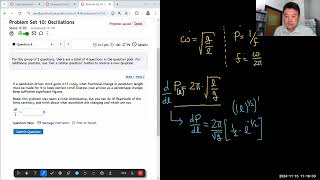
Physics Problem Solving: Calculus-Based University Physics - Chapter 15, Problem 63
Master calculus-based problem-solving techniques for university-level physics through a detailed walkthrough of OpenStax Physics Chapter 15's Problem 63.

Graph Structure of the Nodal Set on Riemannian Manifolds
Explore the geometric analysis of eigenfunction zero sets on Riemannian manifolds, examining connections between graph theory, nodal sets, and critical point estimation in spectral geometry.
Marked Length Spectral Invariants of Birkhoff Billiard Tables and Compactness of Isospectral Sets
Delve into advanced spectral geometry concepts, exploring marked length spectra of planar billiard tables, Mather's beta function, and isospectral compactness in dynamic systems.

Spectral Gap for Random Schottky Surfaces
Delve into advanced mathematical concepts exploring spectral gaps in random Schottky surfaces, examining the behavior of Laplace eigenvalues and their relationship to hyperbolic geometry and probability theory.

Spectral Invariants of Integrable Polygons
Delve into advanced mathematical concepts exploring integrable polygons, their spectral invariants, and connections to plane tessellation and crystallographic Coxeter groups in higher dimensions.
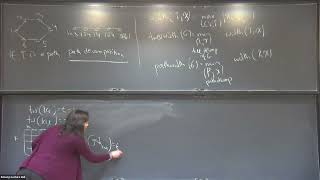
Induced Subgraphs and Pathwidth - Characterizing Bounded Pathwidth Through Graph Theory
Delve into advanced graph theory concepts, focusing on tree decompositions, path decompositions, and induced subgraph obstructions to bounded pathwidth in structural graph analysis.
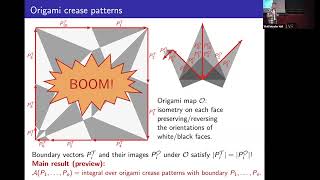
Amplituhedra and Origami
Dive into the fascinating intersection of physics and mathematics, exploring amplituhedra concepts and their connection to origami principles through advanced combinatorial approaches.
Probing Moduli Space Cohomology Using Quantum Field Theory
Delve into advanced quantum field theory applications for analyzing moduli space cohomology, exploring mathematical connections between combinatorics and fundamental physics principles.
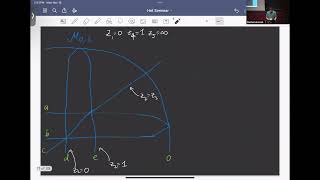
Matroids and Amplitudes: From Linear Independence to Scattering Theory
Delve into the mathematical theory of matroids, exploring their relationship with scattering amplitudes, intersection theory, and positive geometry through advanced theoretical physics concepts.
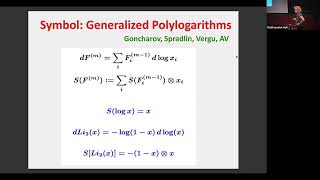
Combinatorics of Symbol Alphabets in N=4 Super Yang-Mills Theory
Delve into advanced combinatorial analysis of symbol alphabets in N=4 Yang-Mills theory, exploring fundamental physics concepts and their mathematical representations in quantum field theory.
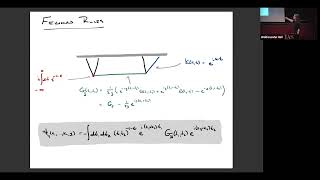
Kinematic Flow and Differential Equations for Cosmological Correlators
Explore advanced mathematical concepts in cosmological correlators, focusing on kinematic flow and differential equations through fundamental physics principles and theoretical frameworks.
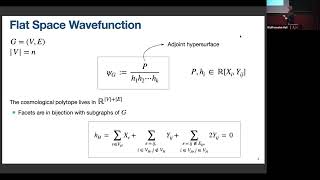
Euler Discriminant of Complements of Hyperplanes
Delve into advanced mathematical concepts exploring the Euler discriminant in hyperplane complements, focusing on combinatorial applications in fundamental physics.
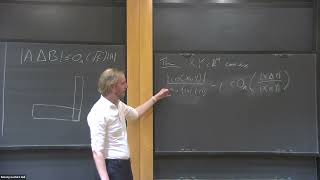
Quadratic Stability of the Brunn-Minkowski Inequality
Delve into advanced mathematical concepts exploring the quadratic stability of Brunn-Minkowski inequality, its geometric implications, and connections to related inequalities in convex geometry.
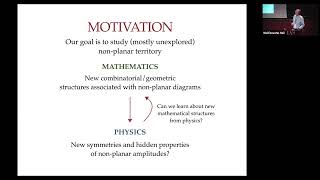
Non-Planar On-Shell Diagrams
Delve into advanced physics concepts exploring non-planar on-shell diagrams and their applications in fundamental physics, presented by UC Davis expert Jaroslav Trnka.
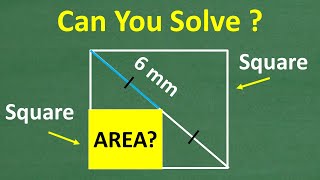
Finding the Area of a Square Inside a Larger Square Using Diagonals
Master geometric problem-solving techniques to calculate the area of an inscribed square formed by the diagonal of a larger square through step-by-step demonstrations and clear explanations.