Experimentation Programs at Scale - Lessons Learned from Top Companies
Discover proven strategies for scaling experimentation programs across organizations, from implementing feature flags to maintaining quality results while increasing experiment frequency and driving data-driven product development.
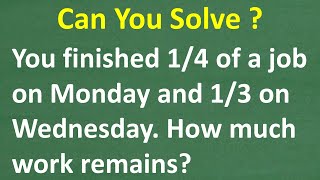
Solving Word Problems with Fractions - Finding Remaining Work
Master solving word problems involving fractions through a practical example of calculating remaining work after completing partial tasks on different days.
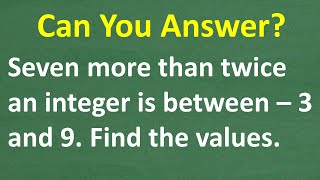
Solving Compound Inequalities with Word Problems
Master solving compound inequalities by working through a practical word problem that teaches how to convert verbal expressions into mathematical solutions.
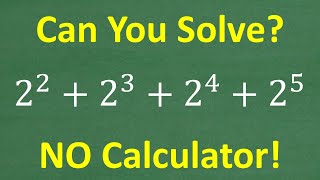
Adding Powers of 2 Without a Calculator - Basic Math and Algebra
Master mental math techniques for adding powers of 2, from squared to fifth power, using basic algebra principles and pattern recognition without relying on calculators.
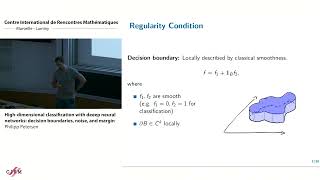
High-Dimensional Classification with Deep Neural Networks: Decision Boundaries
Explore high-dimensional classification theory, focusing on decision boundaries, noise, and margin conditions in neural networks, with applications to efficient approximation and learning rates.
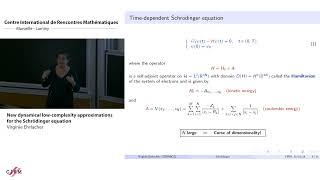
New Dynamical Low-Complexity Approximations for the Schrödinger Equation
Delve into advanced mathematical analysis of time-dependent Schrödinger equations, exploring new variational formulations and low-rank approximations for many-body electronic systems.
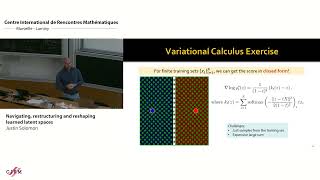
Navigating, Restructuring and Reshaping Learned Latent Spaces
Explore advanced techniques for manipulating learned latent spaces in machine learning, focusing on navigation, restructuring, and reshaping methods for improved model performance and efficiency.
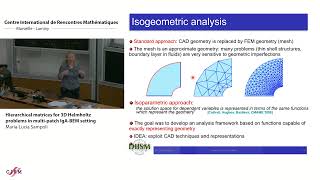
Hierarchical Matrices for 3D Helmholtz Problems in Multi-patch IgA-BEM Setting
Delve into advanced mathematical concepts of hierarchical matrices for 3D Helmholtz problems, exploring their application in multi-patch IgA-BEM frameworks through expert analysis and demonstrations.
Fourier Multipliers for Functions on the Discrete n-Torus
Explore advanced Fourier multiplier theory and its applications in discrete n-torus, connecting transcendental number theory with dimension-free inequalities and Rademacher projections.
Combinatorial Applications of the Shearer and Han Inequalities in Graph Theory and Boolean Functions
Explore the powerful applications of Shearer's and Han's inequalities in information theory, focusing on their role in solving complex problems in graph theory and Boolean functions.
A Rényi Entropy Interpretation of Anti-Concentration
Explore advanced mathematical concepts in concentration functions, examining multivariate entropic settings and volume bounds in isotropic convex bodies through Rényi entropy interpretation.

Vertex, Edge, Clique - Understanding Graph Theory Fundamentals
Explore fundamental concepts of graph theory, from basic elements like vertices and edges to complex structures like cliques, enhancing your understanding of network analysis and data relationships.
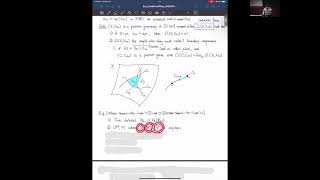
Canonical Forms of Oriented Matroids
Delve into advanced mathematical concepts exploring oriented matroids, their canonical forms, and applications in combinatorial physics through expert analysis and theoretical frameworks.
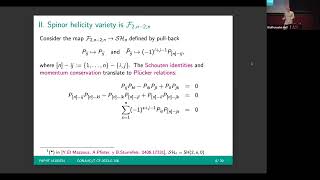
Cluster Structures on Kinematic Spaces
Delve into advanced mathematical concepts exploring cluster structures and their applications in kinematic spaces, focusing on combinatorial approaches in fundamental physics.
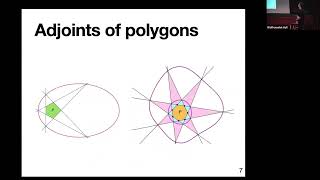
Adjoints and Canonical Differential Forms
Explore the mathematical foundations of adjoints and canonical differential forms through advanced combinatorial physics concepts and their applications in fundamental theory.
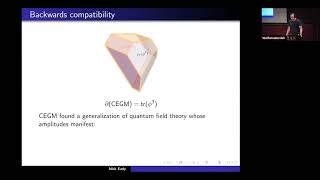
Adventures in Configuration Space
Explore advanced mathematical concepts in configuration space, focusing on combinatorial approaches to fundamental physics problems and their theoretical applications.
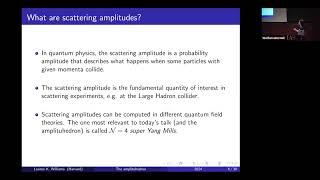
Combinatorics and Geometry of the Amplituhedron
Delve into the mathematical foundations of the amplituhedron, exploring its combinatorial structures and geometric properties through advanced theoretical physics concepts and applications.
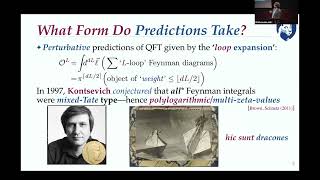
Loop Integration: Phenomenology, Polemics, and Prospects for Improvement
Delve into advanced loop integration concepts in fundamental physics, exploring phenomenology and future prospects with expert insights from theoretical physics research.
Combinatorics on Words in String Amplitudes
Delve into advanced string theory concepts and word combinatorics, exploring their applications in fundamental physics and string amplitude calculations through expert mathematical analysis.
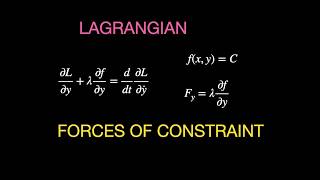
Lagrangian Mechanics - Using Lagrange Multipliers to Find Forces of Constraint
Explore how Lagrange multipliers determine constraint forces in mechanical systems, focusing on the Half Atwood Machine example and tension calculation methods.
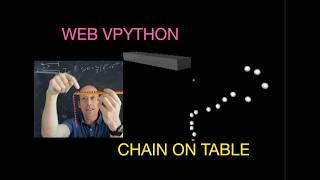
Python Physics: Numerical Modeling of a Chain Sliding Off a Table
Explore the physics of a sliding chain through numerical modeling in Python, demonstrating classical mechanics principles with practical code implementation and visualization.