
All Pairs Shortest Path Using Dynamic Programming: Floyd-Warshall Algorithm
Master the Floyd-Warshall algorithm for finding shortest paths between all vertex pairs in weighted graphs using dynamic programming techniques and systematic path optimization methods.
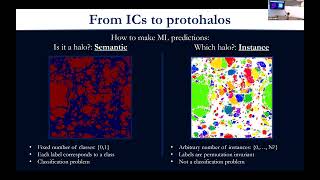
Machine Learning Applications in Cosmology - Past, Present, and Future
Explore the evolution and impact of machine learning in cosmological research, from historical applications to cutting-edge developments and future possibilities in astronomical studies.
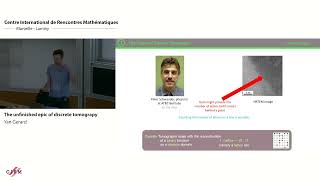
The Unfinished Epic of Discrete Tomography
Delve into the mathematical foundations of discrete tomography through an engaging exploration of its ongoing challenges and theoretical developments in modern computational geometry.

Constant-Cost Communication in Randomized Computing
Explore the fascinating role of randomness in communication complexity, focusing on efficient protocols for solving equality problems and their broader implications in computing theory.
AI Consciousness - Notes from a Logician's Perspective
Explore logical self-reflection in AI systems through the LogiKEy framework, examining how logical formalisms can analyze their own consistency using nested embeddings in higher-order logic.

Diffusion Models - Lecture 18
Dive into the fundamentals of diffusion models with MIT Prof. Song Han, exploring their architecture, principles, and applications in machine learning and AI generation.
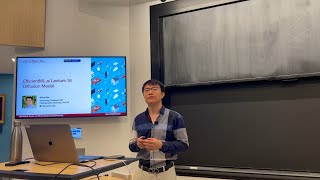
Diffusion Models - Lecture 18
Dive into the fundamentals of diffusion models, exploring their architecture, principles, and applications in machine learning through expert guidance from MIT's Professor Song Han.
Towards Compositional Interpretability for XAI
Explore a mathematical framework using category theory and string diagrams to understand AI model interpretability, focusing on compositional structures and their explainability benefits in neural networks and transformers.

Equilibrium is Inference - Lessons from Liquid-Liquid Phase Separation Models
Delve into the relationship between equilibrium systems and information processing, exploring neural computation models and their applications in molecular systems and phase separation dynamics.

Abstraction and Evolution with Large Language Models
Explore how large language models enhance genetic programming through concept-guided evolution, with applications in symbolic regression and image classification demonstrated through practical examples.

Mastering Confusion Matrix in Machine Learning - From Confusion to Clarity
Master the confusion matrix to evaluate and enhance machine learning model performance through accuracy, precision, and recall metrics for better classification results.
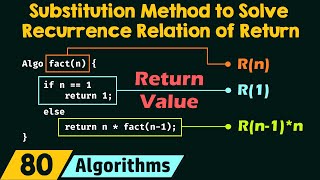
Substitution Method for Solving Recurrence Relations in Algorithms
Master the substitution method for solving recurrence relations, focusing on return value analysis and practical problem-solving techniques in algorithmic complexity.

High-Dimensional Convexity: Testing, Learning, and Complexity
Explore the fascinating parallels between high-dimensional convex sets and monotone Boolean functions, examining algorithmic structures and mathematical complexities in Gaussian space.

An Approach Towards the Aaronson-Ambainis Conjecture via Fourier Completely Bounded Polynomials - Part 1
Delve into quantum computing theory through an analysis of the Aaronson-Ambainis conjecture, exploring its relationship with Fourier completely bounded polynomials and implications for quantum algorithm simulation.

Testing and Learning Phase States and Their Variants - Part 2
Delve into quantum computing concepts focusing on tolerant testing, learning stabilizer states, and understanding degree-based phase states in quantum mechanics.

How Can Large Language Models Learn From Humans? - Understanding Psycholinguistic Predictions and Sheaf Theory
Explore how combining lexical predictions from LLMs with syntactic structures can improve language understanding, using sheaf theory to better match human reading patterns and comprehension.

Checking the Fraction of Satisfying Assignments for 3CNF
Explore computational complexity theory through an analysis of satisfying assignments in 3CNF formulas, based on recent research developments and mathematical proofs.
A Markov Chain Theory of Self-Organization in Nonequilibrium Systems
Explore the groundbreaking theory of 'rattling' in nonequilibrium systems and its role in predicting ordered states across scientific domains, from living systems to statistical mechanics.
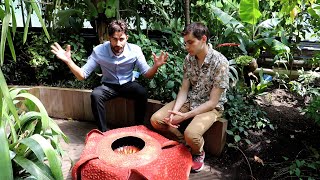
Plants and Mathematics - How Science Collaborates Through Botanical Research
Discover how mathematics and botany intersect in understanding the world's largest, smelliest flower through groundbreaking scientific collaboration and research methods.

Existence of Graphs with High Girth and High Chromatic Number
Delve into probabilistic methods in combinatorics, exploring Erdős's groundbreaking proof of graphs with high girth and chromatic number through elegant mathematical reasoning.

Lower Bounds to Ramsey Numbers - MIT 18.226 Probabilistic Methods in Combinatorics
Delve into probabilistic methods in combinatorics, exploring Ramsey numbers through alteration techniques and the Lovász Local Lemma for advanced mathematical problem-solving.