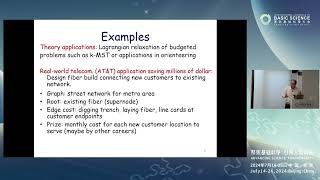
Classic Problems with Modern Techniques - Prize-collecting Framework
Explore state-of-the-art approximation algorithms for classic network design problems using modern techniques, from clustering to recursive methodologies.
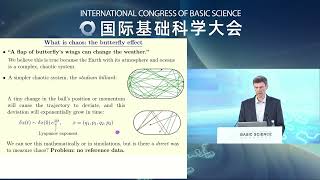
Chaos and Black Holes: From Butterfly Effect to Event Horizons - ICBS 2024
Explore chaos theory, quantum systems, and black holes, examining their interconnections and the fascinating implications for understanding event horizons.
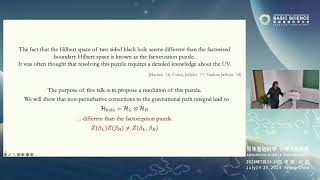
How the Hilbert Space of Two-Sided Black Holes Factorizes - ICBS 2024
Explore the factorisation puzzle in AdS/CFT, examining how spacetime wormholes contribute to Hilbert space factorisation in two-sided black holes and its implications for holography.
Top Down Approach to Generalized Symmetries in Quantum Field Theory and Quantum Gravity
Explore generalized symmetries in quantum field theory and quantum gravity using string theory's extra dimensions, uncovering new physical objects and tracking symmetry fates.
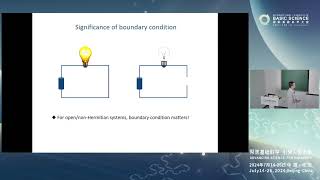
Non-Bloch Band Theory and Amoeba
Explore non-Bloch band theory and amoeba concepts in condensed matter physics with expert Zhong Wang. Gain insights into cutting-edge research in this specialized field.
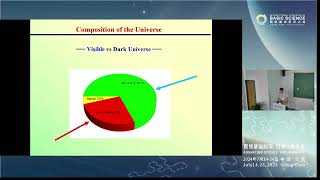
Massive Gauge/Gravity Scattering Amplitudes, Geometric and Topological Mass Generations and Double Copy
Explore massive gauge/gravity scattering amplitudes, geometric and topological mass generations, and double copy constructions in Kaluza-Klein and Chern-Simons theories.
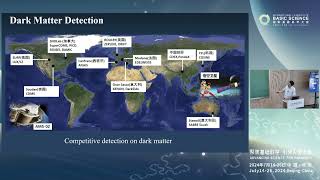
Comparative Lattice Analysis of SU(2) Dark Glueball
Explore SU(2) glueballs as dark matter using lattice simulations. Compare traditional and machine learning methods for mass calculation and scattering cross-section analysis.
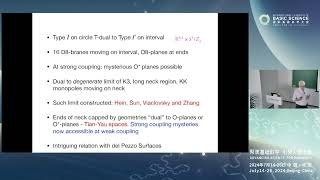
Degeneration, Geometry and Duality in String Theory
Explore generalised T-dualities in string theory, focusing on type I' and IIA duality, SYZ interpretation of mirror symmetry, and geometric duals of strong-coupling phenomena.
Computational Quantum Mechanics in Phase Space - An Attempt to Break the Curse of Dimensionality
Explore computational quantum mechanics in phase space, focusing on breaking the curse of dimensionality through grid-based and particle-based methods for high-dimensional Wigner quantum dynamics simulations.
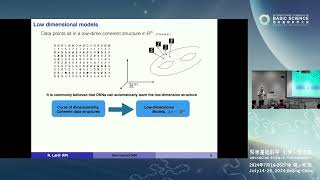
Learning Manifold-Structured Data Using Deep Neural Networks - Theory and Applications
Explore deep neural networks' ability to learn geometric data structures using multi-chart latent spaces and Chart Auto-Encoders, with theoretical foundations and practical applications.
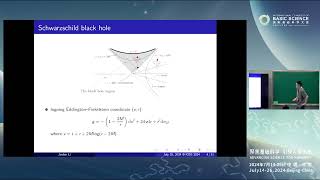
Construction of Collapsing Spacetimes in Vacuum - ICBS 2024
Explore the construction of collapsing spacetimes in vacuum, featuring black hole regions and Cauchy hypersurfaces, without symmetries.
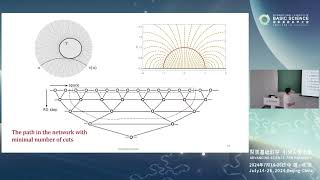
Partial Entanglement Network and Geometry Reconstruction in AdS/CFT
Explore partial entanglement entropy geometrization in AdS/CFT, examining PEE threads, network formation, and bulk geometry reconstruction using novel approaches.
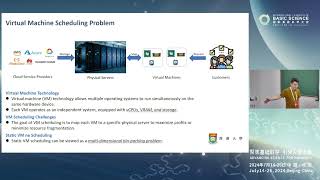
How Optimization Helps Industry: Real Applications in the Era of AI and Cloud Computing
Explore real-world optimization challenges in AI and cloud computing industries, from live streaming to AI-chip design. Gain insights into mathematical representations and recent advancements.
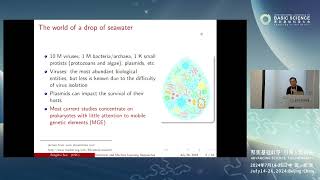
Statistical and Machine Learning Approaches for Investigating Viruses and Virus-Host Interactions
Explore statistical and machine learning methods for identifying novel viruses and virus-host interactions in metagenomic studies, enhancing understanding of microbial communities.
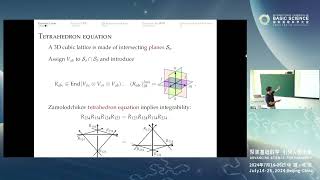
Tetrahedron Duality - ICBS 2024
Explore the Zamolodchikov tetrahedron equation, its role in 3D field theories, and its connection to supersymmetric gauge theory and quantum field theory duality.
Equivariant K-theory Realization of the Affine i-Quantum Group
Explore equivariant K-theory's role in realizing affine i-quantum groups, focusing on type C generalizations and constructing simple/standard modules.
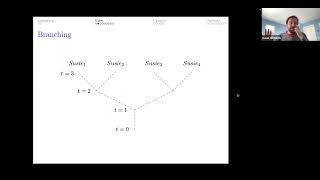
Centering the Everett Interpretation - Probability in Quantum Mechanics
Explore the Everett interpretation of quantum mechanics, focusing on probability as objective chances of centered propositions. Gain insights into fundamental physical theories.
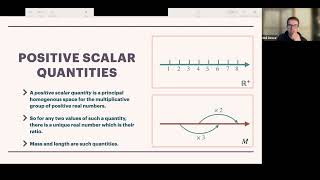
Intrinsic Quantum Mechanics - Extending Classical Physics to Quantum Structures
Explore intrinsic quantum mechanics, focusing on characterizing physical quantities' intrinsic structure and extending classical physics concepts to quantum realm. Gain insights into complex scalar quantities and intrinsic product spaces.
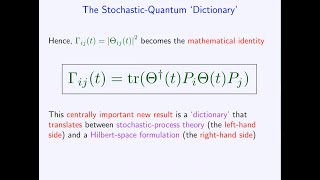
A New Formulation of Quantum Theory
Explore a novel correspondence between stochastic processes and quantum theory, offering new insights into quantum mechanics and potential applications for quantum computing.
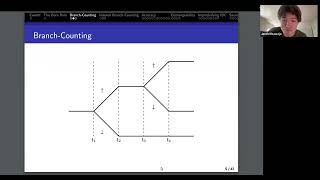
Conquering Mount Everett: Branch-Counting Versus the Born Rule
Explore quantum branching scenarios and self-locating credences through Indexed Branch-Counting, challenging Everettian approaches and the Born Rule in quantum mechanics.
Modeling, Querying and Seeing Time Series Data within a Self-Organizing Mesh Network
Explore graph database modeling for dynamic power grid networks. Learn to query and analyze sensor data, triage at-risk components, and understand network healing processes.