Geometry, Arithmetic, and Dynamics of Discrete Groups - Lecture 14
Delve into advanced mathematical concepts exploring discrete groups, focusing on their geometric properties, arithmetic relationships, and dynamic behaviors in mathematical theory.
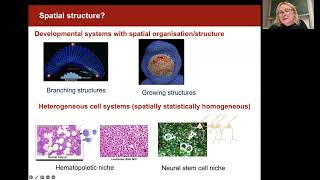
Introduction to Mathematical Modeling of Leukemia - Part 1
Explore the mathematical foundations of leukemia research through expert analysis of oncological models and their applications in understanding disease progression and treatment strategies.
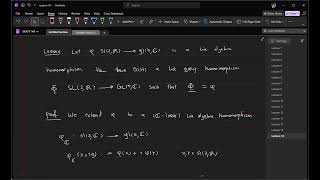
Lie Groups and Quantization - Lecture 16
Delve into advanced mathematical concepts exploring Lie groups and quantization theory, focusing on their interconnections and applications in theoretical physics and geometry.
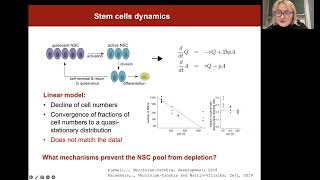
Mathematical Models of Leukemia - Part 2
Delve into advanced mathematical modeling of leukemia dynamics, exploring theoretical frameworks and analytical approaches for understanding cancer progression and treatment strategies.
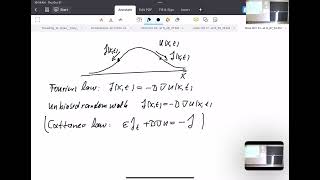
Stochastic Processes and Tumor Control Probability
Explore mathematical modeling of cancer treatment through stochastic processes and probability theory, focusing on tumor control analysis and therapeutic outcomes.
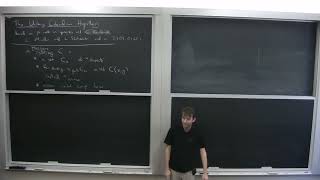
The Unitary Cobordism Hypothesis
Dive into advanced mathematical concepts exploring the unitary cobordism hypothesis, its geometric implications, and connections to physics in this theoretical seminar presentation.
Quantum State Preparation with Optimal T-Count
Explore quantum state preparation techniques and T-gate optimization in multi-qubit systems, focusing on asymptotic scaling and efficient implementation of diagonal unitaries.
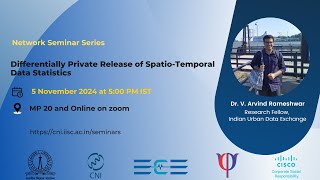
Differentially Private Release of Spatio-Temporal Data Statistics
Explore strategies for releasing spatio-temporal data statistics with differential privacy, focusing on sample mean and variance calculations while minimizing reconstruction errors in urban data management.
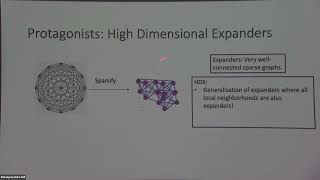
Quasi-Linear Size PCPs with Small Soundness from High-Dimensional Expanders
Delve into probabilistically checkable proofs (PCPs), exploring their encoding, verification, and applications in computer science, with focus on achieving small soundness using high-dimensional expanders.
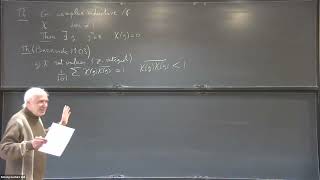
Zeroes of Characters
Delve into advanced mathematical concepts exploring character theory and their zeroes, featuring insights from Serre's paper and Deligne's related mathematical discoveries.
Fault Tolerant Routing Protocols on High-Dimensional Expanders
Delve into fault-tolerant routing protocols on high-dimensional expanders, exploring efficient message transmission systems that maintain reliability even with corrupted network edges and enable advanced distributed computing applications.
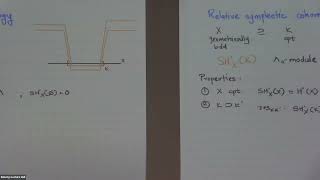
Plumber's Algebra Structure on Symplectic Cohomology
Delve into advanced symplectic geometry concepts, exploring Plumber's PROP structures, nodal Riemann surfaces, and their applications to cohomological field theories and curve counting methods.

Designing a Slimmer Vector of C++ Variants
Dive into advanced C++ optimization techniques for memory-efficient heterogeneous containers, focusing on bit-packed data structures as alternatives to standard vector-variant implementations.
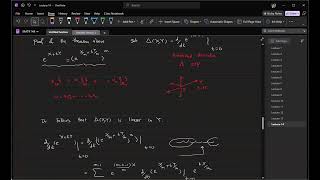
Lie Groups and Quantization - Lecture 15
Delve into advanced mathematical concepts of Lie groups and their applications in quantization theory through rigorous theoretical exploration and practical examples.
Teoria Ergódica Diferenciável - Aula 22
Explore advanced concepts in Differentiable Ergodic Theory, including invariant measures, Poincaré and Birkhoff recurrence theorems, ergodic decomposition, and topological entropy in mathematical dynamics.
L-functions of Elliptic Curves Over Real Quadratic Fields as Special Values of Automorphic Green's Functions
Delve into advanced number theory concepts exploring L-functions of elliptic curves over real quadratic fields and their relationship to automorphic Green's functions through expert mathematical analysis.
Fractal Geometry of the Markov and Lagrange Spectra and Their Set Difference
Delve into the fractal geometry of Markov and Lagrange spectra, exploring their set differences and mathematical properties through advanced number theory and geometric analysis.
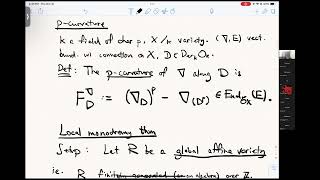
The Exponential Type Conjecture for Quantum Connections
Delve into quantum connections and formal singularity types, exploring the exponential type conjecture proof for closed monotone symplectic manifolds through mod p arguments and Katz's theorem.
Bayesian Tools for the Information Frontier at the LHC
Explore Bayesian machine learning tools and their applications in LHC particle physics research, focusing on information frontier analysis and scientific discovery methods.
Compact Holonomy G2 Manifolds Need Not Be Formal
Delve into advanced mathematical concepts exploring why compact holonomy G_2 manifolds may not exhibit formality, challenging previous conjectures about special and exceptional holonomy manifolds.
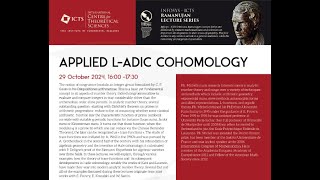
Applied l-adic Cohomology I - Lecture 3
Delve into advanced number theory concepts, exploring l-adic cohomology and trace functions through examples from modern analytic theory, with insights from Gauss, Weil, and Grothendieck's foundational work.