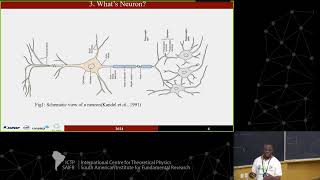
Collective Behaviors in Neuronal Networks Under the Actions of Electric and Magnetic Fields
Explore collective behaviors in neuronal networks influenced by electric and magnetic fields, examining dynamics and implications for complex network processes.
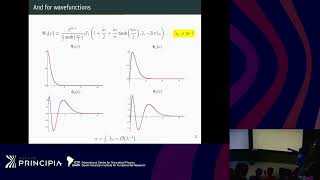
Exploring 2D QCD with Integrability
Explore 2D QCD through integrability techniques, uncovering insights into gauge theory dynamics and string theory connections in this advanced physics lecture.
Causality Detection and Multi-Scale Decomposition of the Climate System Using Machine Learning
Explore machine learning approaches for detecting causal relationships and meaningful patterns in climate systems, focusing on Reservoir Computing and Multi-Resolution Dynamic Mode Decomposition techniques.
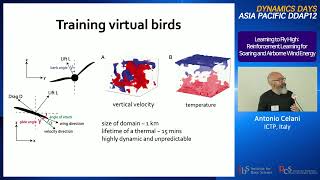
Learning to Fly High: Reinforcement Learning for Soaring and Airborne Wind Energy
Explore reinforcement learning for soaring and airborne wind energy, focusing on optimal control strategies in turbulent atmospheric conditions.
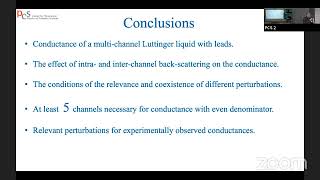
Fractional Conductances in Strongly Interacting 1D Systems
Explore fractional conductances in strongly interacting 1D systems with N channels. Analyze conditions for perturbation coexistence, gap opening, and conductance calculations in complex quantum systems.
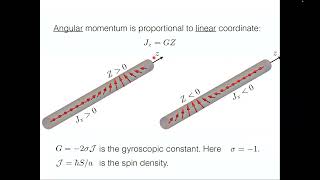
Mechanics of Ferromagnetic Solitons
Explore the fascinating world of ferromagnetic solitons, their mechanics, and potential applications in information storage and processing. Discover surprising behaviors and connections to other areas of mechanics.

Kirk Lecture: A Recent Technology for Scientific Computing - The Virtual Element Method
Explore the Virtual Element Method, a generalization of FEM for solving PDEs using polygonal/polyhedral meshes, offering improved accuracy, efficiency, and flexibility in scientific computing.

When Data Driven Reduced Order Modeling Meets Full Waveform Inversion - Rothschild Lecture
Explore innovative approaches to velocity estimation in wave equation inverse problems, focusing on data-driven reduced order modeling and its application to full waveform inversion.
Introduction to Artificial Intelligence: Monte Carlo Reinforcement Learning Methods - Lecture 16
Explore Monte Carlo reinforcement learning methods, including prediction and policy iteration, with applications to Blackjack and matchbox machine learning.
Grid Algorithms in Video Game AI - Lecture 7
Explore grid algorithms for game AI, including connectivity, BFS, vector fields, and distance maps. Learn techniques for efficient pathfinding and spatial analysis in video games.
Intro to Artificial Intelligence - RL Monte Carlo Methods - Lecture 17
Explore Monte Carlo methods in reinforcement learning, applying algorithmic techniques to solve AI problems in gaming environments.
Introduction to Artificial Intelligence - Bandit Algorithms - Lecture 16
Explore bandit algorithms in AI, learning key techniques for optimizing decision-making in uncertain environments through practical applications and examples.
Intro to Artificial Intelligence - Markov Decision Process (MDP) - Lecture 17
Explore Markov Decision Processes (MDPs) in AI, learning algorithmic techniques for modern problem-solving in uncertain environments.
Is C++23 std::mdspan a Zero-overhead Abstraction? - Lecture
Explore C++23 std::mdspan's efficiency as a zero-overhead abstraction for multi-dimensional arrays through matrix and image operations, comparing assembly output to low-level implementations.

Rust's Trait System as a Proof Engine for ABI Generation
Explore advanced Rust trait system techniques to create stable ABIs, perform type-level computations, and influence type layouts using GATs and const generics.
Very Few Parameter Fine-Tuning with ReFT and LoRA
Explore advanced fine-tuning techniques ReFT and LoRA for efficient parameter optimization in transformer models. Learn implementation, comparison, and practical tips for improved model performance.
New Directions in Correlation Clustering and Biclustering
Explore advanced techniques in correlation clustering and biclustering, focusing on novel approaches and applications in data analysis and machine learning.
Geometry, Topology and Discrete Symmetries Revealed by Deep Neural Networks
Explore deep neural networks' ability to reveal geometry, topology, and discrete symmetries in manifolds. Learn about universal approximators and their applications in inverse problems and group actions.
Sketching Semidefinite Programs for Super-Resolution Problems
Explore super-resolution problems, focusing on measure recovery from Fourier coefficients. Learn about sketching approaches to reduce semidefinite program size and algorithmic developments for integral bounds.
From Thom's Gradient Cell Decomposition to the Curvature of Milnor Fibers
Explore Thom's gradient cell decomposition and its impact on understanding complex hypersurface singularities, polar curves, and Milnor fibers through algebraic, topological, and Lipschitz-geometric perspectives.
Perception of Visual Art and Topological Data Analysis
Explore topological data analysis applications in visual art perception, comparing eye movements for abstract paintings vs. AI-generated images using algebraic topology methods.