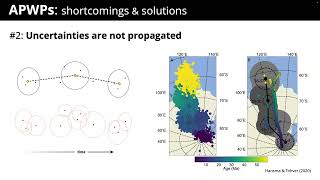
Constructing APWPs from VGPs - Going Virtual
Explore innovative methods for constructing Apparent Polar Wander Paths (APWPs) using Virtual Geomagnetic Poles (VGPs) to enhance understanding of Earth's paleogeography and polar wandering.

Exploring the Creative Union of Artificial Intelligence and Pure Mathematics
Explore the fusion of AI and pure mathematics, uncovering how machine learning can predict complex mathematical structures and potentially revolutionize theorem proving and scientific discovery.
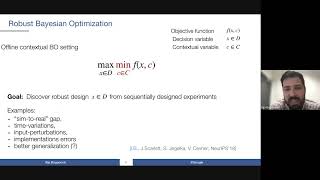
Robust Design Discovery and Exploration in Bayesian Optimization
Explore data-driven methods for robust design discovery and optimization, focusing on Bayesian techniques that efficiently handle uncertainties and adversarial scenarios in various scientific domains.
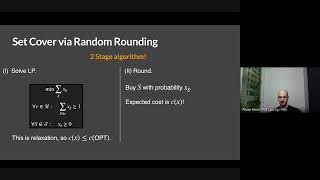
Online Covering: Secretaries, Prophets and Universal Maps
Explore polynomial-time algorithms for online covering IPs, including random-order constraints and prophet versions, with applications to universal maps and competitive ratios.
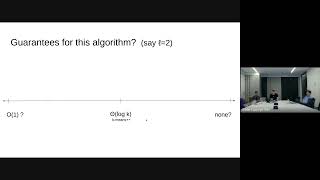
A Nearly Tight Analysis of Greedy k-means++
Explore the greedy k-means++ algorithm's performance, analyzing its approximation guarantees and comparing it to the original k-means++ method for solving the k-means problem.
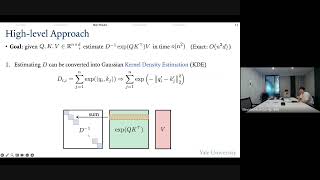
Accelerating Transformers via Kernel Density Estimation - Google TechTalk
Explore efficient Transformer acceleration using kernel density estimation. Learn innovative techniques for handling long sequences and improving performance in deep learning models.
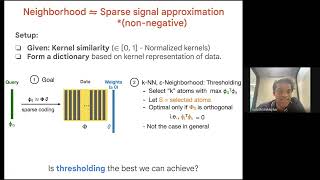
Revisiting Nearest Neighbors from a Sparse Signal Approximation View
Explore nearest neighbor methods from a sparse signal approximation perspective, uncovering improved neighborhood definitions and their applications in graph-based signal processing and machine learning.
High-Dimensional Prediction for Sequential Decision Making
Explore efficient algorithms for online high-dimensional predictions, enabling no-regret guarantees, fairness, and uncertainty quantification in multiclass settings for improved decision-making.
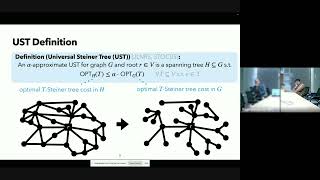
One Tree to Rule Them All: Polylogarithmic Universal Steiner Trees and Strong Sparse Partition Hierarchies
Explore polylogarithmic universal Steiner trees and strong sparse partition hierarchies. Learn about new constructions improving approximation guarantees and matching logarithmic lower bounds.
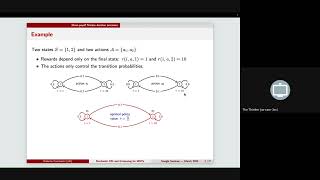
Fixed-point Error Bounds for Mean-payoff Markov Decision Processes
Explore optimal transport techniques for deriving finite-time error bounds in reinforcement learning, focusing on mean-payoff Markov decision processes and stochastic fixed point iterations.
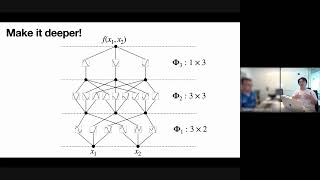
Kolmogorov-Arnold Networks - Alternatives to Multi-Layer Perceptrons
Explore Kolmogorov-Arnold Networks as alternatives to MLPs, offering improved accuracy and interpretability in data fitting and PDE solving. Discover their potential for scientific collaboration and law discovery.
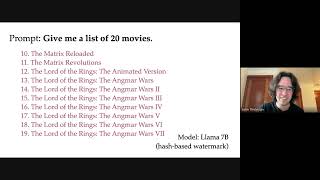
Robust Distortion-free Watermarks for Language Models
Explore robust watermarking techniques for language models, focusing on edit-resistant methods that preserve text distribution. Learn about key-based protocols and their applications.
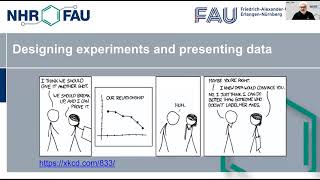
Experiments and Data Presentation in High Performance Computing
Learn effective techniques for conducting experiments and presenting data in high performance computing. Master key aspects of scientific benchmarking, statistical analysis, and data visualization for HPC research.

DGEMM on Integer Tensor Cores - NHR Perflab Seminar
Explore double-precision matrix multiplication using Int8 Tensor Cores and the Ozaki scheme, focusing on high-precision computation with lower-precision hardware for machine learning applications.
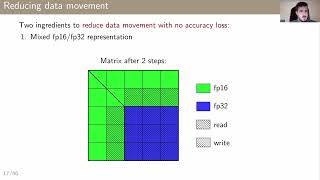
Mixed-Precision Computing: An Overview
Explore mixed-precision computing techniques for high performance and accuracy. Learn about refinement, modularity, and adaptivity in algorithms combining multiple precisions.
Mixing Precisions in Numerical Algorithms - HPC Perspective with Modern Hardware Context
Explore mixed precision algorithms in HPC, focusing on convergence properties and performance considerations for modern hardware implementations of floating-point arithmetic.
A Statistical Journey through Trustworthy AI
Explore statistical perspectives on privacy, robustness, and fairness in AI, focusing on machine un-learning, adversarial robustness, and fair Bayes-optimal classifiers.
Set Valued Hamilton-Jacobi-Bellman Equations - Applications and Theory
Explore set valued PDEs and their applications in stochastic optimization, risk measures, and game theory. Learn about dynamic programming principles and set valued HJB equations.
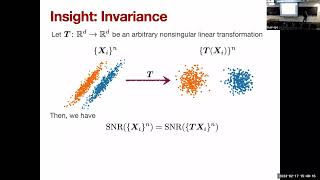
Clustering a Mixture of Gaussians with Unknown Covariance - Lecture
Explore clustering with Gaussian mixtures, focusing on maximum likelihood estimation, Max-Cut solutions, and efficient algorithms. Investigate statistical-computational gaps and challenges in high-dimensional settings.
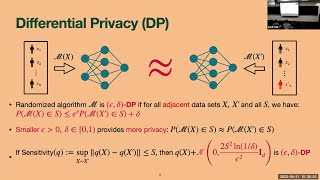
Private Stochastic Optimization with Large Worst-Case Lipschitz Parameter
Explore differentially private stochastic optimization techniques for loss functions with large worst-case Lipschitz parameters, addressing outliers and heavy-tailed data for improved excess risk bounds.

Continuous-in-time Limit for Bandits
Explore the connection between Hamilton-Jacobi-Bellman equations and multi-armed bandit problems, and discover an efficient algorithm for solving MAB challenges.