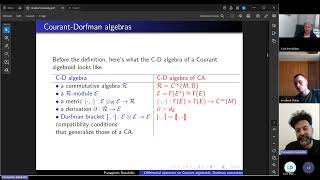
Differential Operators on Courant Algebroids, Dorfman Connections and the Atiyah Class
Explore differential operators on Courant algebroids, Dorfman connections, and the Atiyah class in this advanced mathematical physics seminar.
The Anomalous Transport of Tracers in Active Baths
Explore anomalous transport of tracers in active baths, focusing on long-time dynamics, ratchet effects, and unique friction properties in low-dimensional systems.
Geometry of Nonequilibrium Reaction Networks
Explore geometric interpretations of nonequilibrium reaction networks, extending Hill-Schnakenberg theory to hypergraphs and analyzing cycles, cocycles, and stochastic models.
Packets of Diffusing Particles Exhibit Universal Exponential Tails
Explore universal exponential tails in diffusing particle packets, extending large deviation theory for continuous time random walks and uncovering general behaviors in transport phenomena.
Engineered Swift Equilibration: Applications and Optimization - Lecture
Explore Engineered Swift Equilibration (ESE) applications in physics, including particle compression, first passage time optimization, and atomic force microscopy enhancements.
Stochastic Resetting: Overview and Recent Developments
Explore stochastic resetting in dynamical processes, its impact on system behavior, and applications in chemical reactions and search processes.
Entropy Growth During Free Expansion of an Ideal Gas
Explore entropy growth in free expansion of ideal gas, examining macrostates, irreversibility, and factors influencing entropy increase in non-equilibrium systems.
Quantum Bounds and Fluctuation-Dissipation Relation
Explore quantum bounds for transport coefficients and their connection to the Fluctuation-Dissipation relation, with insights from high-energy physics and String Theory.
The Casimir Energy as a Trace
Explore the Casimir effect's connection to spectral geometry and microlocal analysis. Learn to define Casimir energy as an operator trace and compute it using boundary layer operator determinants.
Injectivity in Second-Gradient Nonlinear Elasticity
Explore injectivity in second-gradient nonlinear elasticity, delving into advanced mathematical concepts and their applications in materials science.
A Nonsmooth Approach to Einstein's Theory of Gravity
Explore a nonsmooth approach to Einstein's gravity theory, focusing on reformulating curvature concepts and developing a synthetic null energy condition for Lorentzian spaces.
Timelike Ricci Bounds and Einstein's Theory of Gravity in Non-Smooth Settings
Explore Lorentzian synthetic spaces, optimal transport theory, and timelike Ricci curvature bounds to characterize Einstein's equations in non-smooth spaces, with applications to gravity.
Alexandrov's Patchwork and the Bonnet-Myers Theorem for Lorentzian Length Spaces
Explore global timelike curvature bounds in Lorentzian length spaces, examining Alexandrov's Patchwork analogue and Bonnet-Myers theorem applications for spacetime geometry.
Gromov's Reconstruction Theorem and Measured Gromov-Hausdorff Convergence in Lorentzian Spaces
Explore Lorentzian space convergence, Gromov reconstruction theorem, and measured Lorentz-Gromov-Hausdorff convergence in nonsmooth general relativity. Gain insights into isomorphy of measured Lorentzian spaces.
Spacetime Geometry of Spin, Polarization, and Wavefunction Collapse
Explore a new spacetime geometry incorporating quantum nonlocality into general relativity, examining implications for spin-1/2 fermions and the Born rule.
The Space of Causal Diamonds as a Lorentzian Pre-Length Space
Explore causal diamonds in Mathematical Relativity, examining their geometry and geodesic structure when endowed with Hausdorff distance, and their implications for metric convergence stability.
Some Mass Concepts in General Relativity
Explore new PDE-based approaches to fundamental results in mathematical general relativity, including positive mass theorem and Riemannian Penrose inequality.
Properties of the Null Distance on a Spacetime
Explore the null distance concept in spacetime, its definition, examples, and relationship to metric space structures.
Global Hyperbolicity Through the Eyes of the Null Distance
Explore global hyperbolicity in spacetime geometry through null distance, encoding causal information in metric space structures and characterizing completeness.
Constructing Distance Realizers via Midpoints in Lorentzian Mid-Length Space
Explore Lorentzian pre-length spaces, null distance, and midpoint properties to construct distance realizers between timelike related points in non-regular spacetime geometry.
Ocean Modeling: Stochastic Approaches to Numerical Simulations
Explore stochastic approaches in ocean modeling, including Monte-Carlo methods, perturbed initial conditions, and stochastic boundary conditions and dissipation operators for improved numerical simulations.