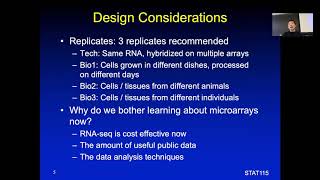
STAT115
Comprehensive lecture series on statistical methods for analyzing genomic data, covering microarrays, RNA-seq, epigenetics, cancer genomics, and more. Focuses on practical applications in bioinformatics and computational biology.

Finding Fairness - Incorporating Societal Values in Computer Algorithms
Exploring algorithmic fairness and privacy in computer science, addressing concerns about incorporating societal values into technology as it increasingly impacts our lives.
Political Geometry - The Mathematics of Redistricting
Explore mathematical approaches to redistricting, examining how models can improve the process and address challenges in voting rights, representation, and fair electoral boundaries.
Knowledge Graphs Seminar - Spring 2020
Explore knowledge graphs through Stanford's seminar series, covering fundamental concepts, applications, and advanced topics in this cutting-edge field of data representation and reasoning.
Assignment Control Plots for Causal Inference Study Design - Rocky Aikens
Explore visual tools for causal inference study design, focusing on assignment-control plots to analyze covariate distribution and improve observational and experimental studies.

Using Language Models to Understand Wage Premia
Explore how NLP techniques predict salaries from job postings, revealing wage premia for various characteristics in the digital economy labor market.
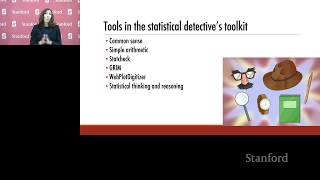
How to Be a Statistical Detective
Learn to detect statistical errors in medical literature using common sense, arithmetic, and online tools. Improve research quality and address the reproducibility crisis in science.
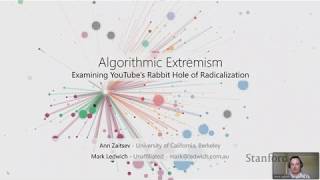
Stanford Seminar - Algorithmic Extremism- Examining YouTube's Rabbit Hole of Radicalization
Examination of YouTube's recommendation algorithm, challenging claims of far-right radicalization. Data analysis reveals a preference for mainstream media over fringe content, with implications for online political discourse.

Stanford Lecture - Pi and The Art of Computer Programming - 2019
Explore π's diverse applications in computer science with Donald Knuth, from numerology to boolean functions, puzzles, and pseudocode, in this engaging Stanford lecture.
Stanford Seminar - Recent Progress in Verifying Neural Networks, Zico Kolter
Explore recent advancements in neural network verification, focusing on robustness and safety validation. Learn about innovative approaches that significantly speed up the verification process for medium-sized networks.

Stanford Seminar - How Can We Understand and Evaluate Election Forecasts, Given That N=15 or Less
Explore election forecasting challenges, including poll analysis, nonresponse bias, and political polarization. Learn to interpret forecasts and understand limitations in predicting outcomes with limited data.

Stanford Lecture - Don Knuth - Twintrees, Baxter Permutations, and Floorplans (2022)
Explore the fascinating connections between twintrees, Baxter permutations, and floorplans in this lecture by renowned computer scientist Donald Knuth, revealing unexpected relationships in mathematics and computer science.
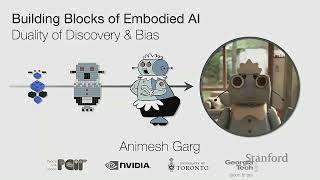
Towards Generalizable Autonomy - Duality of Discovery & Bias
Exploring generalization in embodied AI, focusing on interactive learning, representational biases, and causal inference for robotics and decision-making in complex environments.
Combining Physical and Statistical Models in Projected Global Warming
Combining physical and statistical models to narrow uncertainty in global warming projections, focusing on Earth's energy budget and model-observation relationships for more accurate future warming estimates.
Stanford Lecture - Don Knuth - "A Conjecture That Had To Be True"
Donald Knuth explores a fascinating problem in combinatorial geometry, presenting an intriguing formula and its unexpected universal application, showcasing the beauty of mathematical discovery.

Project Risk Analysis Live Information Session
Explore project risk analysis using interactive simulations and stochastic libraries. Learn cutting-edge methods applicable across industries, balancing theory with practical tools for effective risk assessment and management.
Interactive Autonomy - A Human-Centered Approach for Safe Interactions
Explore interactive autonomy for safe human-robot collaboration, focusing on algorithms that influence human behavior and efficient active learning methods to model human preferences.
Hamiltonian Paths in Antiquity - Stanford Lecture 2016
Explore the ancient origins of Hamiltonian paths with Donald Knuth, tracing their history from Graeco-Roman times through Sanskrit and Arabic documents, and their modern relevance in computer science.
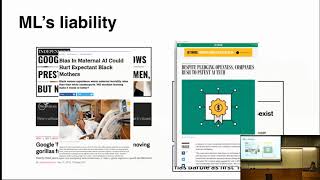
Extending the Theory of ML for Human-Centric Applications
Exploring ML challenges in real-world applications, focusing on data manipulation, multi-objective optimization, and robustness in dynamic environments with human-centric considerations.
Deep Generative Models - Discrete Latent Variable Models - Lecture 17
Explore discrete latent variable models in deep generative modeling, covering key concepts and applications in AI and machine learning.
Deep Generative Models - Lecture 5: Variational Autoencoders
Explore Variational Autoencoders (VAEs) in deep generative modeling, covering theoretical foundations and practical applications in this comprehensive Stanford lecture.