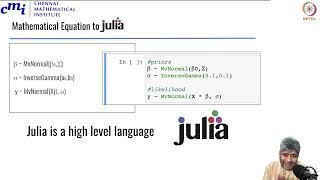
Why Julia is the Future for Data Science Projects
Explore Julia's advantages for data science, including speed, economic viability, and reduced carbon footprint compared to R and Python.

PINNs for Inverse Problems in Scientific Computing
Explore Physics-Informed Neural Networks (PINNs) and their application in solving inverse problems in scientific computing and engineering.
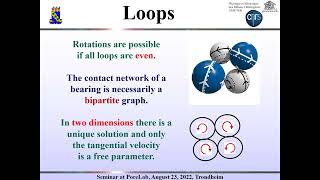
Frustrated Bearings: Exploring Minimum Energy Dissipation in Sphere Systems
Explore the fascinating world of frustrated bearings, their unique properties, and applications in physics and engineering. Discover how these systems exhibit novel states and unexpected behaviors in 2D and 3D.
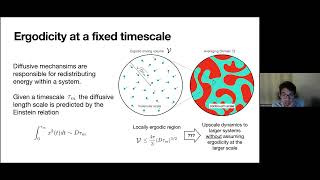
Non-equilibrium Theory for Non-ergodic Systems Based on Time-and-Space Averaging
Explore non-equilibrium theory for non-ergodic systems using time-and-space averaging, focusing on internal energy dynamics and applications to immiscible fluid flow in porous media.
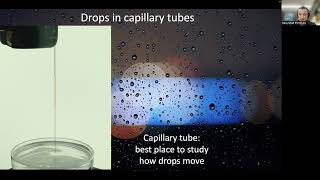
Moving Contact Lines Over Imperfect Surfaces: From Stick-Slip to Steady-Sliding
Explore fluid-fluid interface dynamics on heterogeneous surfaces, from stick-slip to steady sliding. Uncover key parameters and timescales in partial wetting displacement through coupled differential equations and mechanical analogies.
Continuous Upscaling in Multiscale Modeling
Explore continuous upscaling methods for multi-scale modeling. Learn about gradual smoothing transformations, upscaling rules for various physical quantities, and applications to steady-state diffusion problems.
Combinatorics and Geometry of the Amplituhedron
Explore the amplituhedron's geometric properties, connections to various mathematical fields, and recent progress on key conjectures in this advanced mathematical lecture.

Scan Statistics for the Detection of Anomalies in Random Fields
Explore scan statistics for detecting anomalies in random fields, focusing on applications in spatio-temporal data analysis and high-dimensional forecasting methods.
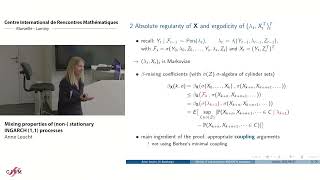
Mixing Properties of (Non-)Stationary INGARCH(1,1) Processes
Explore mixing properties of (non-)stationary INGARCH(1,1) processes in this mathematical conference talk, focusing on adaptive and high-dimensional spatio-temporal forecasting methods.
Lyapunov Exponents of the Navier-Stokes Equations
Explore Lyapunov exponents in Navier-Stokes equations through Alex Blumenthal's conference talk, delving into probabilistic techniques for random and time-dependent dynamical systems.
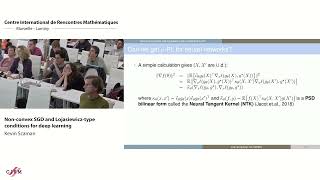
Non-convex SGD and Lojasiewicz-type Conditions for Deep Learning
Explore non-convex SGD and Lojasiewicz-type conditions for deep learning in this mathematical conference talk by Kevin Scaman at CIRM.
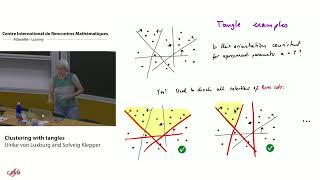
Clustering with Tangles - Machine Learning and Signal Processing on Graphs
Explore clustering with tangles, covering partitions, agreement parameters, cost functions, and applications in machine learning and signal processing on graphs.
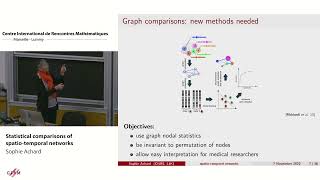
Statistical Comparisons of Spatio-Temporal Networks - Sophie Achard
Explore statistical methods for comparing spatio-temporal networks, focusing on brain analysis and graph comparisons. Learn nodal statistics and structural patterns for network characterization.
Combinatorial Reid's Recipe for Consistent Dimer Models
Explore combinatorial Reid's recipe for consistent dimer models, focusing on Makai correspondence, modular spaces, and derived interpretations in algebraic geometry.
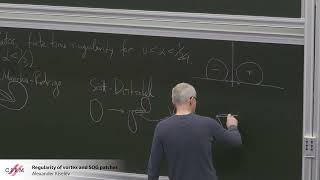
Regularity of Vortex and SQG Patches - Lecture
Explore regularity of vortex and SQG patches, covering existence, global irregularity, numerical simulations, and geometric analysis in fluid dynamics.
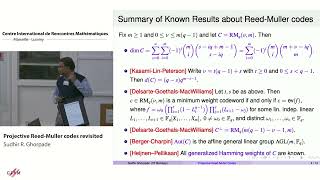
Projective Reed Muller Codes Revisited
Explore projective Reed Muller codes with Sudhir Ghorpade, revisiting key concepts and recent developments in algebraic coding theory.
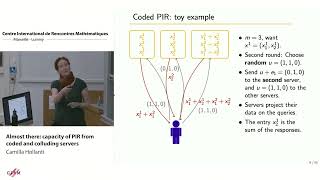
Almost There: Capacity of PIR from Coded and Colluding Servers
Explore capacity of Private Information Retrieval from coded and colluding servers. Gain insights into algebraic and combinatorial methods for coding and cryptography.
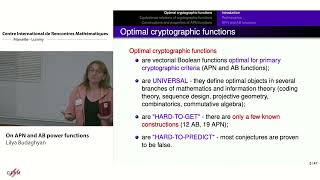
APN and AB Power Functions in Cryptography
Explore APN and AB power functions in algebraic cryptography, focusing on their properties and applications in secure communication systems.
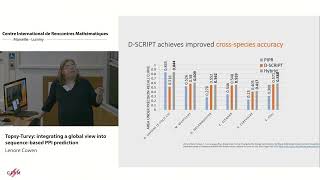
Topsy-Turvy: Integrating a Global View into Sequence-Based PPI Prediction
Explore innovative approaches to protein-protein interaction prediction by integrating global perspectives with sequence-based methods.
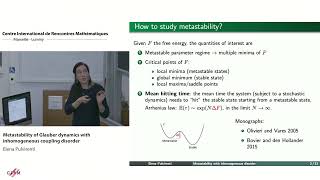
Metastability of Glauber Dynamics with Inhomogeneous Coupling Disorder
Explore metastability in mean-field-like spin systems with random couplings, focusing on Glauber dynamics and quantitative estimates in large volumes at fixed temperatures.
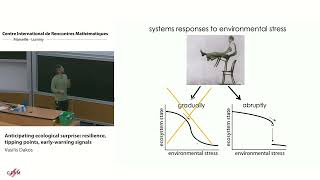
Anticipating Ecological Surprise: Resilience, Tipping Points, and Early-Warning Signals
Explore ecological surprises, resilience, tipping points, and early-warning signals in complex systems. Gain insights into anticipating and understanding sudden environmental changes.