
Anomalous Dissipation and the Strong Onsager Conjecture - Part 2: L^3 Convex Integration
Explore anomalous dissipation and the Strong Onsager Conjecture in turbulent flows, focusing on L^3 convex integration techniques for mathematical analysis of energy transfer.
On the Energy and Helicity of Inflexional Magnetic Braids
Explore energy and helicity in inflexional magnetic braids, examining their properties and implications for astronomical phenomena.
Quantum Vortex Knots and Links under Zero Helicity Condition
Explore quantum vortex knots and links under zero helicity condition in this advanced mathematics lecture by Renzo Ricca.
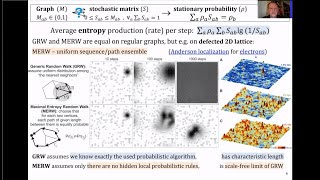
Maximal Entropy Random Walk: Understanding Born Rule and Bell Violation
Explore maximal entropy random walk and its implications for quantum mechanics, including Born rule and Bell violation. Gain insights into statistical mechanics and potential new physics applications.
Non-linear Electrodynamics Derived from Kaluza-Klein 5-Dimensional Gravity
Explore non-linear electrodynamics derived from Kaluza-Klein theory, examining unique Maxwell equation generalizations and potential static solutions as electron models.
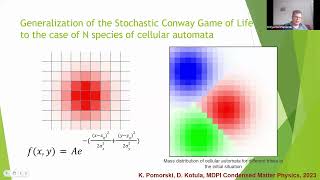
Classical and Quantum Conway Game of Life - Methodologies and Applications
Explore classical and quantum Conway Game of Life methodologies, including stochastic models, dissipative Schrödinger equations, and thermodynamic aspects. Gain insights into complex systems and quantum mechanics applications.
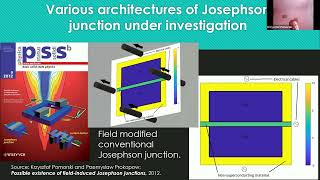
Hybrid Schrödinger-Ginzburg-Landau Approach in Study of Superconducting Integrated Structures
Explore a hybrid Schrödinger-Ginzburg-Landau approach for simulating superconducting lattices and integrated structures. Learn about relaxation algorithms and modeling techniques for superconducting devices.
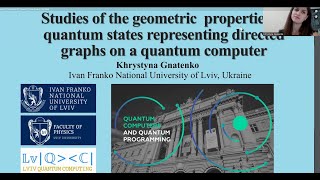
Geometric Properties of Quantum States Representing Directed Graphs on Quantum Computer
Explore geometric properties of multi-qubit states represented by directed graphs, examining curvature, torsion, and entanglement using quantum computers and simulators.

Using Vector Databases with LLMs - Part One
Explore vector databases for LLMs, enhancing audio and visual data processing, recognition, and search capabilities.

Exploring Functional Programming with Scala Cats
Discover functional programming in Scala using Cats library. Learn key concepts and powerful abstractions to enhance your codebase and improve development efficiency.
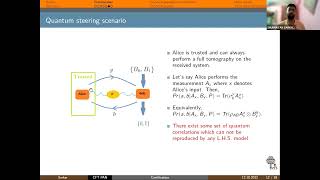
Certification of Entangled Quantum States and Quantum Measurements in Arbitrary Dimensions
Explore device-independent certification of entangled quantum states and measurements in arbitrary dimensions, including recent advancements and randomness generation schemes.
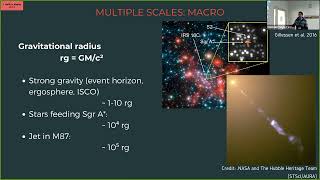
Simulating the Multi-Scale Environment of Supermassive Black Holes
Explore simulation techniques for modeling supermassive black holes, focusing on incorporating large-scale environmental data into event horizon simulations to enhance EHT observations.
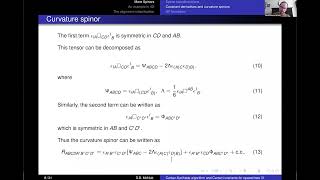
Cartan-Karlhede Algorithm and Cartan Invariants for Spacetimes - Part 3
Explore the Cartan-Karlhede algorithm for classifying spacetime solutions in General Relativity, including mathematical foundations and applications in geometry and gravity theories.
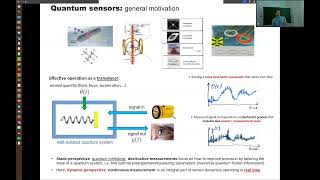
Quantum Sensors Operated in Real Time
Explore quantum sensors' real-time applications, from gravitational-wave detection to brain magnetic field tracking. Learn about enhancing sensitivity through non-classical correlations and measurement-based feedback techniques.
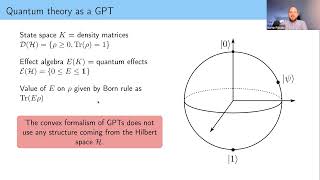
Foundational Problems, Mathematical Results and Applications in Quantum Information
Explore entanglement in non-classical theories, generalized DPS hierarchy, and applications in quantum information, focusing on semi-device independent certification of Schmidt number.
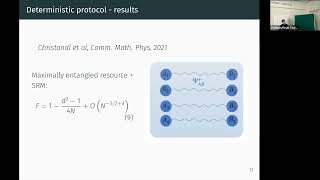
Multi Port-Based Teleportation - A Group Theoretic Approach
Explore multi port-based teleportation using group theory. Analyze capabilities for teleporting multiple qudit states, examining symmetries and representation theory of symmetric groups.

Statistical Analysis in Cosmology: Goodness-of-Fit and Model Selection - Part 2
Explore advanced statistical methods in cosmology, including model selection, MCMC, chi-square, and p-value analysis for robust data interpretation.
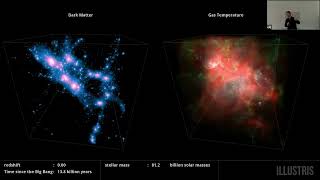
Exploring the Local Group with Constrained Simulations
Explore the Local Group using constrained simulations to study low-mass galaxies, including ultra-diffuse galaxies, and their implications for dark matter and galaxy evolution.
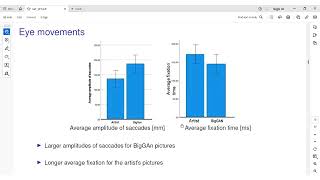
Art and Topology - Applications of Topological Data Analysis in Art Perception
Explore topological data analysis applications in art perception, comparing responses to abstract paintings and AI-generated images through eye movement analysis and geometric feature recognition.
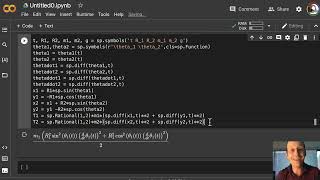
Modeling the Double Pendulum with Python and SymPy
Explore Python and sympy to model the double pendulum, from deriving equations to creating a 3D visualization.
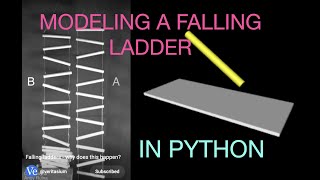
Modeling a Bouncing Stick with Python - Veritasium Falling Ladder Problem
Model a falling and bouncing stick using Python, inspired by Veritasium's falling ladder problem. Explore physics simulations and coding techniques.