
RayTraceHeatTransfer.jl: 2D Enclosure Radiative Heat Transfer - JuliaCon 2024
Explore radiative heat transfer in 2D enclosures using RayTraceHeatTransfer.jl. Master Monte Carlo ray tracing, Exchange Factor matrices, and the Zonal Method for efficient problem-solving in high-temperature environments and engineering applications.
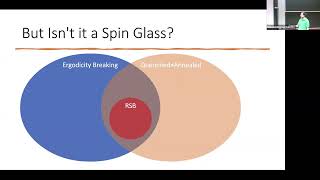
The Spin SYK Model
Delve into quantum gravity and holography through the Spin SYK Model, exploring its emergent properties, SYK-like behavior, and implications for quantum spin glasses and many-body interactions.
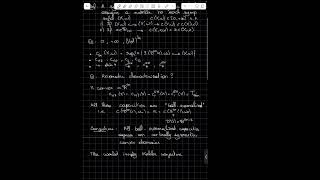
Equivariant Symplectic Homology - Ekeland-Hofer Capacities and Gutt-Hutchings Capacities
Explore the connection between Ekeland-Hofer and Gutt-Hutchings capacities in star-shaped domains, unraveling their equivalence through equivariant symplectic homology.
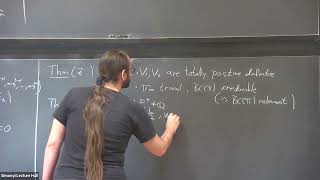
First Explicit Reciprocity Law for Unitary Friedberg-Jacquet Periods
Delve into the first explicit reciprocity law for unitary Friedberg-Jacquet periods. Explore its application to the Bloch-Kato conjecture and challenges arising from lack of local multiplicity one.
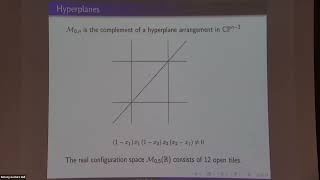
Scattering Amplitudes, Multi-variate Residues and Valuated Matroids
Delve into scattering amplitudes, exploring multi-variate residues on Grassmannians and moduli spaces. Uncover connections between physical problems and geometric combinatorics.
Discrete and Continuous Duality Algebras
Delve into Poincare duality algebras and their extensions, exploring connections to toric varieties, spherical varieties, and K-rings through homogeneous and weighted homogeneous polynomials on vector spaces and lattices.
Attractors.jl - Next-Gen Multi-Stability Analysis for Dynamical Systems
Explore next-gen stability analysis in dynamical systems with Attractors.jl. Discover multistability detection, global stability quantification, and extendable interfaces for advanced applications in Julia.
Finite Element Modeling of Magnetic Fields in Julia
Explore finite element modeling of magnetic fields using Julia in this TU Delft master course. Implement mathematical models and collaborate on real-world projects with industry partners.
Symplectic Orbifold Gromov-Witten Invariants
Dive into symplectic orbifold Gromov-Witten invariants, exploring recent developments in moduli spaces and global Kuranishi charts for pseudo-holomorphic curves in symplectic orbifolds.
Surprising Phenomena of Max-LP-Margin Classifiers in High Dimensions
Delve into surprising phenomena of max-lp-margin classifiers in high dimensions, exploring optimal rates, adaptivity, and performance in noisy observations for machine learning theory enthusiasts.
Emergence and Grokking in Simple Neural Architectures
Dive into emergence and grokking in simple neural architectures. Explore MLPs' remarkable behaviors, feature-learning kernel machines, and their implications for understanding modern deep learning phenomena.
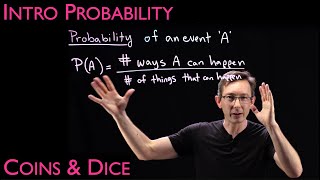
Gentle Introduction to Probability: Counting Coin Flips and Dice
Explore fundamental probability concepts through coin flips and dice rolls, uncovering the nature of randomness and its practical applications in everyday scenarios.
Generalization in Robotic Behavior Cloning: Pitfalls and Promises
Explore challenges and solutions in robotic behavior cloning, focusing on generalization in continuous state/action spaces. Gain insights into frameworks enabling agents to imitate complex behaviors with provable guarantees.
Know When You Know: Handling Adversarial Data by Abstaining
Explore sequential prediction in stochastic settings with adversarial interference. Learn strategies for handling distribution shifts and making confident predictions while abstaining from uncertain cases.
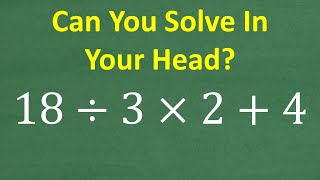
Mental Math Problem: 18 Divided by 3 Times 2 Plus 4
Enhance your knowledge of quick mental math calculations for basic arithmetic operations in this concise tutorial on problem-solving techniques.
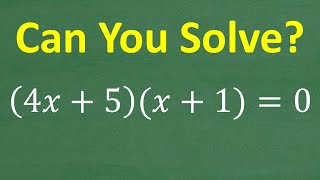
Solving Quadratic Equations Using the Zero-Product Property
Master solving quadratic equations using the zero-product property in this concise algebra tutorial. Enhance your problem-solving skills and boost your mathematical confidence.
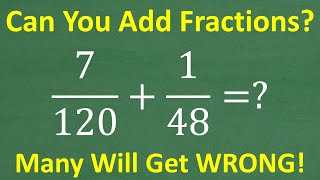
How to Add Fractions and Find the Lowest Common Denominator - Basic Math
Master the process of adding fractions and finding the lowest common denominator (LCD) in this concise tutorial. Enhance your basic math skills with clear explanations and practical examples.
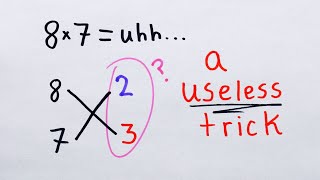
Multiplication Methods in the 1500s - The Grounde of Arts by Robert Recorde
Explore a unique 16th-century multiplication method from Robert Recorde's popular arithmetic textbook. Discover its strengths, weaknesses, and validity through examples and proofs.
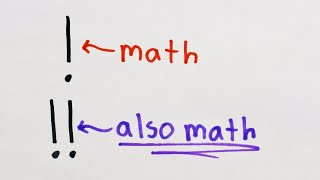
Double Factorial: Introduction to the Alternate Factorial
Explore the double factorial (!!), its unique properties, and applications in graph theory. Discover how this alternate factorial notation skips every other number while respecting parity.
When Do Dependencies in Your Data Help? - Emerging Generalization Settings
Explore how dependencies in data can overcome computational barriers in learning graphical models, using the Glauber dynamics process as a natural data generation method.
Irreversibility and Inference: Classical and Quantum Reverse Processes via Bayesian Inversion
Explore classical and quantum reverse processes through Bayesian inversion, delving into irreversibility and inference concepts with Clive Cenxin Aw.