Resources for Brewing BEIR - Reproducible Reference Models and Statistical Analyses
Explore reproducible reference models and statistical analyses for neural information retrieval using BEIR resources.
Collaborative Filtering Based on Diffusion Models: Unveiling the Potential of High-Order Connectivity
Explore collaborative filtering using diffusion models, unveiling high-order connectivity potential in recommendation systems for enhanced user experiences.
Lightweight Embeddings for Graph Collaborative Filtering - SIGIR 2024
Explore lightweight embeddings for graph collaborative filtering in recommender systems, enhancing efficiency and performance in user-item interactions.
Content-based Graph Reconstruction for Cold-start Item Recommendation - SIGIR 2024
Explore innovative graph reconstruction techniques for cold-start item recommendations, enhancing content-based approaches in recommender systems.
AFDGCF: Adaptive Feature De-correlation Graph Collaborative Filtering for Recommendations
Explore adaptive feature de-correlation in graph collaborative filtering for enhanced recommendation systems. Learn innovative techniques to improve accuracy and relevance.
SIGformer: Sign-aware Graph Transformer for Recommendation
Explore sign-aware graph transformers for recommendation systems, enhancing accuracy through innovative graph-based techniques and transformer architectures.
Stochasticity in Transcription - MPG Primer 2023
Dive into stochasticity in transcription, exploring single-cell data, dynamic regulatory elements, and transcriptional bursting in autoimmune diseases. Gain insights into modeling techniques and gene regulatory programs.
DHMAE: A Disentangled Hypergraph Masked Autoencoder for Group Recommendation - Lecture 4
Explore a novel approach to group recommendation using disentangled hypergraph masked autoencoders, enhancing accuracy and efficiency in collaborative filtering systems.
Geometric Representations of Far Future Predictions in Deep Neural Networks - Next-Token Training
Explore universal geometric representations of far-future beliefs in deep neural networks trained on next-token prediction, uncovering fractal and quantum-like structures embedded in network activations.
Singular Learning, Relative Information and the Dual Numbers
Dive into relative information's role in machine learning, exploring conditional relative information, singular learning theory, and connections to algebraic geometry and category theory.
Comparison and Transfer Between Tasks in Overparameterized Learning
Explore similarities and differences in classification and regression tasks for overparameterized linear models. Gain insights into task transfer and generalization in high-dimensional regimes.
Two Stories in Mechanistic Interpretation of Natural and Artificial Neural Computation
Explore two stories in mechanistic interpretation of neural computation, covering in-context learning in Transformers and insights into linear regression tasks using linear attention models.
Dimension-Free Sobolev-Type Embeddings in the Gauss Space
Explore dimension-free Sobolev-type embeddings in Gauss space, extending Gross' logarithmic Sobolev inequality and examining Orlicz spaces, higher-order derivatives, and Gaussian isoperimetric inequality.
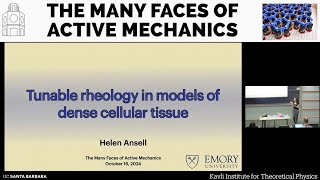
Tunable Rheology in Models of Dense Cellular Tissue
Explore tunable rheology in dense cellular tissue models. Gain insights into active matter phenomena and their applications in biological systems and engineered materials.
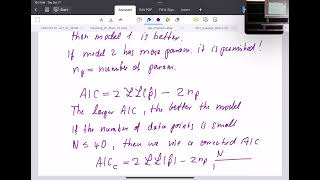
Sensitivity, Spatial Models, and Fokker-Planck Equations in Mathematical Oncology - Graduate Course
Dive into advanced mathematical concepts in oncology, exploring sensitivity analysis, spatial modeling, and Fokker-Planck equations with Dr. Thomas Hillen.
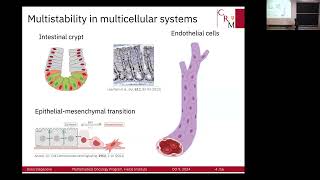
A Method to Coarse-Grain Multi-Agent Stochastic Systems with Regions of Multistability
Dive into a mathematical oncology seminar exploring coarse-graining techniques for multi-agent stochastic systems, focusing on regions of multistability in cancer modeling.
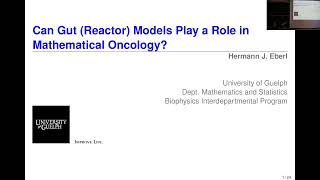
Can Gut Reactor Models Play a Role in Mathematical Oncology?
Explore the potential role of gut reactor models in mathematical oncology through Hermann Eberl's seminar on innovative approaches to cancer research.

Parameter Estimation in Mathematical Oncology - Lecture
Dive into advanced techniques for parameter estimation in mathematical oncology, exploring key concepts and practical applications.
A Short but Up-to-Date Introduction to Partially Parabolic or Dissipative Systems - Lecture 3
Delve into partially parabolic or dissipative systems in fluid mechanics. Explore recent developments, mathematical techniques, and applications in this advanced lecture on fluid flow equations.

Hierarchical Causal Models
Dive into hierarchical causal models with David Blei in this EWSC-MIT EECS Joint Colloquium, exploring novel insights in biomedical research and machine learning advancements.
Regularization by Noise - Lecture 2
Dive into regularization by noise in fluid dynamics, exploring advanced mathematical concepts and their applications to Euler and Navier-Stokes equations in this comprehensive lecture.