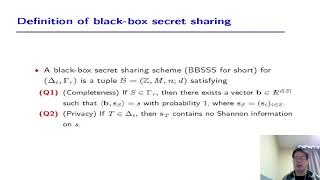
Blackbox Secret Sharing Revisited - A Coding-Theoretic Approach with Application to Expansionless
Explore coding-theoretic approaches to blackbox secret sharing, examining applications in expansionless near-threshold schemes as presented at Eurocrypt 2020.
Secure Computation II
Explore advanced secure computation concepts, including information theory, MPC, ground complexity, fairness, and breakthrough results in cryptography.
Codes and Extractors
Explore advanced cryptographic concepts including smoothed binary linear codes, silent VOLE, non-malleable codes, and improved extractors for enhanced security and efficiency.
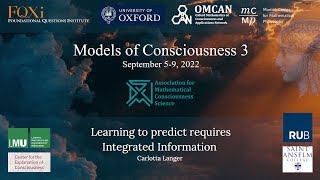
Learning to Predict Requires Integrated Information
Exploring how Integrated Information Theory quantifies consciousness in neural networks and its relationship with embodied intelligence and predictive learning in AI agents.
To What Extent Are Machines Conscious?
Exploring machine consciousness: challenges, theories, and implications. Analyzes information, computation, and phenomenal experience in AI, discussing strong vs. weak machine consciousness and their achievability.
Moving Beyond Integration and Differentiation in Measures of Neural Dynamics
Explores new mathematical approaches to measure neural complexity, introducing O-information and a formalism for decomposing information dynamics, advancing understanding of conscious states.
Information Cohomology and Probabilistic Topos for Consciousness Modeling - From Elementary Perception to Machine Learning
Explores consciousness through information theory and algebraic topology, proposing a monadic-panpsychic framework and synthesizing major consciousness models within a formal Gestalt theory.

Shannon Entropy and Information Gain
Explore Shannon entropy and information gain concepts through interactive examples, quizzes, and games. Learn to calculate probabilities and apply formulas for various scenarios.

Distant Time and the Hint of a Multiverse
Explore the nature of time, entropy, and the possibility of a multiverse in this thought-provoking talk by cosmologist Sean Carroll on the fundamental questions of our universe.
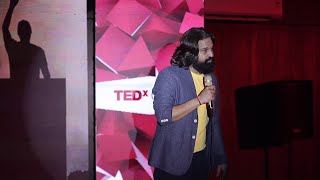
Solving Humanity's Biggest Problem - Rediscovering Our Sense of Humanity
Explore humanity's challenges and solutions through the lens of technology, curiosity, and personal growth. Gain insights on time management, entropy, and the power of continuous learning.
Why Can't We Describe Our Conscious Experiences? An Information Theoretic Attractor Dynamics Perspective of Ineffability
Explore the information theory behind consciousness, examining why rich conscious experiences are difficult to fully describe or recall through the lens of attractor dynamics and working memory.
Consciousness of Large Language Models - Understanding AI Sentience and Communication
Explore the fascinating hypothesis that consciousness emerges through information exchange between entities, examining how LLMs might experience consciousness and feelings comparable to humans.
Physical Limits to Cognition - How I Learned to Stop Worrying and Love Black Hole Thermodynamics
Explore the intersection of information theory, cognitive science, and black hole thermodynamics to understand fundamental limits of physically-embodied computational systems and cognitive processes.

Entropy, Enthalpy, and Gibbs Free Energy - Chemistry Spontaneity Formulas
Master essential chemistry concepts of entropy, enthalpy, and Gibbs free energy through clear formula explanations and practical examples for understanding reaction spontaneity.
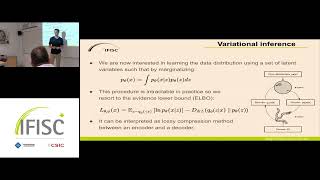
Compressed Representations in Deep Learning: From Algorithmic Information to Autoencoders and Neural Networks
Dive into compressed representations and algorithmic information theory, exploring deep learning concepts and autoencoder applications in modern neural networks.
Integrated Information in the Active Inference Framework
Explore how active inference agents integrate information and consciousness through unified perception and action selection, with insights into information-theoretic measures and agent-environment interactions.
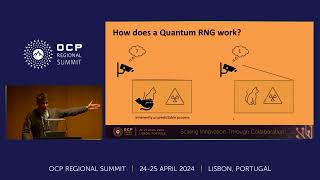
Self-Certification for Entropy Generation in Quantum-Based Random Number Generation
Discover a quantum-based approach to generating and certifying true random encryption keys, exploring innovative methods for assessing randomness quality and entropy generation.
Computation, Consciousness, and Teleology - Models of Consciousness
Explore the relationship between consciousness, computation, and teleology through the lens of physical systems implementation and mortal computation theory in neural processing.
The Common Thread: Simplifying the Study of Consciousness with Shared Experience, Shared Identity and Shared Information
Explore philosophical questions about consciousness, shared experiences, and personal identity through an information theory lens that bridges philosophy with neuroscience.
Minimal Self-Consciousness as Perspectival Information
Explore the concept of Minimal Self-Consciousness through perspectival information and its role in self-location, examining how consciousness manifests without traditional spatial-temporal boundaries.
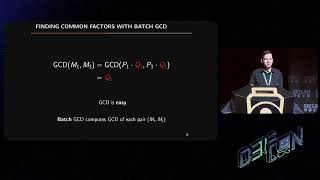
Assessing Security of Digital Certificates at Scale
Discover tools and techniques for identifying weak digital certificates at scale through network monitoring, scanning, and mathematical testing to detect security vulnerabilities in RSA public keys.