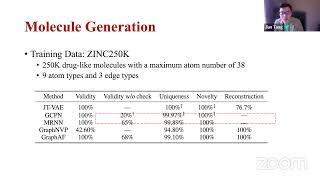
Geometric Deep Learning for Drug Discovery
Explore geometric deep learning techniques for drug discovery, covering graph neural networks, molecule generation, and retrosynthetic prediction. Gain insights into cutting-edge research and applications in pharmaceutical development.

Information Theory of Deep Learning - Naftali Tishby
Explores the connection between deep learning and information theory, offering new insights into neural network design, generalization, and optimization through an information bottleneck framework.

Rational Ignorance - Optimal Learning from Complex Mechanistic Models
Explore optimal Bayesian learning from complex models, challenging traditional approaches and proposing a new method to maximize expected information while avoiding bias in multiparameter systems.
Blessings of Dimensionality for Gaussian Latent Factor Models
Explore how high-dimensional data analysis can benefit from restricted latent factor overlaps, with applications in brain fMRI and financial markets.
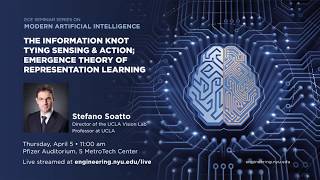
The Information Knot - Tying Sensing and Action; Emergence Theory of Representation Learning
Explore information theory, representation learning, and AI concepts with NYU's Stefano Soatto. Delve into information bottlenecks, mutual information, and disentangling in this advanced seminar on modern AI.
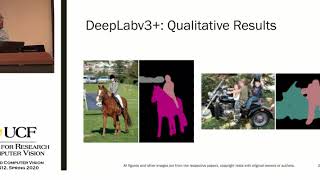
Region Mutual Information Loss for Semantic Segmentation
Explore advanced techniques in semantic segmentation, including region mutual information loss, à trous convolutions, and multi-scale features for improved image analysis and understanding.
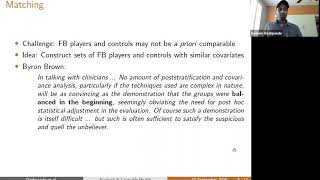
Applied Probability and Statistics Seminar Series
Explore cutting-edge statistical applications in health, astrophysics, and healthcare equity through expert-led seminars on football injuries, dark matter detection, and racial disparities in prostate cancer outcomes.
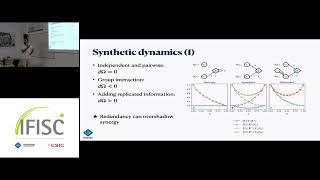
Information-Theoretic Metrics of Higher-Order Interactions on Graphs
Explore information-theoretic metrics for analyzing higher-order interactions in complex networks, focusing on graph theory applications and advanced analytical techniques.
Sequential Design Based on Mutual Information for Computer Experiments - Joakim Beck, KAUST
Explore uncertainty quantification using Gaussian Process emulators for complex systems. Learn about sequential design methods, mutual information criteria, and applications in climate, tsunami, and earthquake modeling.
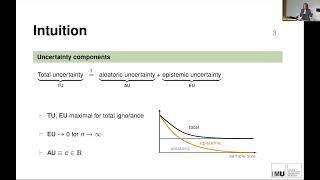
Quantifying Aleatoric and Epistemic Uncertainty in Machine Learning - Session 2
Explore critical analysis of uncertainty quantification in machine learning, examining conditional entropy and mutual information as measures for aleatoric and epistemic uncertainty.
Mutual Information-based Preference Disentangling and Transferring for Cross-Domain Recommendations
Explore mutual information-based techniques for disentangling and transferring user preferences across multiple non-overlapping domains in recommendation systems.
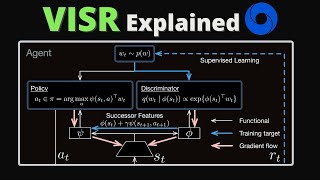
Learning Fast with No Goals - VISR Explained
Explore rapid generalization in Reinforcement Learning with VISR, focusing on successor features and goal-conditioned policies for efficient task adaptation without rewards.
Quantum Error Correcting for Gravity in the Large-N Limit - IPAM at UCLA
Explore quantum error correcting codes for large-N limit theories, focusing on gravitational duals and emerging features. Covers asymptotic operator algebra results and information theoretic constraints.
Maximizing Mutual Information in Flash Memories
Explores optimizing Flash memory performance through mutual information maximization, focusing on LDPC codes and device longevity in the context of multi-bit cell storage and read operations.
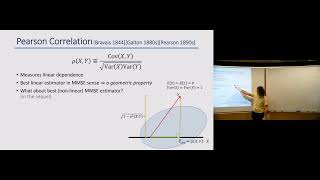
Geometry-oriented Measures of Dependence in Statistical Analysis
Explore geometric approaches to measuring statistical dependence, examining axioms and algorithms for evaluating relationships between variables while comparing classical and modern dependence measures.
Reverse Engineering Structural Connectivity in Brain Networks
Explore the relationship between causal and structural connectivity in brain networks. Learn techniques for reconstructing neural circuitry using pulse outputs and various causality measures.
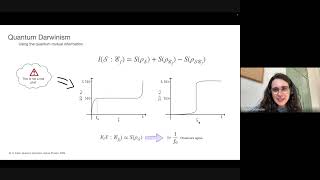
Distinguishing Between Redundancy and Consensus in Quantifying Quantum Objectivity
Explore rigorous definitions of "redundancy" and "consensus" in quantum objectivity, examining their distinct roles in the quantum-to-classical transition and implications for quantum Darwinism.
Defending Against Data Reconstruction Attacks in Federated Learning: An Information Theory Approach
Explore advanced defense strategies against data reconstruction attacks in federated learning through information theory, focusing on privacy preservation and efficient training methods.