The Nonequilibrium Cost of Accurate Information Processing in Quantum Systems
Delve into quantum thermodynamics and information processing, exploring fundamental limits of accuracy in relation to nonequilibrium resources and their implications for quantum computing systems.
An Operational Definition of Entropy for Post-Quantum Theories
Delve into the operational definition of entropy in post-quantum theories, exploring information content measurement and its extension beyond classical and quantum sources.
Optimal Lower Bounds for Quantum Learning via Information Theory
Delve into quantum learning theory's fundamental bounds, exploring information-theoretic approaches to PAC and agnostic models, with insights into the Quantum Coupon Collector problem and state distinguishability.
New Additivity Properties of the Relative Entropy of Entanglement and Its Generalizations
Delve into quantum entanglement theory through an exploration of relative entropy additivity properties, focusing on bipartite pure states, Bell diagonal states, and generalized Dicke states.
Operational Interpretation of the Sandwiched Renyi Divergence of Order 1/2 to 1 as Strong Converse Exponents
Delve into advanced quantum information theory through an exploration of sandwiched Renyi divergence's operational interpretation and its applications in quantum tasks and strong converse exponents.

量子計算と量子暗号 - 量子情報技術の基礎と最新研究
Discover the fundamentals of quantum computing and cryptography through an exploration of quantum mechanics, its computational applications, and secure communication protocols.

Efficiency Through Stateless Microservices: Request Handling
Explore stateless microservices for efficient request handling in ML systems. Learn about API gateways, load balancers, and event-driven architectures to optimize performance and scalability.
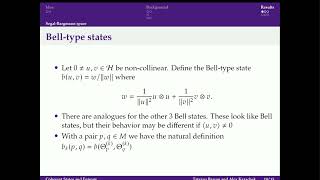
Coherent States and Entropy in Geometric Quantization
Explore coherent states and entropy in geometric quantization, examining entanglement entropy bounds on Kähler manifolds.
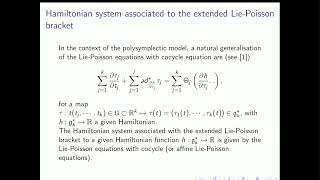
Polysymplectic Souriau Lie Group Thermodynamics and Entropy Geometric Structure as Casimir Invariant
Explore advanced concepts in Lie group thermodynamics, focusing on polysymplectic Souriau theory and entropy's geometric structure as a Casimir invariant.
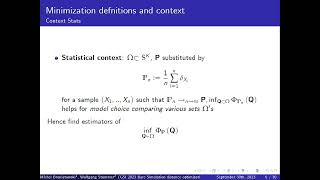
On a Cornerstone of Bare Simulation Distance Divergence Optimization
Explore distance divergence optimization in bare simulation, uncovering key principles and advanced techniques for enhanced computational efficiency.
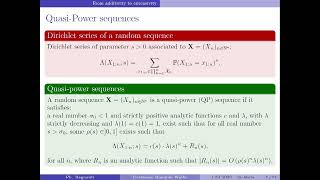
Extensive Entropy Functionals and Non-Ergodic Random Walks
Explore extensive entropy functionals and non-ergodic random walks in statistical physics and complex systems.
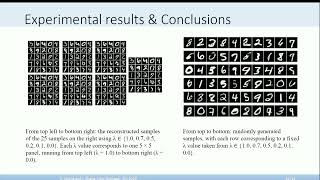
Deformed Evidence Lower Bound (λ-ELBO) Using Rényi and Tsallis Divergence
Explore advanced variational inference techniques using Rényi and Tsallis divergences to optimize the Deformed Evidence Lower Bound (λ-ELBO) for improved probabilistic modeling.
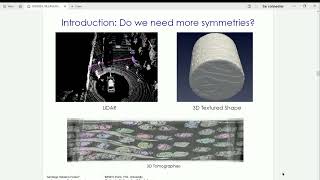
Can Generalized Divergences Help for Invariant Neural Networks?
Explore the potential of generalised divergences in enhancing invariant neural networks, examining their impact on network performance and robustness.
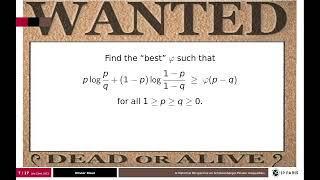
A Historical Perspective on Schützenberger-Pinsker Inequalities
Explore the historical development and significance of Schützenberger-Pinsker inequalities in information theory and probability theory.
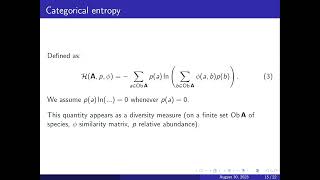
Categorical Magnitude and Entropy
Explore categorical magnitude and entropy concepts, enhancing understanding of data analysis and information theory principles.
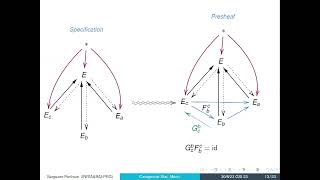
A Categorical Approach to Statistical Mechanics
Explore statistical mechanics through a categorical lens, gaining insights into complex systems and thermodynamic principles.
Entropy - Part 2 - Lecture 72
Explore advanced concepts of entropy, building on foundational knowledge to deepen understanding of thermodynamic principles and their applications.
Blackbody Radiation and the Weyl Law in Disordered Media
Explore blackbody radiation in complex media, focusing on path length invariance, Weyl law, and connections to information theory and quantum vacuum forces.
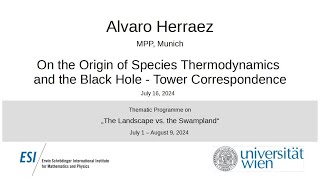
On the Origin of Species Thermodynamics and the Black Hole - Tower Correspondence
Explore species thermodynamics and black hole-tower correspondence, delving into advanced concepts in theoretical physics and cosmology.
Why Study Quantum Computing? - Lesson 100 of Quantum Computer Programming in 100 Easy Lessons
Explore the significance and potential of quantum computing in this thought-provoking conclusion to a comprehensive series on quantum programming.
Holographic Data Representations for Distributed Storage and Network Transmission
Explore holographic data encoding for progressive recovery, ideal for distributed storage and network transmission with unpredictable delays or erasures.