Randomness and Complexity - Lecture 2
Explore connections between randomness and complexity in mathematics, focusing on advanced concepts and their applications in discrete mathematics and computer science.
Kolmogorov Complexity for DNA Sequences Analysis in Python
Learn to analyze DNA sequence complexity using Kolmogorov Complexity and Python. Covers theoretical background, Lempel-Ziv algorithm, and practical implementation with code walkthrough and visualization.
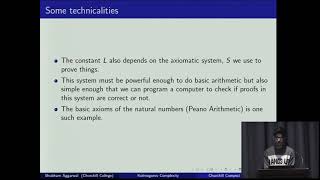
Kolmogorov Complexity and Gödel's Incompleteness Theorems
Explore Kolmogorov complexity, randomness, and compressibility in data, and discover their surprising connections to Gödel's incompleteness theorems in mathematical logic.
Unavoidable Mathematics - Exploring Derived Concepts from Simple Theories
Exploring fundamental mathematical concepts that arise naturally from simple theories, revealing unexpected connections and rich structures in algebra, category theory, and computer science.
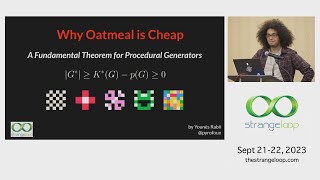
Oatmeal is Cheap - A Fundamental Theorem for Procedural Generators
Explore Kolmogorov complexity in procedural generation, linking generator knowledge to output complexity. Insights for game design decisions in Minecraft, Borderlands, and Tea Garden, with interactive examples.
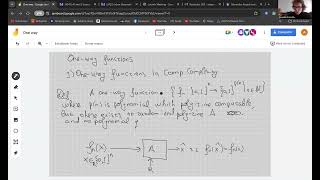
One-Way Computable Transformations - The Barmalias-Zhang Example
Dive into the mathematical exploration of one-way computable transformations through the Barmalias-Zhang example, examining its significance in computational complexity theory.
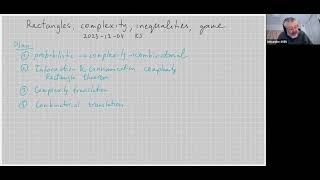
Rectangles, Complexity and Games in Communication Theory - December 4, 2023
Delve into communication complexity theory through rectangles, exploring inequality principles, combinatorial strategies, and their applications in computational game theory.
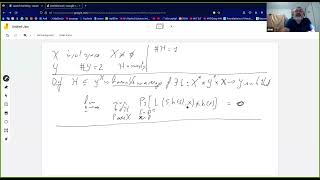
Basic Results About Learning in Computational Complexity - March 2023
Dive into fundamental concepts of computational complexity and learning theory through Bruno Bauwens' detailed exploration at the prestigious Kolmogorov seminar.
Introduction to Probably Approximately Correct (PAC) Learning
Dive into computational complexity and PAC-learning concepts through an in-depth seminar discussion at the prestigious Kolmogorov seminar series on complexity theory.
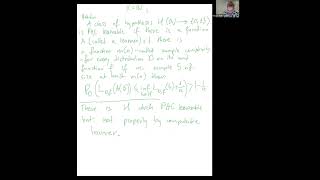
Computable PAC Learning - Part 2
Dive into advanced concepts of computable PAC learning through an in-depth exploration of theoretical frameworks and computational complexity in machine learning theory.
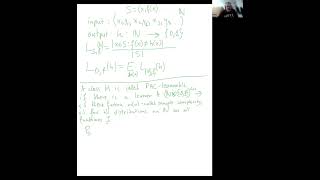
Computable PAC Learning - Part 1
Dive into computational complexity and PAC learning theory through an in-depth exploration of foundational concepts, statistical learning frameworks, and algorithmic approaches.

Combinatorial Rectangles, Kolmogorov Complexity and Experts' Aggregation - March 4, 2024
Delve into communication protocols, exploring their relationship with Kolmogorov complexity, combinatorial rectangles, and the fascinating world of experts' opinion aggregation.
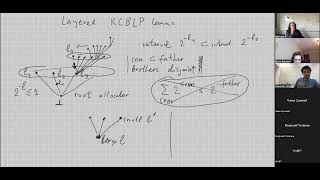
Kraft-Barmpalias-Lewis-Pye Lemma - October 24, 2022
Delve into the layered version of Kraft's lemma, exploring its mathematical foundations and applications in computational complexity theory through expert analysis.
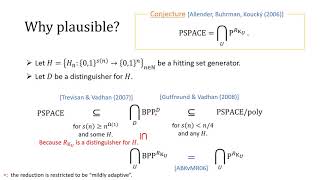
Unexpected Hardness Results for Kolmogorov Complexity Under Uniform Reductions
Explore unexpected findings on Kolmogorov complexity, including hardness results, limits, conjectures, and implications for pseudorandom generators and computational complexity.
Cryptography and Kolmogorov Complexity - A Quick Tutorial
Explore the intersection of cryptography and Kolmogorov complexity, examining minimal complexity assumptions and their implications for secure communication systems.
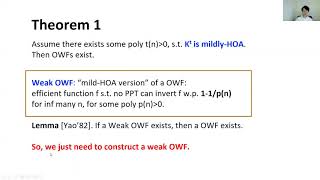
On One-way Functions and Kolmogorov Complexity
Explore the relationship between one-way functions and Kolmogorov complexity in this insightful IEEE talk by Cornell researchers Liu and Pass.
Kolmogorov Music
Explore Kolmogorov complexity in music, algorithmic composition, and program transformations. Discover implications for creation, copyright, and performance through demonstrations and examples.
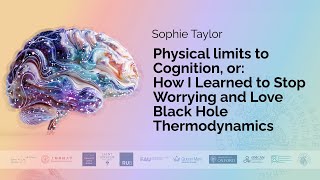
Physical Limits to Cognition - How I Learned to Stop Worrying and Love Black Hole Thermodynamics
Explore the intersection of information theory, cognitive science, and black hole thermodynamics to understand fundamental limits of physically-embodied computational systems and cognitive processes.
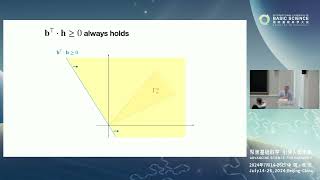
A Geometrical Interpretation of Universally Quantified Inequalities and Its Applications to Mathematics
Explore a geometrical interpretation of universally quantified inequalities and its applications across mathematics, focusing on Shannon entropy and connections to various mathematical branches.

The Mathematical Universe Behind Deep Neural Networks - Rothschild Lecture
Explore the mathematical foundations of deep neural networks, covering functional analysis, harmonic analysis, complex analysis, approximation theory, and more with Professor Helmut Bölcskei.

Automatic Complexity and Block-Entropy Coding - Preparations for Lempel-Ziv Analysis
Explore the mathematical foundations of string complexity through three equivalent measures: block entropy, finite-state transduction, and superadditive functions, leading to Lempel-Ziv compression analysis.