Cryptography and Kolmogorov Complexity - A Quick Tutorial
Explore the intersection of cryptography and Kolmogorov complexity, examining minimal complexity assumptions and their implications for secure communication systems.
Information-Theoretic Quantum Cryptography Part 2 of 2 - IPAM at UCLA
Explore advanced quantum cryptography topics, including secure delegated computation, quantum key distribution, and certified deletion, with a focus on security against unbounded adversaries.
Collision-Resistance from Multi-Collision-Resistance
Exploring the transformation of multi-collision-resistant hash functions into collision-resistant hash functions, with insights on Reed-Solomon codes and cryptographic primitives.
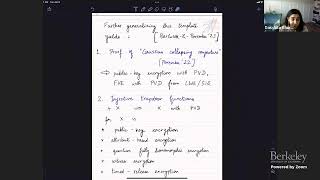
Cryptography with Certified Deletion
Explore quantum cryptography's certified deletion, enabling verifiable information-theoretic deletion of encrypted secrets, with applications in various cryptosystems and recent advancements in public verification.
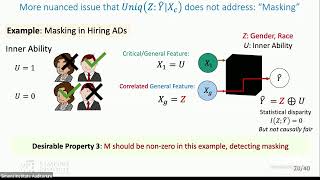
Algorithmic Fairness From The Lens Of Causality And Information Theory
Explore algorithmic fairness through causality and information theory, focusing on identifying and explaining sources of disparity in ML models and quantifying accuracy-fairness trade-offs.

Overview of Code-Based Crypto Assumptions
Explore code-based cryptography assumptions, including Hamming codes, decoding problems, and cryptosystems. Learn about security analyses and generic attacks in post-quantum cryptography.
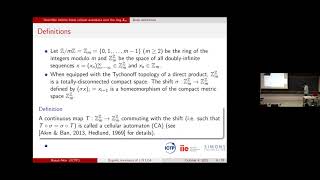
Reversible D-Dimensional CA Over the Ring ZM and Some Applications in Ergodic Theory
Explore cellular automata on $\mathbf{Z}_p$ and $\mathbf{Z}_m$, covering invertibility, ergodic properties, and entropy concepts. Delve into measure-theoretic and topological entropy for 1D linear CA and $\mathbb{Z}^2$-actions.
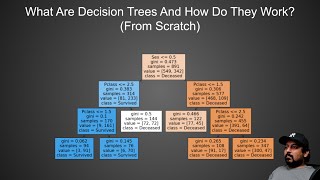
What Are Decision Trees and How Do They Work - From Scratch
Comprehensive guide to decision trees in machine learning, covering basics, implementation, and advanced concepts using real-world examples and scikit-learn comparisons.
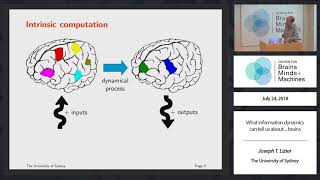
What Information Dynamics Can Tell Us About Brains
Explore information dynamics in complex systems, focusing on intrinsic computation, information transfer, and applications in neuroscience and network analysis.
2021 ITC Conference- Online Linear Extractors for Independent Sources
Explore online linear extractors for independent sources, focusing on key components of Windows 10's RNG design and examining the effectiveness of rotation as an extractor and condenser.
2021 ITC Conference - Code Offset in the Exponent
Explore novel fuzzy extractor construction using error-correcting codes and cryptographic groups, supporting MIPURS distributions for enhanced biometric authentication security.

Huffman Codes - An Information Theory Perspective
Explore the evolution of data compression algorithms, from information theory principles to Huffman's groundbreaking discovery, with practical examples and implementation insights.
Hamming Code and Hadamard Code - Lecture 11c of CS Theory Toolkit
Explore Hamming and Hadamard codes: linear error correction techniques with contrasting rate and distance properties. Learn their applications in theoretical computer science research.

Quantum "Supremacy" - Lecture 25 of Quantum Computation at CMU
Explore quantum supremacy, its challenges, and implications in computational theory. Delve into error correction, threshold theorems, and the potential of quantum systems.

Tales from the Crypt - A Cryptography Primer
Explore cryptography essentials, including encryption methods, digital signatures, and hashing. Learn to secure user data and choose appropriate algorithms for your applications.

Understand ECC Support for NAND Flash Devices in Linux
Explore NAND flash ECC support in Linux, covering algorithms, engine missions, and configurations for robust error correction in storage devices.
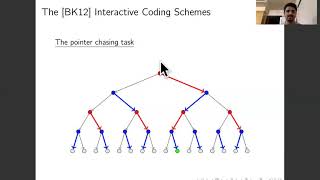
Deterministic and Efficient Interactive Coding from Hard-to-Decode Tree Codes
Explore efficient interactive coding techniques using hard-to-decode tree codes, focusing on deterministic approaches and their applications in communication protocols.
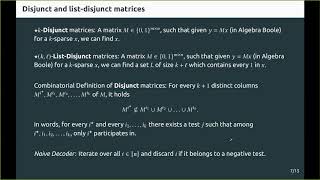
Combinatorial Group Testing and Sparse Recovery Schemes with Near-Optimal Decoding Time
Explore efficient algorithms for combinatorial group testing and sparse recovery, focusing on near-optimal decoding time and practical applications in data analysis and signal processing.
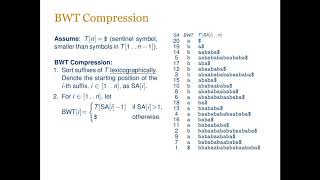
Resolution of the Burrows-Wheeler Transform Conjecture
Explore the groundbreaking resolution of a long-standing conjecture in data compression, presented by researchers from UC Berkeley and Bar-Ilan University.
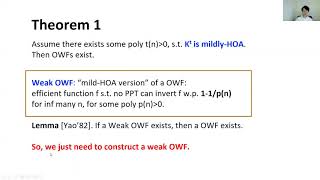
On One-way Functions and Kolmogorov Complexity
Explore the relationship between one-way functions and Kolmogorov complexity in this insightful IEEE talk by Cornell researchers Liu and Pass.
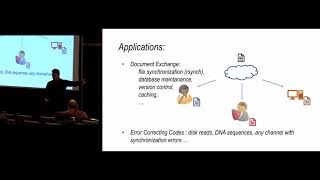
Optimal Document Exchange and New Codes for Insertions and Deletions
Explore optimal document exchange techniques and innovative coding methods for handling insertions and deletions in data transmission and storage systems.