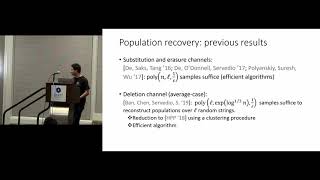
Beyond Trace Reconstruction: Population Recovery from the Deletion Channel
Explore advanced techniques for population recovery from deletion channels, focusing on trace reconstruction and its applications in data analysis and information theory.
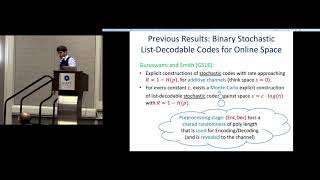
Quasilinear Time List Decodable Codes for Space Bounded Channels
Explore quasilinear time list decodable codes for space bounded channels, advancing understanding of efficient error correction in constrained environments.
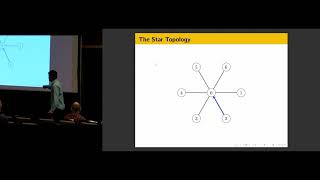
Radio Network Coding Requires Logarithmic Overhead
Explore efficient communication in radio networks, focusing on coding techniques and logarithmic overhead requirements for optimal data transmission.
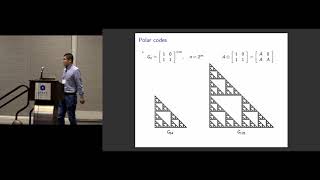
Reed-Muller Codes Polarize
Explore the polarization phenomenon in Reed-Muller codes, uncovering their unique properties and potential applications in coding theory and information transmission.
Complexity and Coding Theory - Session 6A
Explore cutting-edge research in complexity and coding theory, delving into advanced mathematical concepts and their applications in computer science and information theory.
Coding Theory - Session 4A
Explore cutting-edge advancements in coding theory, examining innovative approaches and their implications for information transmission and error correction in modern communication systems.
Relaxed Locally Decodable Codes - Part 2
Explore advanced concepts in relaxed locally decodable codes, building on foundational knowledge to deepen understanding of this important area in coding theory.
Predictions About Artificial Super Intelligence - Theoretical Limits and Capabilities
Explore theoretical limits and cutting-edge capabilities in AI, quantum computing, and more. Delve into concepts like the Landauer Limit, universal computation, and optimal intelligence to understand the future of machine cognition.
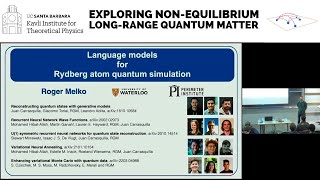
Language Models for Rydberg Atom Quantum Simulation - Roger Melko
Explore language models for Rydberg atom quantum simulation in this talk by Roger Melko, bridging quantum physics and machine learning for novel insights into long-range quantum matter.
Coulomb Universality - Leo Radzihovsky
Explore Coulomb universality in quantum many-body systems with long-range interactions. Discover novel phases and out-of-equilibrium phenomena in this cutting-edge physics lecture.
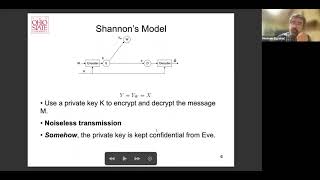
Information Theoretic Security - From Classical to Quantum
Explore classical and quantum information theoretic security with Prof. El Gamal, covering key concepts and advancements in cybersecurity and digital trust.
Fast Erasure Decoder for a Class of Quantum LDPC Codes - IPAM at UCLA
Explore fast erasure decoding for quantum LDPC codes, focusing on hypergraph product codes and their potential to reduce qubit count in fault-tolerant quantum computers.
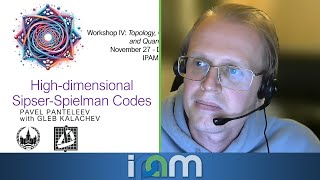
High-Dimensional Sipser-Spielman Codes - IPAM at UCLA
Exploration of high-dimensional Sipser-Spielman codes, extending expander codes to cell complexes and cellular sheaves, with applications in quantum error correction and coding theory.
Quantum Error Correcting for Gravity in the Large-N Limit - IPAM at UCLA
Explore quantum error correcting codes for large-N limit theories, focusing on gravitational duals and emerging features. Covers asymptotic operator algebra results and information theoretic constraints.

Peter Shor - Quantum Computing - Green Family Lecture at IPAM at UCLA
Explore quantum computing's impact on information theory, computation, and cryptography, including Shor's algorithm for prime factorization and other quantum discoveries.
Distinguished Seminar in Optimization and Data - Ryan O'Donnell
Explore quantum state tomography, distribution metrics, and independence testing with insights on quantum-inspired improvements to classical problems in optimization and data analysis.
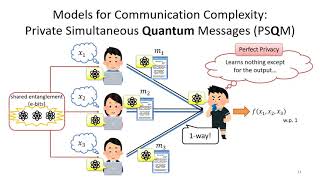
Communication Complexity of Private Simultaneous Messages Protocols - 2021 ITC Conference
Exploring communication complexity in private simultaneous messages protocols, examining quantum advantages and demonstrating gaps between classical and quantum models in secure multiparty computation.
Fooling an Unbounded Adversary with a Short Key, Repeatedly - The Honey Encryption Perspective
Explores honey encryption for unconditional security with short keys, presenting a new scheme for semantic security in the standard model and enabling multiple message encryption with a single key.
ZK-PCPs from Leakage-Resilient Secret Sharing - 2021 ITC Conference
Explore cutting-edge cryptography research on ZK-PCPs derived from leakage-resilient secret sharing. Learn about innovative constructions combining the best aspects of zero-knowledge proofs and probabilistically checkable proofs.
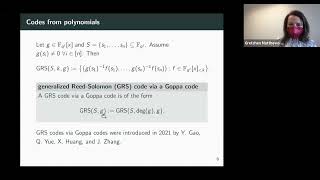
Multivariate Goppa Codes - Applications in Cryptography and Error Correction
Explore multivariate Goppa codes, their properties, and applications in cryptography and quantum error correction. Gain insights into advanced coding theory and its practical implications.
The Leverage of Language - How Information Theory Impacts Security - Lecture 2.2.2
Explore information theory and its impact on language, communication, and security in this thought-provoking talk by Conrad Constantine.