Query Optimization and Evaluation 1 - Output Size Bounds and Information Theory
Explore output size bounds and information theory in query optimization, focusing on advanced techniques for efficient database management and AI applications.
William Marshall – A Measure for Intrinsic Information
Explores a unique information measure reflecting intrinsic perspectives in communication, with implications for integrated information theory and consciousness.
Aïda Elamrani - Inputs, Outputs, and Meta-Models
Explore inputs, outputs, and meta-models in consciousness science, examining a unifying framework to compare diverse theories and bridge the mind-matter divide.
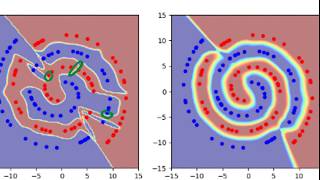
Manifold Mixup: Better Representations by Interpolating Hidden States
Explore Manifold Mixup, a regularization technique that improves neural network performance by interpolating hidden representations, leading to smoother decision boundaries and more robust predictions.
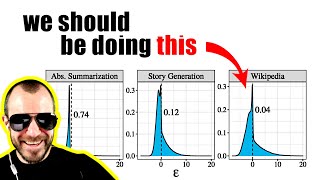
Typical Decoding for Natural Language Generation - Get More Human-Like Outputs From Language Models
Explore typical sampling, a new decoding method for language models that balances high-probability and high-information outputs, resulting in more diverse and interesting generated text.
Quantum Computation
Explore quantum computation fundamentals, local Hamiltonians, entropy, and historical results in this comprehensive overview of cutting-edge computational theory.
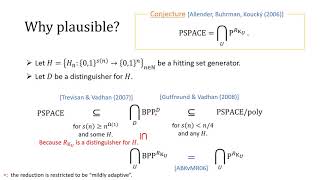
Unexpected Hardness Results for Kolmogorov Complexity Under Uniform Reductions
Explore unexpected findings on Kolmogorov complexity, including hardness results, limits, conjectures, and implications for pseudorandom generators and computational complexity.
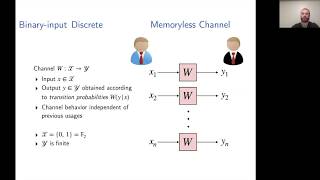
Arikan Meets Shannon - Polar Codes With Near-Optimal Convergence to Channel Capacity
Explore polar codes for efficient data transmission, examining their convergence to channel capacity and applications in binary-input discrete symmetric memoryless channels.

Computational Barriers in Statistical Estimation and Learning
Explore statistical estimation challenges, information theory, and computational barriers in high-dimensional settings with Stanford's Andrea Montanari in this Richard M. Karp Distinguished Lecture.

The Information Bottleneck Theory of Deep Neural Networks
Explore the Information Bottleneck Theory's application to deep neural networks, examining statistical learning, information theory, and stochastic gradient descent in brain data analysis.

Mathematical Theories of Communication - Old and New
Explore mathematical theories of communication, from Shannon's foundational work to modern interactive coding schemes and semantic communication, with applications to real-world scenarios.
Checksums and Hamming Distance - Error Detection in Data Transmission
Explore error detection codes, their effectiveness, and calculation methods. Learn about different checksum types and their ability to detect various errors in data transmission.
150 Years of Entropy by William Bialek
Explore the concept of entropy across physics, information theory, and technology with Princeton's William Bialek. Discover how this fundamental idea shapes our understanding of the universe and modern innovations.
Mathematics of Computation Through the Lens of Linear Equations and Lattices
Explore mathematical foundations of computation through linear equations and lattices, covering error correction, vector problems, and lattice theory with implications for future computing.
Oscillator-to-Oscillator Codes Do Not Have a Threshold
Explores limitations of oscillator-to-oscillator codes in quantum information, proving they lack a threshold property for error correction when using constant squeezing and maximum likelihood decoding.
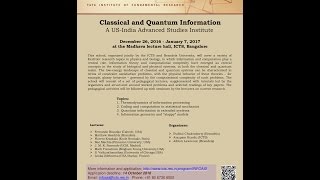
From Information Theory to Learning via Statistical Physics - Introduction
Explore connections between information theory, statistical physics, and learning. Delve into classical statistics, high-dimensional problems, and Bayesian approaches, with applications in signal processing and regression.

Topology of Surprisal - Information Theory and Vietoris-Rips Filtrations
Explore the fusion of information theory and Vietoris-Rips filtrations, focusing on Kullback-Leibler divergence and its applications in deep learning, with insights on overcoming non-symmetry challenges.
Information-Theoretic Foundations of Generative Adversarial Models
Explore information-theoretic methods for trustworthy machine learning, focusing on generative adversarial models and their foundations for enhanced reliability and performance.
Generalization Bounds for Neural Network Based Decoders
Explore generalization bounds for neural network decoders, examining their implications for information-theoretic approaches in trustworthy machine learning.
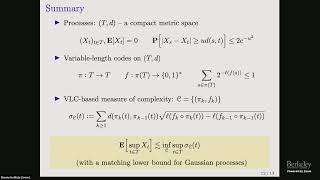
Majorizing Measures, Codes, and Information
Explore the connections between majorizing measures, coding theory, and information theory in machine learning, with insights from Maxim Raginsky.
A -Con-Sequential View of Information for Statistical Learning and Optimization
Explore information-theoretic approaches to statistical learning and optimization, focusing on sequential methods for improved trustworthiness in machine learning.