Integration of Monogenic and Common Variants in Human Disease - CGSI 2022
Explore the integration of monogenic and common variants in human disease, focusing on complex traits, congenital heart defects, and the challenges of phenotyping rare diseases.
Recent Progress Towards Petabase-Scale Genomics
Explore recent advancements in petabase-scale genomics, focusing on efficient whole-genome assembly techniques and large-scale sequence alignment for viral discovery.

Sardinia Population History and Complex Trait Variation - CGSI 2022
Explore Sardinia's unique genetic history and its impact on complex trait variation, uncovering insights into population dynamics, selection, and disease risk.
Living in the Future of Genomics
Explore cutting-edge genomics research and its future implications with insights from Rayan Chikhi at the Computational Genomics Summer Institute.
Computational Biomedicine: Epigenetics, Liquid Biopsy, and Alternative Polyadenylation Therapy
Explore computational biomedicine, focusing on epigenetics, liquid biopsy, and alternative polyadenylation therapy. Gain insights into cutting-edge research and applications in genomics and cancer detection.
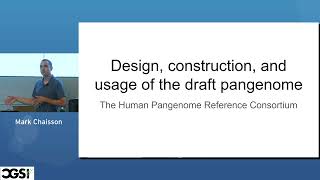
Design, Construction, and Usage of the Draft Pangenome - CGSI 2023
Explore the design, construction, and application of draft pangenomes in genomics. Learn about structural variations, gene expression impacts, and efficient genotyping techniques using cutting-edge pangenome approaches.
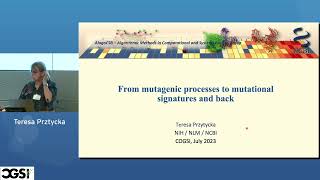
From Mutagenic Processes to Mutational Signatures and Back
Explore mutagenic processes and mutational signatures in cancer genomics. Uncover DNA repair contributions, influence networks, and novel approaches to understanding cancer mutational landscapes.
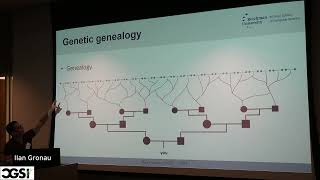
Generating Realistic Chromosome-Scale Simulations for Population Genomics Studies
Explore realistic chromosome-scale simulations for population genomics using advanced tools and techniques. Learn to generate accurate models for genetic studies and research.
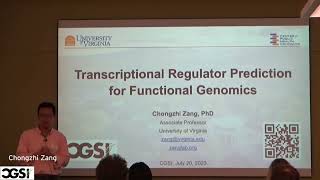
BART: A Transcriptional Regulator Prediction Method for Functional Genomics
Explore BART, a powerful method for predicting transcriptional regulators in functional genomics. Learn its applications, underlying algorithms, and impact on gene regulation research.

SwabSeq: Sequencing-based Detection of Pathogens - CGSI 2023
Explore SwabSeq, a sequencing-based method for detecting pathogens like SARS-CoV-2. Learn about its high-throughput capabilities, lean principles for quality improvement, and applications in COVID-19 testing.
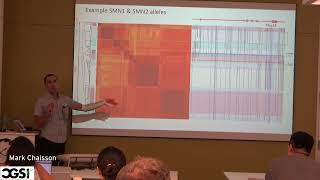
Genotyping Allele-Specific Copy Number Variants Using Pangenomes
Explore allele-specific copy number variant genotyping using pangenomes. Learn advanced techniques for analyzing complex genomic variations in human populations.
Computational Methods for Modeling and Analyzing Epigenomic Data - CGSI 2023
Explore computational methods for modeling and analyzing epigenomic data, focusing on chromatin state discovery, genome annotation, and cross-species conservation in functional genomics.
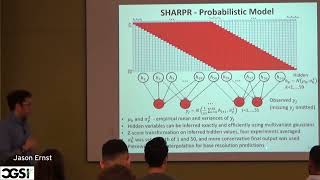
Leveraging High-throughput Functional Characterization Data to Dissect and Annotate Human Regulatory Regions
Explore high-throughput functional characterization techniques for dissecting and annotating human regulatory regions, leveraging advanced genomic mapping and integrative epigenomic approaches.
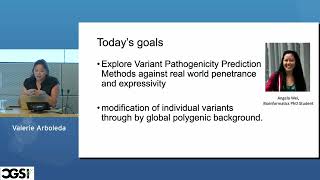
Biobanks from a Pathologist's Viewpoint - CGSI 2023
Explore biobanks from a pathologist's perspective, focusing on genetic disorders, variant classification, and the interplay between monogenic and polygenic factors in disease expression.

Geometric Deep Learning Framework for De Novo Genome Assembly
Explore a novel geometric deep learning framework for de novo genome assembly, enhancing path identification in complex assembly graphs for improved genomic sequence reconstruction.
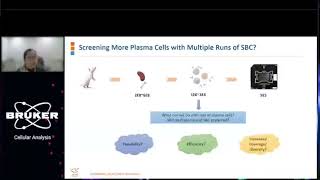
Full Human Antibody Discovery with Beacon and Harbour Mice
Explore advanced human antibody discovery techniques using Beacon system and Harbour Mice® technology. Learn about single B cell cloning, NGS integration, and in-chip assays for efficient screening and diverse antibody development.
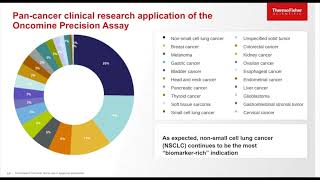
Oncomine Precision Assay on the Genexus System - Next-Generation Sequencing Workflow Automation
Explore next-generation sequencing with the Ion Torrent Genexus System and Oncomine Precision Assay. Learn about automated specimen-to-report workflow, performance, and data analysis in molecular testing labs.
The Algorithm for Precision Medicine
Explore the intersection of algorithms and precision medicine, uncovering innovative approaches to personalized healthcare and treatment strategies.
Strange Loops: Journeys in Declarative Logic Programming in Genomics and Beyond
Explore declarative logic programming applications in genomics and other fields through Christopher Mungall's insightful journey and discoveries.

Predicting Single-Cell Perturbation Responses for Unseen Drugs
Explore single-cell perturbation response prediction for novel drugs using an encoder-decoder architecture and transfer learning, enhancing drug discovery efficiency through in-silico hypothesis generation.
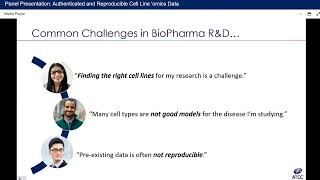
Authenticated and Reproducible Cell Line 'omics Data
Explore ATCC Cell Line Land for authenticated genomic profiles of cell lines. Access standardized 'omics data to enhance preclinical experiment planning and design. Learn about data curation, provenance, and practical applications.