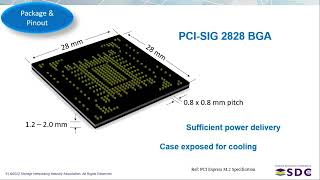
Automotive SSD Specification Update - Next Generation Vehicle Storage Solutions
Discover how next-gen automobiles leverage PCIe communications and JEDEC Automotive SSD solutions for enhanced vehicle control, sensors, communications, entertainment, and AI functionality.
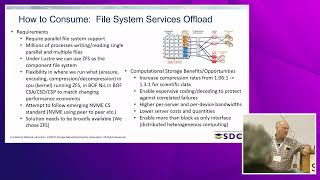
HPC Scientific Simulation and Computational Storage for Large-Scale Data Management
Explore how Los Alamos revolutionizes scientific data management using NVME Computational Storage, featuring proof-of-concept applications and industry partnerships for large-scale data solutions.

Storage Virtualization and Hardware-agnostic Acceleration Using IPDK and xPU
Discover how IPDK enables vendor-agnostic storage virtualization and hardware acceleration, allowing standard drivers to access remote storage at scale while leveraging SmartNIC/DPU/IPU/xPU capabilities.
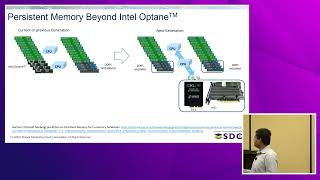
Future of Persistent Memory Form Factors and Architectures with CXL
Explore the convergence of storage and memory technologies through CXL protocols, focusing on form factors, management interfaces, and the future of persistent memory architectures.

Disaggregated NVMe/TCP Storage Using an Infrastructure Processing Unit (IPU)
Explore end-to-end Software Defined Storage solutions using Infrastructure Processing Units, focusing on NVMe/TCP integration, Kubernetes CSI plugins, and orchestration frameworks for cloud data centers.
Introducing CXL 3.0 - Expanded Capabilities for Scale and Resource Optimization
Explore the next-gen CXL 3.0 technology's enhanced capabilities, including doubled bandwidth, improved memory pooling, multi-level switching, and advanced coherency features for high-performance computing workloads.

NVMe/FC and NVMe/TCP: An In-depth Packet and Flow Level Comparison
Dive into a comprehensive comparison of NVMe/FC and NVMe/TCP protocols, exploring packet-level details, network configurations, and practical implementation strategies for optimal datacenter fabric design.

Optimal Performance Parameters for NVMe SSDs - Understanding Configuration and Host Usage
Delve into optimal performance parameters for NVMe SSDs, covering NAND attributes, controller settings, and host software optimization techniques for enhanced storage performance.
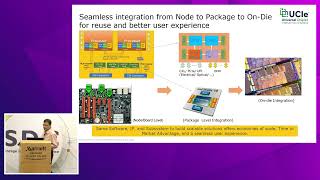
Universal Chiplet Interconnect Express (UCIe): Accelerating the Future of Semiconductor Innovations
Explore the Universal Chiplet Interconnect Express (UCIe) specification and its role in enabling modular semiconductor design through standardized chiplet connectivity and integration for next-gen computing systems.
Custom Chips Needed for Efficient High-Performance Computing
Explore the future of computing power through custom hardware solutions, from manycore systems to silicon development, addressing latency and energy efficiency challenges in high-performance computing.

Being Friendly to Your Computer Hardware in Software Development
Discover how software engineering practices can better align with modern hardware architectures, optimizing performance through hardware-aware development approaches and practical implementation strategies.

Advanced Color Management on Linux with AMD and Steam Deck
Dive into AMD display driver architecture and color management implementation for Linux systems, focusing on HDR capabilities and SteamOS integration for enhanced gaming experiences.
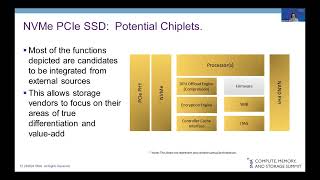
Enabling an Open Chiplet Ecosystem with UCIe - Introduction to UCIe 1.1 Specification
Explore the UCIe 1.1 specification's features and discover how it enables interoperable chiplet integration through standardized die-to-die interconnects and protocols for package-level solutions.
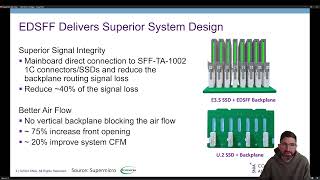
Latest Developments in SSD Form Factors and Data Center Optimization
Explore the evolution of SSD form factors and their impact on data center optimization, scalability, and TCO through SNIA's latest specifications and EDSFF-enabled platforms.
Deep Dive and Comparison of NVMe RAID Solutions - Performance Analysis and Datapath Breakdown
Dive into a comprehensive analysis of NVMe RAID engines, exploring performance characteristics, architectural differences, and optimization strategies across mdraid, xiraid, and SPDK RAID solutions.
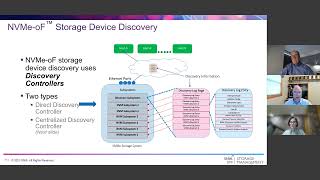
Managing NVMe and NVMe-oF Technology in Enterprise Storage with SNIA Swordfish
Discover how to effectively manage NVMe and NVMe-oF technologies in enterprise data centers using SNIA Swordfish specifications, with practical insights on discovery controllers and simplified management models.

New Developments in Cloud Storage Acceleration Layer - SPDK Integration and Use Cases
Explore the latest advancements in Cloud Storage Acceleration Layer (CSAL), including new use cases, SLC support, RAID5F integration, and development of an NVMe-oF TCP target reference solution.
PCIe 7.0 Specification - 128 GT/s Bandwidth for Future Data-Intensive Markets
Explore the next-generation PCIe 7.0 specification, featuring 128 GT/s transfer rates, PAM4 signaling, and enhanced power efficiency for advanced computing and data-intensive applications.

Emulation Framework for Computational Storage Using QEMU, SPDK, and Libvfio-user
Explore the development of computational storage emulation using QEMU, SPDK, and libvfio-user frameworks for testing and benchmarking storage-driven computational systems before production deployment.

Multi Queue Linux Block Device Drivers in Rust - Building Safe Kernel Drivers
Explore the implementation of Linux block device drivers using Rust, focusing on memory safety, performance optimization, and practical applications in NVMe and null_blk drivers.

NVMe Computational Storage Standards and Command Sets
Dive into NVMe architecture for computational storage, exploring command sets, subsystem local memory, and reachability architecture for enhanced storage device performance and functionality.