Coding Theory in Almost Linear Time and Sublinear Space
Explore efficient error-correcting codes with near-linear time and sub-linear space encoding/decoding algorithms. Learn about innovative techniques in hashing, locally correctable codes, and derandomization.
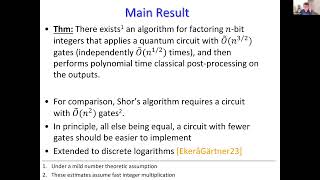
An Efficient Quantum Factoring Algorithm - Quantum Colloquium
Explore a groundbreaking quantum factoring algorithm that outperforms Shor's algorithm, using fewer quantum gates and classical post-processing to factorize large integers more efficiently.
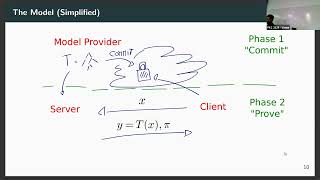
Zero Knowledge and Advanced Cryptography - Sessions from PKC 2024
Explore cutting-edge cryptography topics in Zero Knowledge and Advanced Crypto sessions from PKC 2024, featuring expert presentations on latest research and innovations.
Quantum Constraint Satisfaction - Richard M. Karp Distinguished Lecture
Explore quantum Hamiltonian complexity, comparing it to classical constraint satisfaction. Learn about QMA-completeness, search-to-decision, dichotomy theorems, and coping with QMA-hardness in quantum applications.
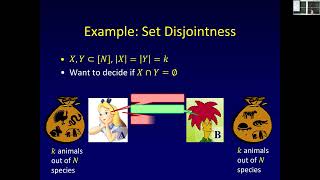
Communication and Information Complexity
Explore the intersection of communication and information complexity with Princeton's Mark Braverman, delving into cutting-edge research and theoretical advancements in this field.

The Complex(ity) Landscape of Checking Infinite Descent
Explore the complexity of checking Infinite Descent in cyclic proof systems, examining various criteria and their parameterized time complexities to improve automatic verification techniques.
New Directions in Property Testing
Explore recent advancements in property testing algorithms, including new problems and frameworks connected to machine learning theory and high-dimensional data analysis.
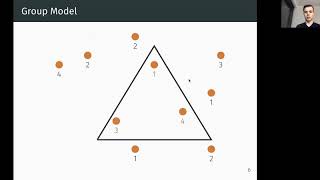
Polynomial Data Structure Lower Bounds in the Group Model
Explore polynomial data structure lower bounds in the group model, covering static structures, lower bounds, models, and efficiency concepts. Insights on k-wise independence and derandomization.
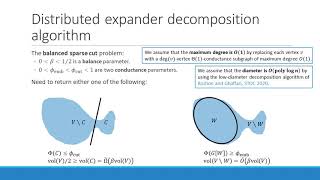
Deterministic Distributed Expander Decomposition Routing with Applications in Distributed Derandomization
Explore deterministic distributed algorithms for expander decompositions and routing, with applications in derandomization. Learn about balanced sparse cut algorithms and recursive techniques.
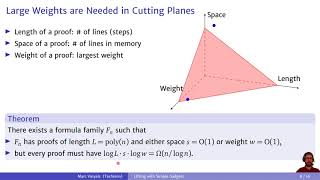
Lifting with Simple Gadgets and Applications to Circuit and Proof Complexity
Explore lifting techniques in circuit and proof complexity, focusing on Cutting Planes measures, communication complexity, and applications to monotone circuits and formulas.
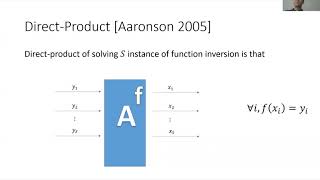
Tight Quantum Time-Space Tradeoffs for Function Inversion
Explore quantum time-space tradeoffs for function inversion, examining classical tradeoffs, circuit complexity, and a generic framework. Delve into proof overviews and multi-instance gains.
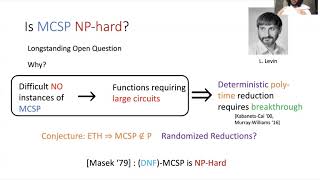
The Constant Depth Formula and Partial Function Versions of MCSP are Hard
Explore the complexity of MCSP variants, including partial function and constant depth formula versions, and their implications for circuit lower bounds and computational hardness.
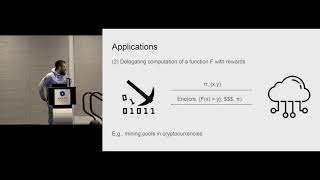
Laconic Conditional Disclosure of Secrets and Applications
Explore innovative cryptographic techniques for secure information sharing, including probabilistically checkable proofs and garbled circuits, with applications in malicious laconic oblivious transfer.
Optimizing Semi-Honest Secure Multiparty Computation for the Internet
Optimizing secure multiparty computation for internet use, focusing on efficiency improvements in BMR protocol and OT-based methods for honest-minority settings.
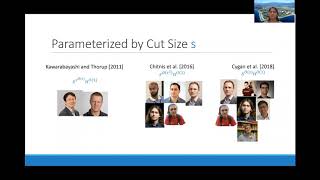
A Parameterized Approximation Scheme for Min k-Cut
Explore a parameterized approximation scheme for the Min k-Cut problem, covering algorithms, research directions, and proof ingredients like tree decomposition and polynomial time analysis.
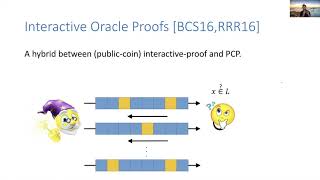
Local Proofs Approaching the Witness Length
Explore probabilistically checkable proofs, interactive oracle proofs, and tensor codes in this talk on local proofs and witness length optimization.
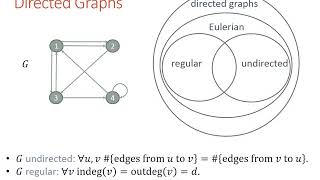
High-Precision Estimation of Random Walks in Small Space
Explore advanced techniques for estimating random walks in limited space, covering pseudorandom generators, graph algorithms, and Laplacian systems for efficient problem-solving.
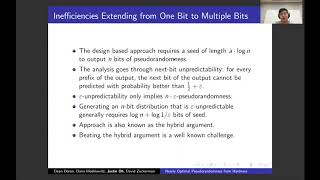
Nearly Optimal Pseudorandomness From Hardness
Explore cutting-edge pseudorandomness techniques derived from computational hardness, focusing on novel approaches using codes with large alphabets and pseudoentropy extraction.
A Note on Perfect Correctness by Derandomization
Explore derandomization techniques for achieving perfect correctness in cryptographic schemes, focusing on public-key encryption and the concept of cryptographic strings.
Parameterized Complexity of Weighted Local Hamiltonian Problems and the Quantum Exponential Time Hypothesis
Delve into parameterized complexity of weighted local Hamiltonian problems, exploring quantum states, Hamming weight constraints, and their implications for quantum computational theory.
Quantum Mass Production Theorems - Implementing Multiple Copies of Quantum Circuits
Delve into quantum circuit optimization through mass production theorems, exploring efficient implementations of multiple copies of quantum transformations and their theoretical implications.