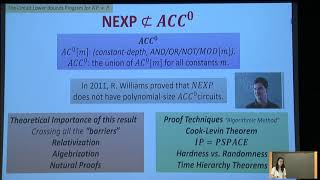
Strong Average-Case Circuit Lower Bounds from Non-trivial Derandomization - Lijie Chen
Explore advanced topics in computational complexity, including circuit lower bounds, derandomization, and their connections. Gain insights into cutting-edge research and theoretical developments in computer science.
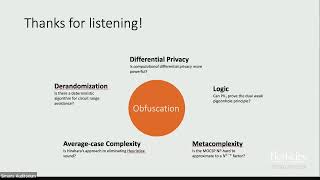
Tales of Obfuscation in Bounded Arithmetic, Metacomplexity, and Differential Privacy
Explores obfuscation's role in theoretical computer science, covering Circuit Range Avoidance, metacomplexity of Kolmogorov complexity, and computational differential privacy, with focus on recent results and open questions.
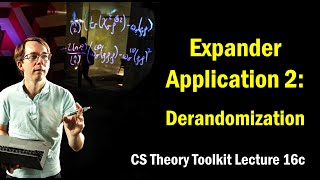
Expander Graph Application 2: Derandomization - Lecture 16c of CS Theory Toolkit
Explore derandomization techniques using expander graphs to reduce error in randomized algorithms without significantly increasing random bits used.
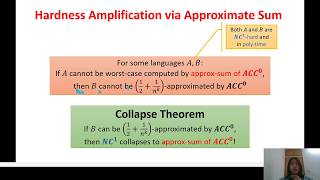
Strong Average-Case Circuit Lower Bounds from Non-trivial Derandomization
Explore circuit lower bounds and derandomization, focusing on AC circuits, algorithmic methods, and pseudorandom generators. Learn about recent developments in average-case circuit analysis.
Derandomization: A Quick Tutorial
Explore efficient methods for transforming interactive protocols into NP-type verifiers, using targeted pseudorandom generators and complexity-theoretic assumptions.
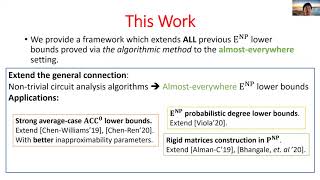
Almost-Everywhere Circuit Lower Bounds from Non-Trivial Derandomization
Explore groundbreaking research on circuit complexity theory, focusing on the connection between derandomization techniques and establishing lower bounds for circuit sizes across various computational models.
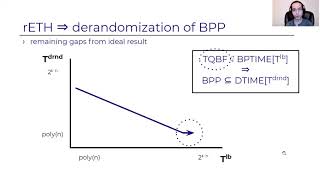
On Exponential-Time Hypotheses, Derandomization, and Circuit Lower Bounds
Explore connections between computational complexity theories, focusing on exponential-time hypotheses, derandomization techniques, and circuit lower bounds in theoretical computer science.
Coding Theory in Almost Linear Time and Sublinear Space
Explore efficient error-correcting codes with near-linear time and sub-linear space encoding/decoding algorithms. Learn about innovative techniques in hashing, locally correctable codes, and derandomization.
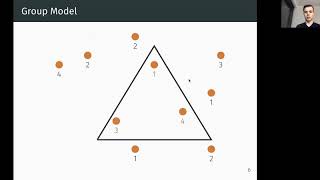
Polynomial Data Structure Lower Bounds in the Group Model
Explore polynomial data structure lower bounds in the group model, covering static structures, lower bounds, models, and efficiency concepts. Insights on k-wise independence and derandomization.
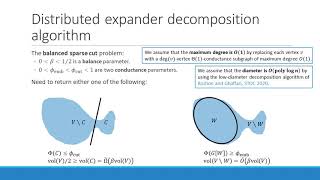
Deterministic Distributed Expander Decomposition Routing with Applications in Distributed Derandomization
Explore deterministic distributed algorithms for expander decompositions and routing, with applications in derandomization. Learn about balanced sparse cut algorithms and recursive techniques.
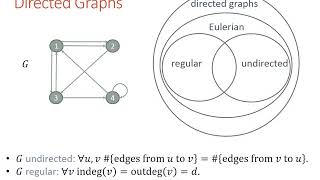
High-Precision Estimation of Random Walks in Small Space
Explore advanced techniques for estimating random walks in limited space, covering pseudorandom generators, graph algorithms, and Laplacian systems for efficient problem-solving.
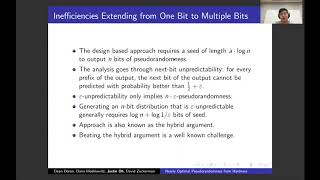
Nearly Optimal Pseudorandomness From Hardness
Explore cutting-edge pseudorandomness techniques derived from computational hardness, focusing on novel approaches using codes with large alphabets and pseudoentropy extraction.
A Note on Perfect Correctness by Derandomization
Explore derandomization techniques for achieving perfect correctness in cryptographic schemes, focusing on public-key encryption and the concept of cryptographic strings.
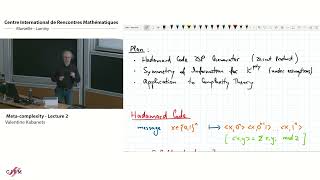
Derandomization and Meta-complexity - Part 2
Explore meta-complexity in derandomization through an advanced tutorial. Delve into cutting-edge mathematical concepts and their applications in randomness and complexity theory.
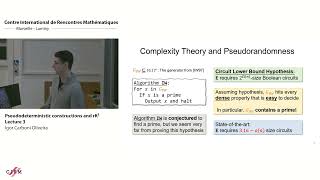
Pseudodeterministic Constructions and rK^t - Tutorial 3
Explore pseudodeterministic constructions and rK^t in this advanced mathematics tutorial by Igor Carboni Oliveira, delving into randomness, information, and complexity theory.
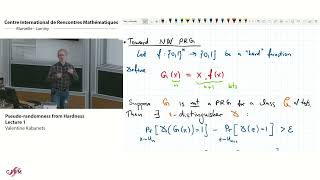
Derandomization: Pseudo-randomness from Hardness - Part 1
Explore pseudo-randomness from hardness in derandomization with Valentine Kabanets. Gain insights into this mathematical concept through a comprehensive tutorial.
Concentration on HDX: Derandomization Beyond Chernoff - Lecture
Explore advanced derandomization techniques beyond Chernoff's bound, focusing on high-dimensional expanders and their applications in theoretical computer science and complexity theory.