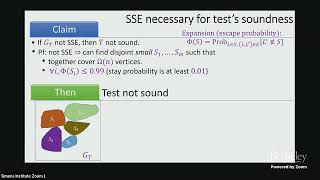
PCPs and Global Hyper-contractivity - Lecture 1
Explore advanced concepts in theoretical computer science, focusing on Probabilistically Checkable Proofs and global hyper-contractivity with expert Dor Minzer.
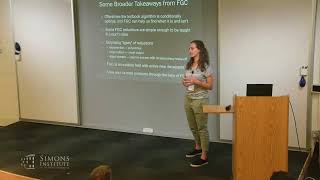
Fine-Grained Complexity 2 - Advanced Concepts and Applications
Explore advanced concepts in fine-grained complexity theory, focusing on algorithmic challenges and computational limits in database theory and AI applications.
Fine-Grained Complexity - Lecture 1
Explore cutting-edge research in fine-grained complexity theory with MIT expert Virginia Vassilevska Williams, delving into advanced algorithmic concepts and their applications.
Logic and Probabilistic Circuits - Lecture 4
Explore advanced concepts in logic and probabilistic circuits, focusing on their applications in database theory and artificial intelligence.
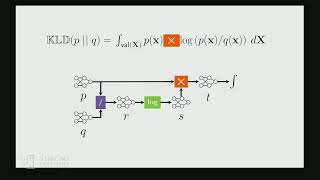
Logic and Probabilistic Circuits - Part 3
Explore advanced concepts in logic and probabilistic circuits, focusing on their applications in database theory and AI algorithms.
Fine-Grained Complexity - Lecture 4
Explore advanced concepts in fine-grained complexity theory, focusing on algorithmic challenges and their implications for database theory and AI applications.
Fine-Grained Complexity 3 - Logic and Algorithms in Database Theory and AI
Explore advanced concepts in fine-grained complexity theory, focusing on algorithmic challenges and their implications for database theory and AI.
Top-Down Lower Bounds for Depth-Four Circuits
Explores new proof techniques for depth-4 boolean circuit complexity, applying robust sunflowers and block unpredictability to demonstrate exponential lower bounds for the parity function.
Fully Linear PCPs and Their Cryptographic Applications
Explore probabilistically checkable proofs, distributed verifiers, and cryptographic applications with a focus on fully linear PCPs and their impact on secure protocols and communication complexity.

How to Do Fiat-Shamir in the Standard Model
Explore interactive protocols, Fiat-Shamir transformation, and delegation in cryptography. Learn about security assumptions, hash functions, and correlation intractability in probabilistic proof systems.
How to Delegate Computations Publicly
Explore probabilistically checkable and interactive proof systems, focusing on publicly verifiable arguments and non-interactive protocols for delegating computations.
Transparent SNARKs from DARK Compilers
Explore transparent SNARKs and DARK compilers in cryptography. Learn about polynomial commitments, interactive proof systems, and recent advancements in zero-knowledge proofs for blockchain applications.
Efficient Zero Knowledge Proof from Interactive Proofs
Explore efficient zero-knowledge proofs derived from interactive proofs, focusing on new algorithms, performance improvements, and comparisons to existing systems.
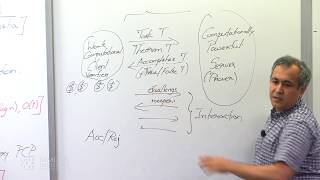
Probabilistically Checkable Proofs - Part I
Explore probabilistically checkable proofs, focusing on proof verification, randomized verifiers, and proof rewriting techniques in this advanced theoretical computer science lecture.
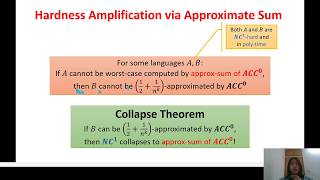
Strong Average-Case Circuit Lower Bounds from Non-trivial Derandomization
Explore circuit lower bounds and derandomization, focusing on AC circuits, algorithmic methods, and pseudorandom generators. Learn about recent developments in average-case circuit analysis.
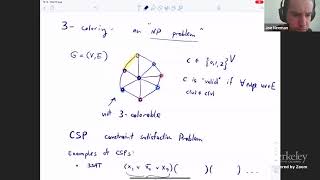
Crash Course on Probabilistically Checkable Proofs - Introduction
Explore probabilistically checkable proofs, including recoloring, constraint satisfaction, and the PCP theorem. Learn about verifier parameters and hardness of approximation in this comprehensive introduction.
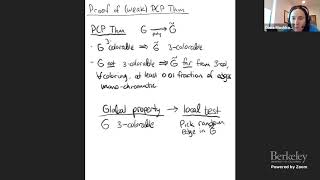
Crash Course on Probabilistically Checkable Proofs - PCP
Explore probabilistically checkable proofs, their formulation, global vs local tests, and computational implications in this comprehensive lecture on advanced theoretical computer science concepts.
Derandomization: A Quick Tutorial
Explore efficient methods for transforming interactive protocols into NP-type verifiers, using targeted pseudorandom generators and complexity-theoretic assumptions.
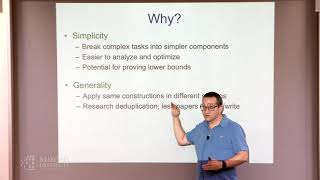
Efficient Zero-Knowledge Proofs: A Modular Approach
Explore modular techniques for creating efficient zero-knowledge proofs, focusing on probabilistically checkable and interactive proof systems in cryptography.
Recent Structure Lemmas for Depth-Two Threshold Circuits
Explore recent advancements in structure lemmas for depth-two threshold circuits, focusing on Boolean devices and their implications in computational complexity theory.
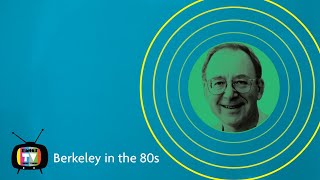
Berkeley in the 80s - Richard Karp and the Theory of Computing
In-depth interview with Turing Laureate Richard Karp, exploring his groundbreaking research on computational theory at Berkeley in the 1980s and its lasting impact on computer science.