Introduction to Parameterized Algorithms, Lecture I
Gentle introduction to parameterized complexity, focusing on basic techniques like branching, color coding, and kernelization. Explores connections to linear programming and discrete optimization.
Recent Hardness of Approximation Results in Parameterized Complexity
Survey of recent hardness of approximation results in parameterized complexity, focusing on k-clique problem inapproximability, with technical insights and open problems discussion.
Parametrized Algorithms and Possible Future Directions
Explore current research and future directions in Parameterized Complexity, focusing on algorithmic approaches and potential areas for further investigation.
Michal Pilipczuk: Introduction to Parameterized Algorithms, Lecture II
Explore parameterized complexity, focusing on LP-related methods. Learn branching, color coding, kernelization, and dynamic programming techniques for algorithm design and optimization.
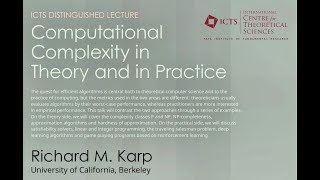
Computational Complexity in Theory and in Practice by Richard M. Karp
Explore the contrast between theoretical and practical approaches to algorithm efficiency, covering complexity classes, NP-completeness, approximation algorithms, and real-world applications.
Undergrad Complexity at CMU - Oracle Turing Machines and P^NP
Explore oracle Turing machines and P^NP in computational complexity theory, focusing on solving algorithms, consequences, and the Minimum Circuit Problem.
Undergrad Complexity at CMU - BPP
Explore probabilistic algorithms and complexity class BPP in this advanced lecture on computational theory, featuring axis property amplification and upper bounds.
Undergrad Complexity at CMU - Randomized Complexity- RP, coRP, and ZPP
Explore randomized complexity classes RP, coRP, and ZPP, covering probabilistic Turing machines, error amplification, and nondeterminism in computational complexity theory.
Undergrad Complexity at CMU - The Immerman-Szelepcsényi Theorem
Explore the Immerman--Szelepcsényi Theorem in computational complexity theory, covering key concepts, proofs, and implications for nondeterministic space complexity classes.
Undergrad Complexity at CMU - From P-Completeness to PSPACE-Completeness
Explore P-completeness, reductions, and PSPACE-completeness in computational complexity theory, covering key concepts like the Cook-Levin Theorem and TQBF.
Undergrad Complexity at CMU - Savitch's Theorem and NL
Explore Savitch's Theorem and NL in computational complexity theory, focusing on space complexity, recursion, and pseudocode implementation for advanced undergraduate-level understanding.
Undergrad Complexity at CMU - NP
Explore NP complexity, verification, and key features in computational theory. Delve into stronger conjectures, brute force algorithms, and proofs for squares and colors.
Undergrad Complexity at CMU - SAT
Explore the intricacies of SAT in computational complexity theory, covering Boolean circuits, algorithms, and CNF formulas in this comprehensive undergraduate lecture.
Undergrad Complexity at CMU - Problems in P
Explore computational complexity theory, focusing on problems in P, simulations, and Turing machine variants. Learn about time hierarchy, natural problems, and efficient algorithms.
Undergrad Complexity at CMU - Turing Machines
Explore Turing Machines in computational complexity theory, covering formalization, the Turing Thesis, examples, and mathematical definitions for a comprehensive understanding.
Quantum Complexity - Quantum Computation at CMU
Explore quantum complexity, error probabilities, and complexity classes in this advanced lecture on quantum computation and information theory.
Razborov-Smolensky Lower Bounds for AC0[p] - Graduate Complexity Lecture at CMU
Explore Razborov-Smolensky lower bounds for AC0[p] circuits, covering key theorems, gate replacements, and error bounds in computational complexity theory.
Permanent is #P-Complete: Graduate Complexity Lecture at CMU
Explore the #P-completeness of the Permanent problem in this advanced computational complexity theory lecture, covering key concepts and reduction techniques.
The Switching Lemma - PRST Version - Graduate Complexity Lecture at CMU
Explore the Switching Lemma in computational complexity theory, focusing on the PRST version and its proof, with insights on decision trees and probability bounds.
IP = PSPACE - Graduate Complexity Lecture at CMU
Explore interactive proof systems and their relationship to complexity classes, focusing on the IP = PSPACE theorem and its implications for computational theory.
Approximate Counting - Graduate Complexity Lecture at CMU
Explore advanced computational complexity theory, focusing on approximate counting techniques, Chebyshev's Inequality, and interactive proofs in this graduate-level lecture.