More on Constant-Round Interactive Proof Systems - Graduate Complexity Lecture at CMU
Explore constant-round interactive proof systems in computational complexity theory, covering MA, AM, BPP, and efficient error reduction techniques.
Time-Space Tradeoffs for SAT - Graduate Complexity Lecture at CMU
Explore time/space tradeoffs for SAT in this graduate-level complexity theory lecture, covering key results, proofs, and techniques like padding and alternation elimination.
The Polynomial Time Hierarchy: Graduate Complexity Lecture at CMU
Explore the Polynomial Time Hierarchy in computational complexity theory, covering definitions, examples, and key concepts like quantifying over circuits and alternation.
Hierarchy Theorems - Time, Space, and Nondeterministic: Graduate Complexity Lecture at CMU
Explore hierarchy theorems in computational complexity, covering time, space, and nondeterministic aspects. Gain insights into encoding schemes, Turing machines, and nondeterministic certificates.
Hopcroft-Paul-Valiant Theorem - Graduate Complexity Lecture at CMU
Explore the Hopcroft-Paul-Valiant theorem in computational complexity, covering simulation, graph analysis, and pebble games. Gain insights into low space simulation and depth reduction techniques.
Circuits - Graduate Complexity Lecture 4 at CMU
Explore graduate-level computational complexity theory, focusing on circuits, complexity measures, and lower bounds in this advanced lecture from Carnegie Mellon University.
Undergrad Complexity at CMU - Why is P vs. NP Difficult?
Explore the challenges of the P vs. NP problem in computational complexity theory, including negative results, Ladner's theorem, and simulations.
Undergrad Complexity at CMU - Hardness within P
Explore computational complexity theory, focusing on hardness within P, time hierarchy theorem, and fine-grained complexity. Delve into reductions, algorithms, and open questions in this advanced undergraduate lecture.
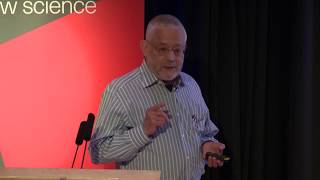
Alan Turing and the Other Theory of Computing and Can a Machine Be Conscious?
Explore neuroscience advances in understanding consciousness, including the Global Workspace Model and its computational implications, with insights on free will and determinism.
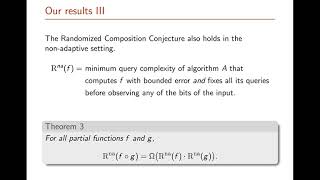
A Tight Composition Theorem for the Randomized Query Complexity of Partial Functions
Explore the randomized query complexity of partial functions and its tight composition theorem, advancing understanding in computational complexity theory.
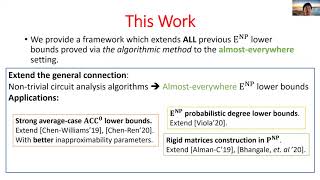
Almost-Everywhere Circuit Lower Bounds from Non-Trivial Derandomization
Explore groundbreaking research on circuit complexity theory, focusing on the connection between derandomization techniques and establishing lower bounds for circuit sizes across various computational models.
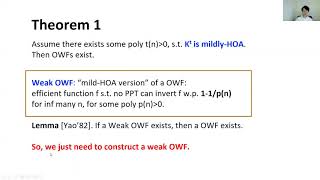
On One-way Functions and Kolmogorov Complexity
Explore the relationship between one-way functions and Kolmogorov complexity in this insightful IEEE talk by Cornell researchers Liu and Pass.
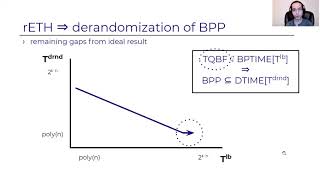
On Exponential-Time Hypotheses, Derandomization, and Circuit Lower Bounds
Explore connections between computational complexity theories, focusing on exponential-time hypotheses, derandomization techniques, and circuit lower bounds in theoretical computer science.
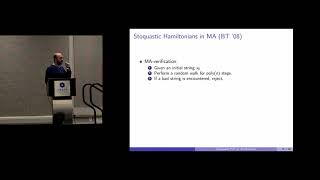
Stoquastic PCP vs. Randomness
Explore the intriguing relationship between stoquastic PCP and randomness in quantum computing, delving into cutting-edge research and its implications for complexity theory.
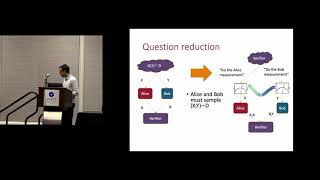
NEXP is Contained in MIP* - Complexity Theory Breakthrough
Explore groundbreaking results in computational complexity theory, examining the relationship between NEXP and MIP* with insights from experts Anand Natarajan and John Wright.
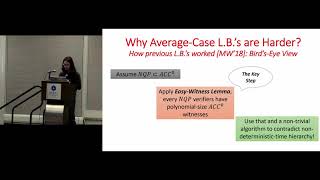
Non-deterministic Quasi-Polynomial Time is Average-case Hard for ACC Circuits
Explore the complexity theory concept of non-deterministic quasi-polynomial time and its average-case hardness for ACC circuits in this advanced computer science presentation.
Complexity Theory - Session 1A
Explore complexity theory in this IEEE conference session, delving into advanced concepts and recent developments in computational complexity.
ZK-PCPs from Leakage-Resilient Secret Sharing - 2021 ITC Conference
Explore cutting-edge cryptography research on ZK-PCPs derived from leakage-resilient secret sharing. Learn about innovative constructions combining the best aspects of zero-knowledge proofs and probabilistically checkable proofs.

Learning Shallow Quantum Circuits and Quantum States in Polynomial Time
Efficient algorithms for learning shallow quantum circuits and states, extending to polylog depth. Key techniques involve reconstructing low-complexity quantum systems from local observables.
Circuit Conspiracies - Verifiable NISQ Quantum Supremacy and AI Interpretability
Exploring quantum circuit properties and their implications for NISQ quantum supremacy, with connections to AI interpretability and neural networks.
Parameterized Inapproximability of the Minimum Distance Problem over All Fields
Explores inapproximability of Minimum Distance Problem for linear codes over finite fields, proving W[1]-hardness. Extends results to Shortest Vector Problem on integer lattices.