
Can an Algorithmic System Be a 'Friend' to a Police Officer's Discretion?
Explore the intersection of algorithmic systems and police discretion, examining challenges, legal frameworks, and real-world applications in domestic abuse risk assessment and decision-making.

The Algorithmic Leviathan - Arbitrariness, Unfairness, and Opportunity in Algorithmic Decision Making
Explore the ethical implications of algorithmic decision-making systems, focusing on arbitrariness, unfairness, and potential solutions in automated processes across various domains.

Sublinear Algorithms for Gap Edit Distance
Explore sublinear algorithms for efficiently computing gap edit distance, including dynamic programming, approximation techniques, and key theoretical results.
Efficient Construction of Rigid Matrices Using an NP Oracle
Explore matrix rigidity, its applications in communication complexity and circuit lower bounds, and innovative algorithmic approaches for constructing rigid matrices.
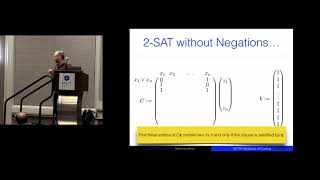
Hardness of Coding Problems
Explore SETH hardness in coding problems, focusing on linear codes, nearest codeword problem, and minimum distance problem. Learn about reductions and key concepts in computational complexity.
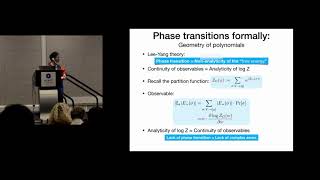
A Deterministic Algorithm for Counting Colorings with 2Δ Colors
Explore a deterministic algorithm for counting colorings, delving into phase transitions, partition functions, and entropy conditions in graph theory.
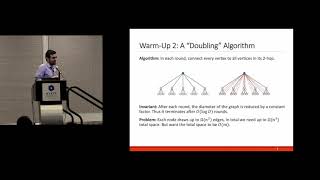
Near Optimal Massively Parallel Graph Connectivity
Explore efficient parallel algorithms for graph connectivity, focusing on near-optimal solutions and innovative techniques for large-scale graph processing.
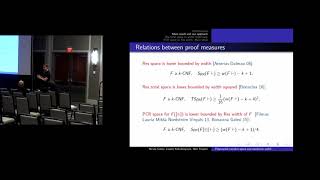
Polynomial Calculus Space and Resolution Width
Explore proof complexity, resolution systems, and space complexity in polynomial calculus, featuring combinatorial characterizations and discussions on total spaces and tight bounds.
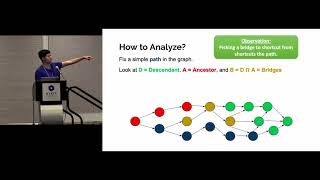
Parallel Reachability in Almost Linear Work and Square Root Depth
Explore efficient parallel algorithms for graph reachability, focusing on distributed computing and improved runtime complexity in large-scale networks.
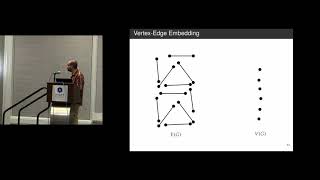
Inapproximability of Clustering in Lp Metrics
Explores computational complexity of clustering in Lp metrics, discussing approximation algorithms, hardness of approximation, and key concepts like Johnson Coverage Hypothesis.
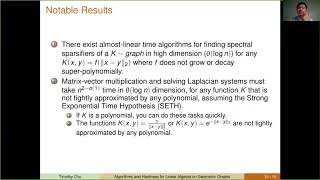
Algorithms and Hardness for Linear Algebra on Geometric Graphs
Explore algorithms and hardness for linear algebra on geometric graphs, focusing on K and K-graphs, sparsifiers, matrix-vector multiplication, and Hamming nearest neighbor problems.
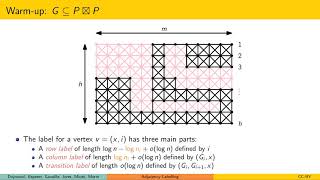
Adjacency Labelling for Planar Graphs - and Beyond
Explore adjacency labelling for planar graphs, covering universal graphs, labeling schemes, and the Strong Graph Product. Learn about binary search trees and their applications in graph theory.
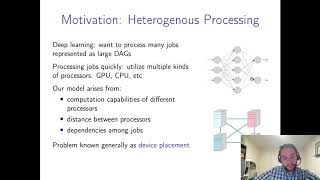
Scheduling Precedence-Constrained Jobs on Related Machines with Communication Delay
Explore efficient job scheduling on related machines, considering precedence constraints and communication delays. Learn about duplication strategies and algorithmic approaches for optimizing makespan.

Analysis of Two-variable Recurrence Relations with Application to Parameterized Approximations
Explore two-variable recurrence relations and their application to parameterized approximations, focusing on vertex cover problems and algorithmic techniques.
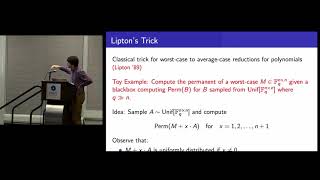
The Average-Case Complexity of Counting Cliques in Erdos-Renyi Hypergraphs
Explore average-case complexity of counting cliques in Erdos-Renyi hypergraphs, covering proof techniques, random KQ accounting, and binary expansions.
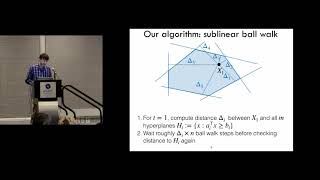
Faster Polytope Rounding, Sampling, and Volume Computation via a Sublinear Ball Walk
Explore advanced algorithms for efficient polytope analysis, including rounding, sampling, and volume computation using innovative Markov chain techniques.
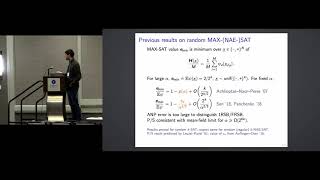
Breaking of 1RSB in Random MAX-NAE-SAT
Explore the intricacies of random MAX-NAE-SAT, focusing on 1RSB breaking, solution spaces, and key concepts like garnet transition and moment bounds.
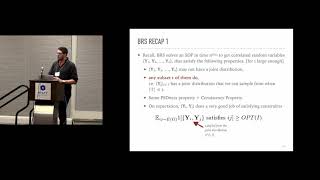
Approximating Constraint Satisfaction Problems on High Dimensional Expanders
Explore high-dimensional expanders and their role in approximating constraint satisfaction problems, with insights on natural collections and general expanders.
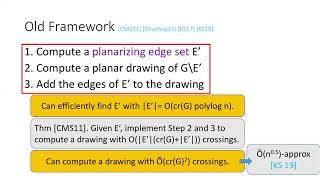
Towards Better Approximation of Graph Crossing Number
Explores advanced techniques for approximating graph crossing numbers, focusing on new frameworks and theorems for both general and bounded-degree graphs.
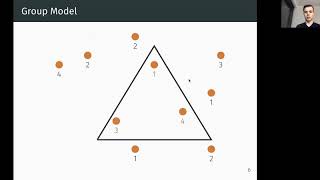
Polynomial Data Structure Lower Bounds in the Group Model
Explore polynomial data structure lower bounds in the group model, covering static structures, lower bounds, models, and efficiency concepts. Insights on k-wise independence and derandomization.
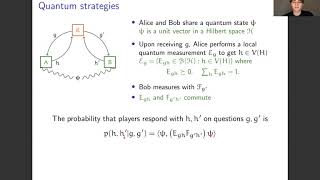
Quantum Isomorphism Is Equivalent to Equality of Homomorphism Counts from Planar Graphs
Explore quantum isomorphism and its equivalence to homomorphism counts from planar graphs, delving into quantum strategies, permutation matrices, and bilabel graphs.