Dijkstra's Algorithm - Finding Single Source Shortest Path
Explore Dijkstra's algorithm for finding the shortest path in graphs using the greedy method. Learn its implementation and applications in computer science.
Memory as a Lens to Understand Efficient Learning and Optimization
Exploring memory's role in optimization, discussing convergence rates of memory-limited algorithms vs. computationally expensive methods, and examining new problem structures to improve gradient descent variants.
Robust Learning of a Single Neuron - Bridging Computational Gaps Using Optimization
Explore robust learning of a single neuron with ReLU activation, focusing on optimization techniques to achieve near-optimal mean square loss in adversarial settings. Discover novel approaches for various activation functions.
Longest Common Subsequence Using Dynamic Programming - Design and Analysis of Algorithms
Explore dynamic programming to solve the Longest Common Subsequence problem efficiently. Learn step-by-step implementation and optimization techniques for this fundamental algorithm.

Sum of Subset Problem Using Backtracking - Design and Analysis of Algorithms
Explore the Sum of Subset problem using backtracking, with practical examples. Learn efficient algorithm design and analysis techniques for solving complex computational challenges.
Locality in Codes and Computation
Exploring local algorithms in error-correcting codes and their impact on computational theory, from error detection to cryptocurrency applications. Challenges and future directions discussed.
DMaps for Delightful Dynamism - Enhancing Functional Programming
Explore DMaps for enhancing dynamism in programming. Learn innovative techniques to create flexible and adaptable code structures, improving software design and functionality.
Sublinear Time Algorithms for Estimating Edit Distance
Explore efficient methods for approximating edit distance between strings, focusing on sublinear time algorithms and their applications in computational biology and text processing.
New Advances on Multi-Pass Graph Streaming Lower Bounds
Explore cutting-edge developments in multi-pass graph streaming lower bounds, focusing on sublinear algorithms and their applications in data analysis and network theory.
Coresets and Their Applications to Design Sublinear Algorithms
Explore coresets and their role in designing efficient sublinear algorithms, enhancing computational performance for large-scale data analysis and machine learning tasks.
Adversarially Robust Streaming Algorithms
Explore techniques for designing streaming algorithms that maintain accuracy under adversarial data manipulation, enhancing resilience in data processing systems.
An Overview of Data Streams Algorithms
Explore efficient algorithms for processing massive data streams, focusing on space-saving techniques and approximation methods for real-time analysis and decision-making.
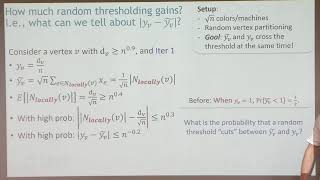
Graph Algorithms in the Massively Parallel Computation Model
Explore efficient graph algorithms in the Massively Parallel Computation model, focusing on techniques for near-linear memory regime and comparing MPC to other distributed/parallel models.
Conditional Hardness for Massively Parallel Computing Via Distributed Lower Bounds
Explore conditional hardness in massively parallel computing through distributed lower bounds, examining theoretical challenges and algorithmic implications for sublinear algorithms.
An Introduction to Distributed, Massively Parallel, and Local Computation Algorithms
Explore distributed, massively parallel, and local computation algorithms, focusing on their applications, challenges, and recent advancements in sublinear algorithmic techniques.
Testing Boolean Functions
Explore efficient algorithms for testing Boolean function properties, covering definitions, variants, and key analyses in sublinear complexity.
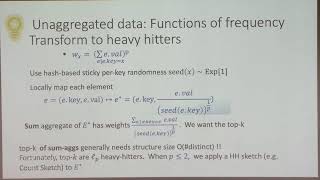
Sampling Big Ideas in Sublinear Algorithms
Explore random sampling techniques for enhancing data analysis scalability, focusing on weighted and coordinated sampling schemes for streamed or distributed data.

Beyond Moments - Robust Certificates for Affine Transformations
Explores algorithm for recovering affine transformations from corrupted samples, presenting robust certificates and highlighting limitations of moment-based methods in robust statistics.
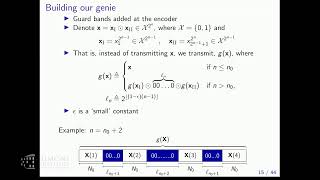
Polar Codes for IDS Channels
Explore polar codes for IDS channels, addressing numerical instability, partial stragglers, and worker computation time in sparse matrix scenarios. Learn recent contributions to overcome these challenges.
Dynamic Denoising for AMP Applied to Sparse Regression Inner Codes with Outer Codes
Explores dynamic denoising in AMP for sparse regression codes with outer codes, discussing performance improvements, state evolution approximations, and extensions to multi-user scenarios and multiple measurement vectors.
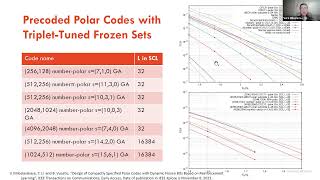
Precoded Polar Codes With High Error-Correction Capability
Explore recent advancements in precoded polar codes, focusing on low-complexity design, high error-correction capability, and efficient decoding for improved communication systems.