Non Linear Data Structures - Complete Non Linear Data Structures - Data Structures Part-2
Comprehensive exploration of non-linear data structures, covering trees and graphs. Learn terminology, representations, traversals, and algorithms for binary trees, BSTs, AVL trees, and graph operations.

Stacks & Queues Interview Questions - Google, Facebook, Amazon, Microsoft
Comprehensive guide to solving stack and queue interview questions from top tech companies, with step-by-step explanations and code walkthroughs for various difficulty levels.

Rotations in AVL Trees - Data Structures
Learn about the four rotations in AVL trees for balancing nodes during insertion and deletion operations, including LL, RR, LR, and RL rotations.

Tree Terminology - Data Structures
Explore essential tree data structure concepts, including roots, nodes, edges, and relationships, to build a strong foundation for advanced programming and algorithm design.

Shell Sort with Example
Learn the Shell Sort algorithm through examples, understanding its unique approach of sorting elements based on their distance for improved efficiency.
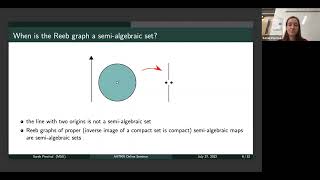
Computation of Reeb Graphs in a Semi-Algebraic Setting
Explore semi-algebraic geometry in applied topology, focusing on Reeb graphs and spaces. Learn about an efficient algorithm for computing semi-algebraic descriptions of Reeb graphs.
Constraint Satisfaction Problem - What Makes the Problem Easy
Explore constraint satisfaction problems, their complexity, and variants. Learn about polynomial-time solvable cases and NP-complete instances in this mathematical deep dive.
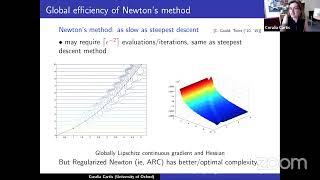
Evaluation Complexity of Algorithms for Nonconvex Optimization
Overview of global convergence rates and evaluation complexity for nonconvex smooth optimization methods, comparing steepest descent and Newton's method, and exploring benefits of higher-order regularization algorithms.
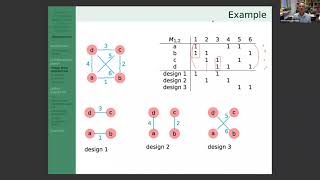
Search for Combinatorial Objects Using Lattice Algorithms - Revisited
Explore advanced lattice algorithms for efficient combinatorial object searches, enhancing problem-solving techniques in discrete mathematics and computational geometry.
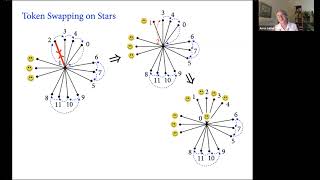
Token Swapping
Explore token swapping algorithms and their applications in graph theory with insights from Anna Lubiw of the University of Waterloo.
Selection Sort with Example
Learn the Selection Sort algorithm through a detailed example, understanding its implementation and efficiency for sorting data structures.
NP-Hardness of Approximating Meta-Complexity: A Cryptographic Approach
Explores NP-hardness of approximating meta-complexity using cryptographic constructions, focusing on near-optimal results for Minimum Oracle Circuit Size Problem and its implications.
Derandomization: A Quick Tutorial
Explore efficient methods for transforming interactive protocols into NP-type verifiers, using targeted pseudorandom generators and complexity-theoretic assumptions.
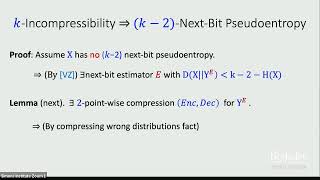
Incompressibility and Next-Block Pseudoentropy
Explores the relationship between incompressible distributions and next-block pseudoentropy, advancing understanding of computational entropy and its implications for cryptographic hardness assumptions.
Constant-Round Arguments from One-Way Functions
Explore constant-round argument systems for log-space uniform circuits, achieving almost-linear verification time using only one-way functions, advancing cryptographic protocol efficiency.
Communication Complexity, Streaming and Computational Assumptions
Explore how computational limitations and cryptographic tools can bypass impossibility results in communication complexity and streaming, with examples and open problems discussed.
A Polynomial-Time Classical Algorithm for Noisy Random Circuit Sampling
Explores polynomial-time classical algorithm for noisy random circuit sampling, challenging quantum supremacy claims. Discusses computational complexity, experimental implications, and recent progress in quantum computing.
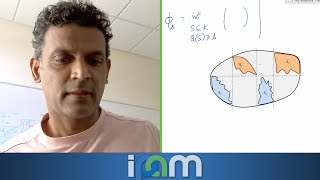
Gibbs Sampling for Convex Bodies and an L_0 Isoperimetric Inequality
Explore Gibbs sampling for high-dimensional distributions, focusing on convergence guarantees and conductance bounds for sampling from convex bodies. Gain insights into this widely-used algorithm's efficiency and limitations.
Reasoning Algorithmically- From Toy Experiments to AGI Modules
Explore neural networks' potential in algorithmic computation, from toy experiments to groundbreaking applications in mathematics and AI reasoning, with insights on their transformative impact on machine learning and computer science.
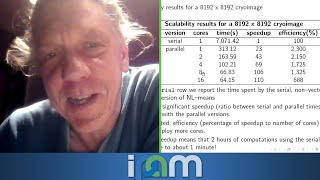
Algorithms for Non-Local Filtering - Application Cryo-Electron and Biological Microscopy
Efficient algorithms for non-local filtering in microscopy, focusing on fast implementations of Non-Local Means Denoising and feature detection in biological images for improved image processing and analysis.
Economic Fairness - IPAM at UCLA
Explore economic fairness concepts with Sendhil Mullainathan in this UCLA summer school lecture, covering key principles and their applications in algorithmic decision-making.