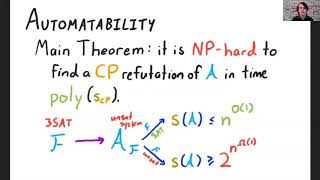
Automating Cutting Planes is NP-Hard
Explore the complexity of automating cutting planes in computational geometry, covering historical context, algorithmic challenges, and proof systems.
Rounding Dynamic Matchings Against an Adaptive Adversary
Explore dynamic matching algorithms against adaptive adversaries, covering sparsifiers, fractional matching, and edge coloring to improve computational efficiency in graph theory.
Quadratic Speedup for Finding Marked Vertices by Quantum Walks
Explore quantum walks for efficient vertex search, offering quadratic speedup over classical methods. Learn about structured search, constraints, and applications in quantum computing.
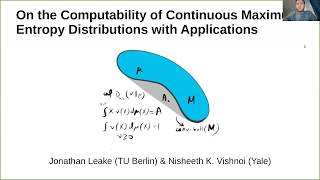
On the Computability of Continuous Maximum Entropy Distributions with Applications
Explore computability of continuous maximum entropy distributions, their applications in quantum entropy and interior point methods, and implications for SDP rounding algorithms.
New Algorithms and Hardness for Incremental Single-Source Shortest Paths in Directed Graphs
Explore cutting-edge algorithms and complexity analysis for incremental single-source shortest paths in directed graphs, focusing on ES Tree and Lazy ES Tree approaches.
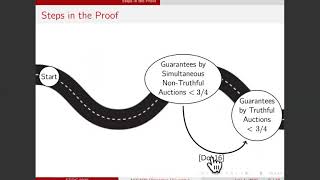
The Communication Complexity of Truthful vs Non-Truthful Combinatorial Auctions
Explore communication complexity in combinatorial auctions, comparing truthful and non-truthful mechanisms through theoretical analysis and proof techniques.
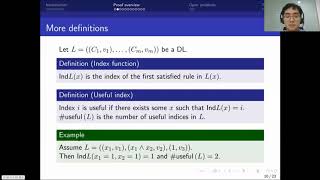
Decision List Compression by Mild Random Restrictions
Explore decision list compression techniques using mild random restrictions, focusing on applications, definitions, and step-by-step compression methods for improved efficiency.
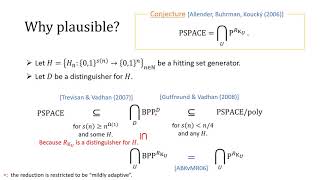
Unexpected Hardness Results for Kolmogorov Complexity Under Uniform Reductions
Explore unexpected findings on Kolmogorov complexity, including hardness results, limits, conjectures, and implications for pseudorandom generators and computational complexity.
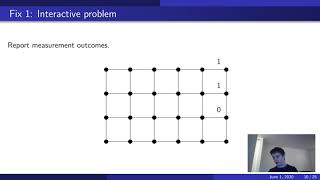
Interactive Shallow Clifford Circuits- Quantum Advantage Against NC and Beyond
Explore quantum advantage in interactive shallow Clifford circuits, examining their superiority over classical NC¹ computations and beyond through innovative problem-solving approaches.
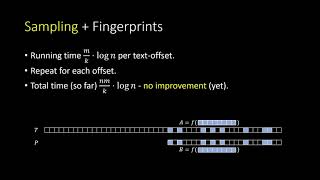
Approximating Text-to-Pattern Hamming Distances
Explore efficient algorithms for approximating Hamming distances between text and pattern strings, focusing on structured and combined sampling techniques.
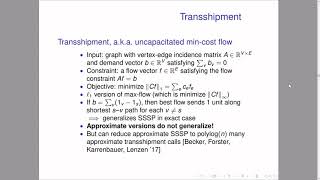
Faster Parallel Algorithm for Approximate Shortest Path
Explore advanced techniques for optimizing parallel algorithms to compute approximate shortest paths, focusing on transshipment, Sherman's framework, and oblivious routing.

Separations and Equivalences Between Turnstile Streaming and Linear Sketching
Explore streaming algorithms, linear sketching, and their equivalences. Learn about turnstile streaming, limitations, and separations in bounded-degree triangle counting and insertion-only algorithms.
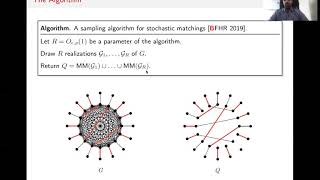
Stochastic Matching with Few Queries - 1-Epsilon Approximation
Explore efficient algorithms for stochastic matching, focusing on (1-epsilon) approximation with limited queries. Learn about vertex independent matchings and local algorithms.
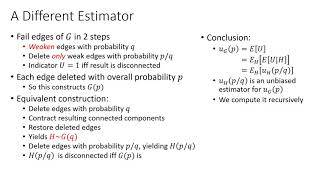
A Phase Transition and Quadratic Time Estimator for Network Reliability
Explore network reliability estimation, including a novel quadratic-time approach, phase transitions, and unbiased estimators for efficient analysis of complex networks.
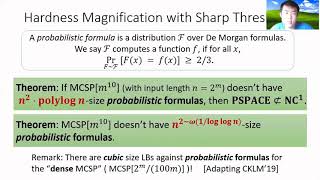
Sharp Threshold Results for Computational Complexity
Explore cutting-edge research on computational complexity, focusing on sharp threshold results, hardness magnification, and probabilistic formulas in this advanced theoretical computer science talk.
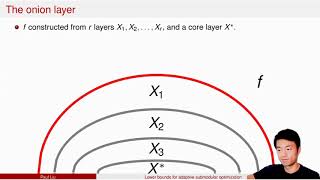
A Polynomial Lower Bound on Adaptive Complexity of Submodular Maximization
Explore adaptive complexity in submodular maximization, covering nonmonotone approximation and hardness. Gain insights into this advanced computational topic through a concise presentation of key concepts and findings.
Estimating Normalizing Constants for Log-Concave Distributions - Algorithms and Lower Bounds
Explore algorithms and lower bounds for estimating normalizing constants in log-concave distributions, covering annealing, Monte Carlo methods, and Langevin dynamics.
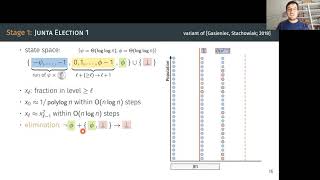
Optimal Time and Space Leader Election in Population Protocols
Explores optimal time and space complexity for leader election in population protocols, presenting a novel algorithm achieving O(n log n) interactions with Θ(log log n) states per agent.
Reducing Path TSP to TSP
Learn about reducing Path TSP to TSP, exploring canonical ideas, large distances, special cases, and practical examples in this concise algorithmic exploration.

Introduction to Linked Lists - Data Structures and Algorithms
Learn the fundamentals of linked lists, their benefits, structure, and operations like adding and deleting nodes. Gain practical knowledge to implement this essential data structure in your programming projects.

Solving an Impossible Riddle with Code
Explore Python coding to simulate and solve the 100 prisoner riddle, comparing random and loop strategies through data visualization and network analysis.