Sketching Techniques for Data Structures and Optimization - Part 3
Explore advanced sketching techniques for data structures and optimization in fast algorithms, focusing on cutting-edge research and practical applications.
Sketching Techniques for Data Structures and Optimization - Part 2
Explore advanced sketching techniques for data structures and optimization in fast algorithms, focusing on practical applications and theoretical foundations.
Sketching Techniques for Data Structures and Optimization - Part 1
Explore data structure optimization techniques for fast algorithms, focusing on sketching methods to enhance computational efficiency and performance.
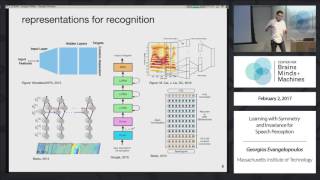
Learning with Symmetry and Invariance for Speech Perception
Explore symmetry and invariance in speech perception, focusing on acoustic variability, feedforward models, and invariant representations. Learn about word orbits, phone representations, and acoustic modeling techniques.
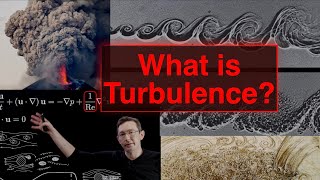
What Is Turbulence? - Turbulent Fluid Dynamics Are Everywhere
Explore the fundamental characteristics of turbulent fluid dynamics, their prevalence in nature and engineering, and the role of Reynolds number in controlling complexity.
Computing Partition Functions, Part I
Explore computational techniques for partition functions in statistical physics, focusing on spin systems, phase transitions, and algorithmic approaches like Markov Chain Monte Carlo.
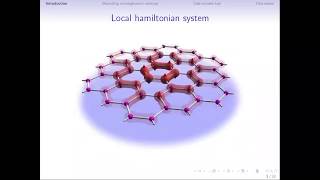
Entanglement Subvolume Law for 2D Frustration-Free Spin Systems
Explore entanglement entropy in 2D frustration-free spin systems, examining Hastings' proof, robust polynomials, and the Whole Screen Directivity Lemma.

What Is Reality? - With Frank Wilczek
Nobel laureate Frank Wilczek explores fundamental concepts shaping our understanding of the universe, including time, space, matter, energy, complexity, and complementarity, offering insights into the nature of reality.
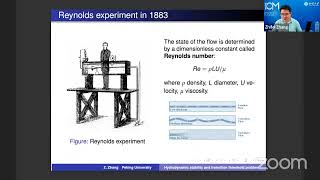
Hydrodynamic Stability at High Reynolds Number and Transition Threshold Problem
Explores hydrodynamic stability theory, focusing on laminar flow instability and turbulence transition at high Reynolds numbers. Discusses key physical effects and recent progress in linear inviscid damping and enhanced dissipation for shear flows.
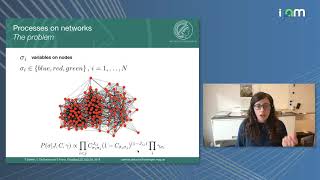
Matrix Product States for Modeling Dynamical Processes on Networks
Explore matrix product states and dynamic message-passing algorithms for modeling network dynamics, reducing computational complexity from exponential to polynomial in system size and duration.
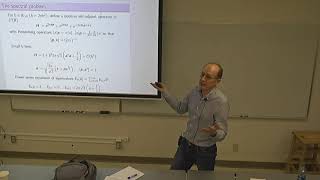
On the Spectral Problem of a Three Term Difference Operator
Explore the spectral problem of quantum mechanical operators in complex Planck's constant scenarios, focusing on toric Calabi-Yau threefolds and their implications.
Introduction to Quantum Computation - Antonello Scardicchio
Learn the basics of quantum computation, its potential for problem-solving, and current technological advancements in this field. Explore algorithms, complexity classes, and real-world applications.
Machine Learning to Improve the Exchange and Correlation Functional in DFT
Explore machine learning approaches to improve exchange and correlation functionals in density functional theory, discussing physically informed methods and their advantages in quantum mechanics.
Compact Representations of Excited States from QMC, as Data for Low-Energy Models
Explore compact wave function representations for excited states in quantum mechanics, focusing on variational Monte Carlo methods and their applications in effective model development.
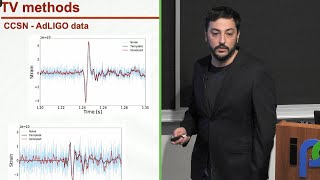
Variational Models and Algorithms for GW Denoising and Reconstruction
Explore variational models and algorithms for gravitational wave denoising and reconstruction, including applications to simulated and real detector data, signal classification, and glitch detection.
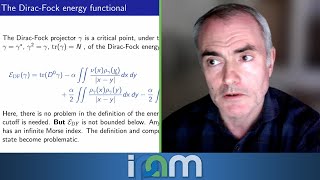
The Ground State of the Dirac-Fock Energy for Molecules and Crystals - IPAM at UCLA
Explore ground state definition for Dirac-Fock energy in molecules and crystals, including existence results and computational algorithms. Insights for theoretical and numerical investigations.
Why Do Simple Models Work? Partial Answers from Information Geometry - Lecture 1
Explores information geometry to understand why simple models effectively describe complex systems, focusing on statistical mechanics, renormalization, and model reduction in physics and biology.
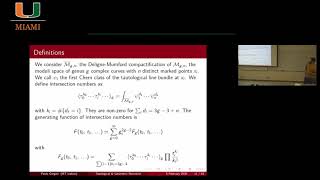
Asymptotics and Resurgence in Weil-Petersson Volumes
Explore non-perturbative properties of 2D gravity models using Resurgence, uncovering insights into Weil-Petersson volume asymptotics and topological gravity instanton contributions.
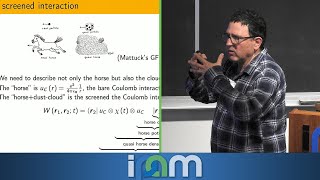
Stochastic Vector Methods for Extended Systems - IPAM at UCLA
Explore stochastic vector approaches for electronic structure in condensed matter systems, reducing complexity and enhancing efficiency in computational quantum mechanics.
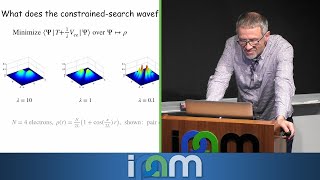
Fast Algorithm for the Strong-Interaction Limit of Density Functional Theory
Explore a novel algorithm for computing the strong-interaction limit in density functional theory, enhancing accuracy in modeling strongly correlated systems and overcoming computational challenges.
From Physics to Machine Learning and Back
Explore the fascinating intersection of physics and machine learning, uncovering how these fields influence and enhance each other's methodologies and discoveries.