Are All True Mathematical Statements Provable? - Famous Math Problems
Explores the philosophical question of mathematical truth and provability, challenging conventional views with explicit examples of likely true but unprovable mathematical statements.

Infinities and Skepticism in Mathematics - Interview with N J Wildberger
Exploration of foundational issues in mathematics, including infinities, skepticism, and modern mathematical challenges. Discusses algorithms, paradoxes, and the future direction of mathematics.
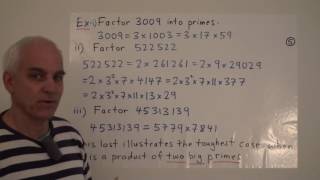
Unique Factorization and Its Difficulties - Data Structures Math Foundations 199
Exploring unique factorization, its challenges with large numbers, and modern factoring techniques. Discusses implications for internet security and computational complexity.
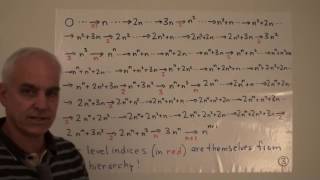
Limit Levels and Self-Similarity in Successor-Limit Hierarchy - Data Structures Math Foundations 184
Explore self-similarity in successor-limit hierarchy, examining limit levels and computational challenges. Insights for programmers on pure mathematics at extreme numerical heights.
A Generalized Central Limit Conjecture for Convex Bodies
Explore a generalized central limit theorem for convex bodies, its connection to the KLS conjecture, and implications for asymptotic convex geometry in this advanced mathematics lecture.
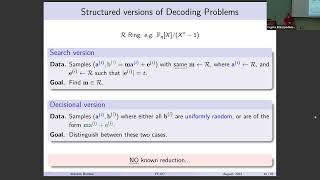
Coding Theory - Advances and Applications
Explore cutting-edge advancements in coding theory and cryptography at this Crypto 2022 session, featuring expert discussions on innovative algorithms and security protocols.
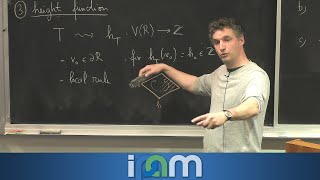
Dimer Models and Random Tilings - Part 1
Explore dimer models and random tilings with Cédric Boutillier. Learn about Kasteleyn's theory, combinatorial correspondences, and asymptotic methods for studying perfect matchings on lattices.
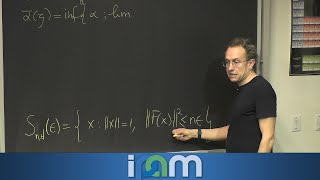
Solving Overparametrized Systems of Nonlinear Equations
Explore overparametrized nonlinear equation systems, their solutions, and implications for neural network optimization landscapes with Stanford's Andrea Montanari at IPAM's EnCORE Workshop.
Perfect t-embeddings of Uniform Aztec Diamond Graphs
Explores t-embeddings of uniform Aztec diamond graphs, providing new formulas and asymptotic analysis to prove convergence of dimer model height fluctuations to a Gaussian Free Field.
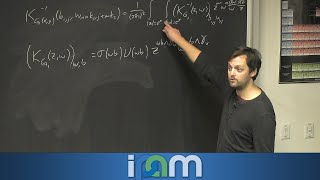
Dimer Models and Random Tilings - Part 2
Explore dimer models, perfect matchings, and tilings with advanced mathematical tools. Delve into Kasteleyn's theory, combinatorial correspondences, and asymptotic methods for large-scale limits.
Fluctuations of Linear Eigenvalue Statistics in Sample Covariance Matrices - Tensor Product Data
Explore fluctuations in linear eigenvalue statistics of sample covariance matrices with tensor product data, comparing normal and uniform distributions on unit sphere.
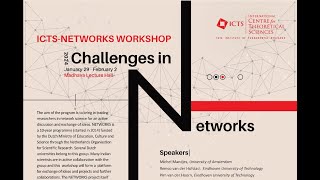
Asymptotics of Invariant Measures of Mean-field Markov Models on Countable State Spaces
Explore asymptotics of invariant measures in mean-field Markov models on countable spaces. Gain insights into network science, probability theory, and applications in complex systems and data analysis.
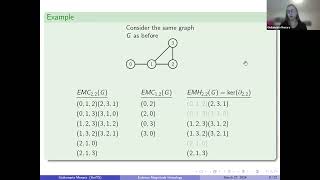
Eulerian Magnitude Homology - Subgraph Structure and Random Graphs
Explore connections between magnitude homology group ranks and graph substructures. Introduces eulerian and discriminant magnitude homology, relating them to subgraph counts and random graph models.
Sparsifying Generalized Linear Models
Explores sparsification of sums in generalized linear models, presenting algorithms for efficient computation and applications to optimization problems like regression.

Chance to See Life - Expressing the World Through Probability
Exploring mathematical models and probability to interpret the world, blending quantitative analysis with human nature insights for a unique perspective on life and investment.
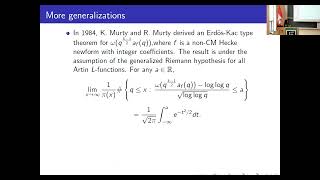
A Survey of Central Limit Theorems in Number Theory
Explore key central limit theorems in number theory, examining their applications and implications for understanding mathematical distributions and patterns.
How Hard is it to Solve This? - Computational Complexity in Problem Solving
Explore problem-solving techniques in mathematics and statistics through lectures, hands-on sessions, and interactions with distinguished researchers. Gain broader exposure to key topics and enhance analytical skills.

Hypergeometric Matrix Models and their Duals
Explore hypergeometric functions of complex matrices, their connections to algebraic combinatorics, and a novel approach to approximating these functions using Hurwitz theory concepts.
Cutoff for Biased Transpositions in Card Shuffling
Explore card shuffling algorithms and mixing times with biased transpositions, extending Diaconis and Shahshahani's work on random transpositions in deck shuffling.

Global Asymptotics of Jack-Deformed Random Young Diagrams via Lukasiewicz Paths
Explores discrete analogues of log-gas systems, examining universal formulas for global asymptotics in various temperature regimes, using weighted lattice paths and revealing phase transition phenomena.
Growth and Tensor Products in Representation Theory - Lecture 1
Explore asymptotic counting of summands in tensor products of representations, with numerous examples to illustrate concepts in symmetric tensor categories and representation theory.