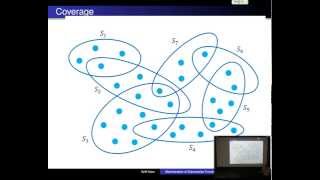
Recent Results on Maximizing Submodular Functions
Explore recent advancements in submodular maximization, covering constrained and unconstrained scenarios for monotone and non-monotone functions within combinatorial optimization.
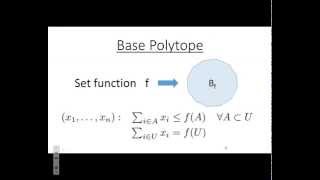
Provable Submodular Function Minimization via Fujishige Wolfe Algorithm
Explore submodular function minimization through the Fujishige-Wolfe algorithm, analyzing its convergence and implications for combinatorial optimization.
Andreas E. Feldmann - A -embedding of Low Highway Dimension Graphs into Bounded Treewidth Graphs
Explores embedding low highway dimension graphs into bounded treewidth graphs, with applications in transportation network optimization problems like Travelling Salesman and Facility Location.
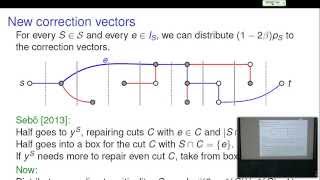
Reassembling Trees for the Traveling Salesman
Explore advanced approximation algorithms for traveling salesman problems, focusing on tree reassembly techniques to improve solutions beyond traditional methods.

On LP-Relaxations for the Tree Augmentation Problem
Explore LP-relaxations for tree augmentation, including dual-fitting algorithms, shadow-minimal solutions, and blocking trees. Gain insights into improved approximation techniques for combinatorial optimization problems.
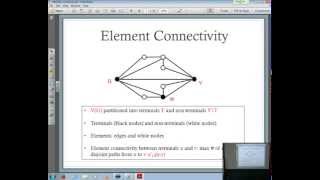
On Element Connectivity Preserving Graph Simplification
Explores element-connectivity in graph simplification, focusing on reduction techniques, algorithmic results, and applications in network design. Highlights open problems and submodularity properties for faster algorithms.
Random Matrix Theory and Its Applications - Lecture 5
Explore advanced random matrix theory concepts, including Gaussian ensembles, coarse-graining techniques, and the Wigner semi-circular law in this comprehensive lecture.
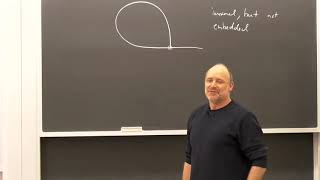
Hilbert's 16th Problem and O-Minimality - Lecture 1
Explore the topology of cycles, limit cycles, and related mathematical concepts in this advanced graduate-level lecture on Hilbert's 16th problem and o-minimality.
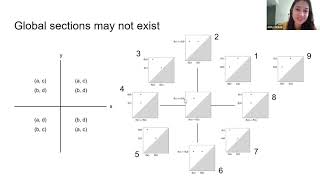
Persistence Diagram Bundles- A Multidimensional Generalization of Vineyards
Explore persistence diagram bundles, a multidimensional generalization of vineyards for analyzing topological changes in data sets with multiple parameters, including computation methods and potential applications.
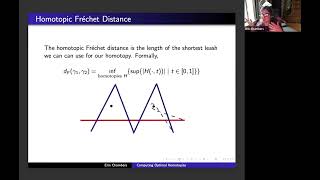
Computing Optimal Homotopies
Explore optimal curve similarity measures using homotopy-based approaches, examining structural properties, algorithms, and open questions in topology and computational geometry.
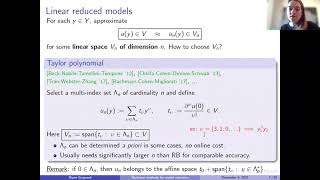
Nonlinear Reduced Models for Parametric/Random PDEs
Explore efficient techniques for constructing reduced models of parametric/random PDEs, focusing on error estimation, library construction, and practical applications in thermal systems and state estimation.
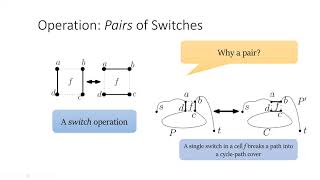
Reconfiguring Simple ST Hamiltonian Paths in Rectangular Grid Graphs
Explore reconfiguration of Hamiltonian paths in grid graphs, focusing on algorithms, mechanisms, and structures for path transformation using switch pairs and zipping techniques.

Breakthroughs - A Refined Laser Method and Faster Matrix Multiplication
Explore advanced techniques in matrix multiplication, including the refined Laser method, to enhance computational efficiency and speed in mathematical operations.

Effective Arithmetic Geometry
Explore advanced concepts in arithmetic geometry, focusing on effective methods and their applications in number theory and algebraic geometry.

High Dimensional Robust Sparse Regression
Explore advanced techniques for robust sparse regression in high-dimensional data, focusing on sublinear algorithms and nearest-neighbor search methods.
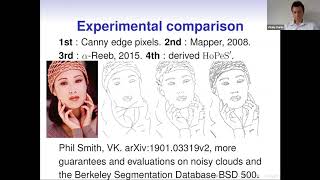
Persistence-Based Skeletonization of Images
Explores algorithms for splitting images into convex polygons using topological persistence, including Convex Constrained Mesh and Persistent Resolution-Independent Mesh for edge detection.
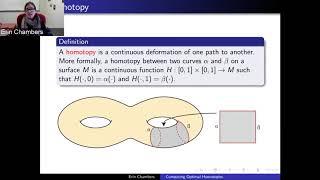
Computing Optimal Homotopies
Explore curve similarity measures and homotopy-based deformations in GIS, medical imaging, and graphics. Survey geometric and topological metrics, algorithms, and open questions in optimal homotopy computation.
Solving Equations and Optimization Problems with Uncertainty
Explore algorithms for detecting zeros of imprecise continuous functions and approximating worst-case optima in optimization problems with uncertain feasible domains.
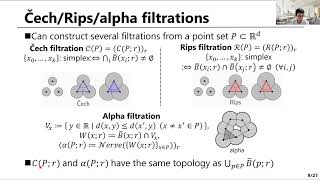
RipsNet- Fast and Robust Estimation of Persistent Homology for Point Clouds
Estimating persistence diagrams of point clouds using neural networks for faster, more robust topological analysis. Overcomes computational complexity and sensitivity to outliers in practical applications.
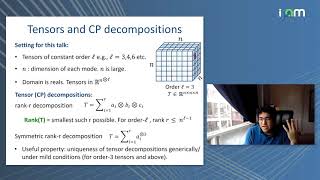
Smoothed Analysis for Tensor Decompositions and Unsupervised Learning
Explore smoothed analysis for tensor decompositions and unsupervised learning, focusing on polynomial time guarantees and robust decompositions of symmetric overcomplete tensors.
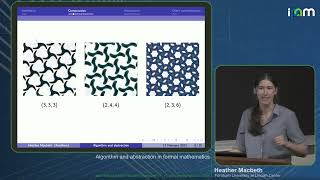
Algorithm and Abstraction in Formal Mathematics - IPAM at UCLA
Explore the paradox of formalized proofs, blending abstraction and computation in mathematics. Discover a new aesthetic that embraces algorithms and cross-referencing in formal mathematical discourse.