Solving Optimization Problems on Databricks for the Ad Industry
Explore scalable optimization techniques for ad industry using Databricks. Learn algorithms and tuning methods to process data efficiently and solve large-scale problems while integrating with existing infrastructure.
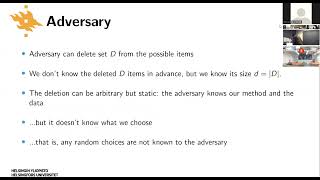
Coresets for Robust Submodular Maximization with Deletions
Explore submodular maximization against deletions, learning about coresets and algorithms for robust optimization in data science problems. Gain insights from Nikolaj Tatti's research on streaming and offline approaches.

Orthologic with Axioms - Proof Theory and Algorithms
Explore orthologic with axioms, its proof theory, and algorithms. Discover generalized ortholattice reasoning and its applications in verification condition simplification and normalization.

The Discrete Fourier Transform - Most Important Algorithm Ever?
Explore the Discrete Fourier Transform's derivation, properties, and significance in modern technology through a discovery-oriented approach, from basic concepts to complex exponentials.
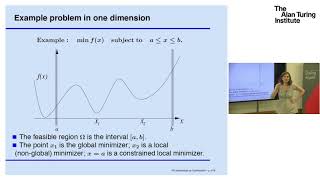
Optimisation - An Introduction: Professor Coralia Cartis, University of Oxford
Explore optimization techniques, from basic concepts to advanced methods, covering minimizers, derivatives, quadratic functions, and gradient methods for solving complex mathematical problems.

A Solution to the Stable Marriage Problem - Emily Riehl Public Lecture
Explore the mathematics behind the stable marriage problem, its sexist implications, and real-world applications in this engaging lecture by mathematician Emily Riehl.

How to Solve a Rubik's Cube in 8 Steps - The Math of Games and Puzzles
Learn an 8-step method to solve a Rubik's Cube quickly and accurately. Explore the mathematics behind the puzzle and master a world-champion algorithm to solve any cube in under three minutes.

Introduction to 2D Arrays in C++ - LeetCode Questions
Comprehensive tutorial on 2D arrays in C++, covering creation, input/output, searching, and solving LeetCode problems. Includes practical coding examples and problem-solving strategies for matrix operations.
Interior Point Methods
Explore advanced interior point methods for optimization, covering key ideas, path following analysis, and specialized algorithms like Renegar's and regularized John ellipse barrier.
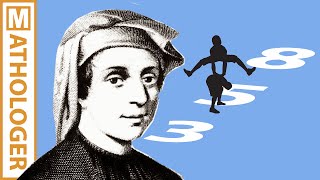
How Did Fibonacci Beat the Solitaire Army?
Explore Fibonacci's mathematical strategy to defeat the Solitaire army, featuring life-and-death mathematics, triangles of death, and captivating animations.

Cryptanalysis 2
Explore cryptanalysis techniques, focusing on discrete logarithm problems in finite fields. Learn about L notation, historical developments, and computational complexity.
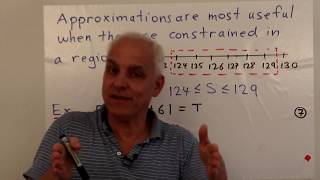
Adding Bigger Sums Using Open Numbers - Elementary Mathematics Explained
Learn a novel approach to adding larger sums using open numbers, focusing on a big end approach. Discover advantages and practice approximating sums by finding ranges for answers.
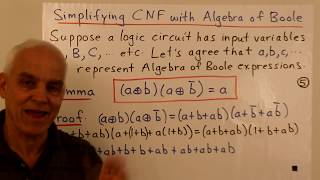
Trying to Sidestep the SAT Problem - N J Wildberger
Explores the SAT problem in Boolean algebra and logic circuits, introducing the Algebra of Boole approach as an alternative for analyzing smaller circuits and potentially addressing larger-scale issues in integrated circuit design.
Combinatorics - Math History - NJ Wildberger
Explore combinatorics through historical examples, counting problems, graph theory, and generating functions. Delve into partitions, Fibonacci numbers, Catalan sequence, and famous theorems in this engaging mathematical journey.
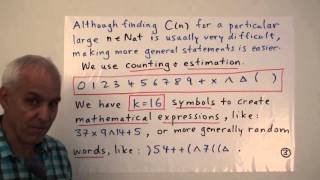
The Sporadic Nature of Big Numbers - Data Structures in Mathematics
Explores how arithmetic breaks down with large numbers, revealing most "numbers" are invisible to us. Challenges conventional number theory and questions the nature of natural numbers.
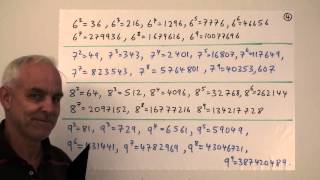
The Chaotic Complexity of Natural Numbers - Data Structures in Mathematics
Exploring the complex nature of arithmetic with large numbers, focusing on exponential and triangular complexity, and examining the role of powers in mathematical computations.
Goemans-Williamson: Rounding the Max-Cut SDP - Lecture 20a of CS Theory Toolkit
Efficient algorithm for approximating maximum graph cuts using semidefinite programming and randomized rounding, with guaranteed performance ratio of 0.878.
Expander Graph Application 2: Derandomization - Lecture 16c of CS Theory Toolkit
Explore derandomization techniques using expander graphs to reduce error in randomized algorithms without significantly increasing random bits used.
Big O and Friends - Lecture 2a of CS Theory Toolkit
Explore asymptotic notation in theoretical computer science, covering Big O, Omega, and related concepts. Essential for understanding algorithm efficiency and complexity analysis.
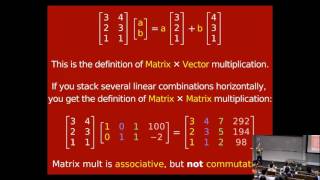
Linear Algebra
Explore vector spaces, linear combinations, and applications in computer science, including Fibonacci sequences and message transmission on noisy channels.

Self-Study Computational Neuroscience - Coding, Textbooks, Math
Comprehensive guide to starting computational neuroscience: programming languages, coding practice, textbooks, math resources, project ideas, and datasets for self-study and skill development.