
Lempel-Ziv Algorithm: Complexity Analysis and Automaton Conversion
Delve into the Lempel-Ziv algorithm's complexity analysis, exploring its relationship with superadditive functions and automaton conversion principles in computational theory.

Improving Solovay's Theorem in Computational Complexity - Part 1
Delve into computational complexity theory and explore improvements to Solovay's theorem through advanced mathematical analysis and theoretical frameworks.

Improving Solovay's Theorem - Part 2
Delve into advanced computational complexity theory through an examination of Solovay's theorem improvements, focusing on mathematical proofs and theoretical foundations.

Полудуплексная Коммуникационная Сложность: Разные Виды Adversary
Dive into the intricacies of half-duplex communication complexity, exploring different adversary types and their impact on complexity measures through concrete examples and theoretical analysis.

Computing Majority of N Using Majority-K Circuits with Logarithmic Depth
Delve into probabilistic constructions and computational complexity, exploring Valiant's theorem on majority functions using Maj-k circuits and their depth analysis.
Regular Types in C++ Programming - Revisited
Explore Regular types in C++ programming, their importance in STL design, and their impact on everyday coding. Learn to design intuitive, well-constrained types and functions.
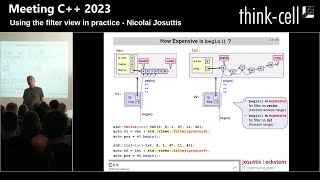
Using the Filter View in Practice - C++20 Standard Views
Explore the C++20 filter view's design, benefits, and potential pitfalls. Learn crucial aspects for successful element filtering and avoid unexpected compile-time and runtime errors.
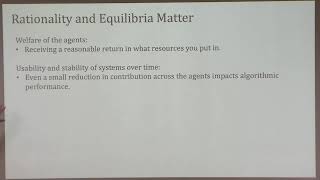
A Theory of Multi-objective Machine Learning
Explore multi-objective learning as a unifying paradigm for robustness, collaboration, and fairness in machine learning, with technical tools and empirical evidence.
Adversarial Machine Learning: Categories, Concepts, and Current Landscape
Explore adversarial machine learning vulnerabilities, including data subversion, evasion, and model revelation. Learn to identify potential threats and build robust defense strategies.
Introduction to Machine Learning - Clustering - Part 3
Explore clustering in machine learning, focusing on k-means and hierarchical algorithms. Learn to uncover data relationships and apply techniques with practical considerations.
Introduction to Python Libraries and Algorithms for Machine Learning
Explore Python libraries and algorithms for machine learning, covering regression, clustering, and classification using popular tools like Pandas.
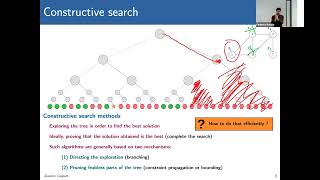
Learning to Bound Using Decision Diagrams and Reinforcement Learning
Explore decision diagrams and reinforcement learning for tighter bounds in discrete optimization, enhancing branch-and-bound algorithms with improved variable ordering techniques.
How to Use Mean-Field Control for Restless Bandits and Weakly Coupled MDPs
Explore mean-field control techniques for resource allocation in weakly coupled MDPs and restless bandits, focusing on LP-based relaxations and asymptotic optimality.
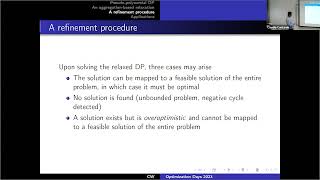
On the Solution of Pseudo-Polynomial Dynamic Programs Involving Large Magnitudes
Explore an iterative algorithm for solving pseudo-polynomial dynamic programs with large magnitudes, focusing on optimization techniques and practical applications.
Generalizations of Matrix Multiplication for Solving the Light Bulb Problem
Explore a novel approach to solving the Light Bulb Problem using tensor-based algorithms, potentially outperforming traditional matrix multiplication methods for faster data analysis and pattern recognition.
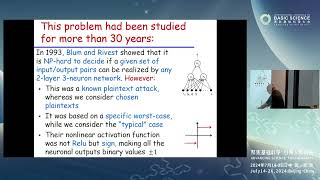
Polynomial Time Cryptanalytic Extraction of Neural Network Models
Explore polynomial-time techniques for extracting neural network parameters, improving upon previous methods and demonstrating practical efficiency on a CIFAR10 classifier.
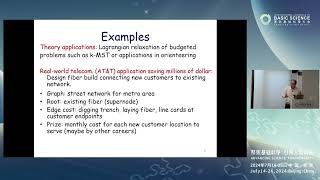
Classic Problems with Modern Techniques - Prize-collecting Framework
Explore state-of-the-art approximation algorithms for classic network design problems using modern techniques, from clustering to recursive methodologies.
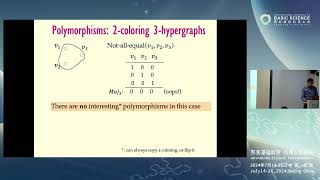
When and Why Do Efficient Algorithms Exist for Constraint Satisfaction and Beyond
Explore the mathematical structures behind efficient algorithms for constraint satisfaction problems and beyond, focusing on polymorphisms and their role in computational complexity.
Modeling, Querying and Seeing Time Series Data within a Self-Organizing Mesh Network
Explore graph database modeling for dynamic power grid networks. Learn to query and analyze sensor data, triage at-risk components, and understand network healing processes.
Basics of Neural Networks - Lecture 2
Explore neural network fundamentals, including architecture, training, and optimization techniques for efficient machine learning model development.
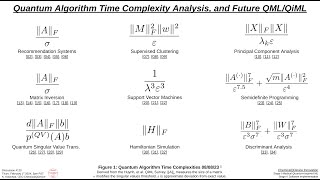
Quantum Algorithm Time Complexity Analysis and Future QML/QiML
Analyze quantum algorithm time complexity and explore future developments in quantum machine learning, with insights from leading researchers.