
Fast Exact Algorithms for Interdiction Problems - Coffee Talk
Explore fast exact algorithms for interdiction problems, focusing on knapsack and minimum spanning tree variants. Learn about Stackelberg games and branch-and-bound techniques for optimization.
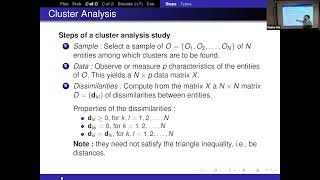
Decision-Based Scenario Clustering - General Bounds for Stochastic Optimization Models
Explore decision-based scenario clustering for stochastic optimization models. Learn to derive efficient bounds and address computational challenges in uncertainty-driven decision-making.
Tensor Reconstruction Beyond Constant Rank
Explorez les algorithmes efficaces pour calculer le rang tensoriel et reconstruire des circuits algébriques restreints, améliorant les résultats existants pour les tenseurs de rang faible mais non constant.

On the Spectrum of the Poincaré Operator in Ellipsoids
Explore the Poincaré operator's spectrum in ellipsoids, examining fluid motion, wave operators, and eigenvalue asymptotics in rotating incompressible fluids.
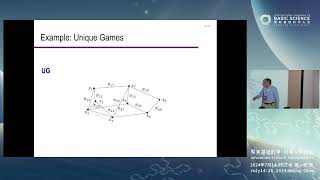
Hard and Easy Constraint Problems - ICBS 2024
Explore the Constraint Satisfaction Problem framework, its connections to various fields, and the resolution of the Feder-Vardi conjecture on efficiently solvable CSPs.

Fast Language Generation by Finetuning Pretrained Transformers
Explore efficient language generation by converting pretrained transformers to RNNs, improving speed without sacrificing accuracy through a swap-then-finetune approach.

A.I. in the Multiverse - Measuring ROI When A/B Tests Are Not Possible
Explore deep learning techniques for assessing AI's revenue impact in e-commerce without A/B testing. Learn to measure and monitor ML pipeline performance in various business settings.

EfficientML.ai - Basics of Neural Networks - Lecture 2
Explore neural network fundamentals, including architecture, training, and optimization techniques. Gain insights into efficient machine learning concepts and applications.
Basics of Neural Networks - EfficientML.ai Lecture 2
Explore neural network fundamentals, including architecture, training, and optimization techniques, in this comprehensive MIT lecture on efficient machine learning.
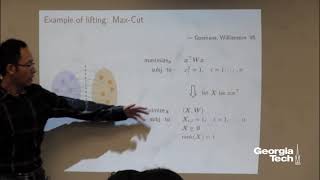
The Power of Nonconvex Optimization in Solving Random Quadratic Systems of Equations - Lecture 1
Explore nonconvex optimization for solving random quadratic systems, achieving optimal accuracy in linear time. Learn about applications in imaging science and neural networks.

Tutorial on Deductive Program Synthesis - Part 2: Hands-on Derivation and Advanced Techniques
Learn deductive program synthesis through hands-on examples, exploring SSL rules, recursion handling, and step-by-step derivation of provably correct pointer-manipulating programs.

Arduino Uno R4 WiFi - Sorting a List of Grades in an Array - Lesson 37
Learn to use Arduino arrays and implement sorting algorithms for ascending and descending order in this hands-on tutorial.
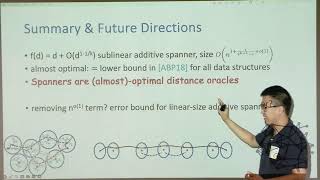
Almost-Optimal Sublinear Additive Spanners in Graph Theory
Explore sublinear additive spanners in graph theory, focusing on optimal stretch functions and size bounds for undirected unweighted graphs. Learn about recent advancements and their implications.
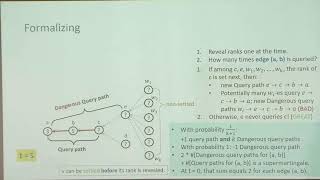
Sublinear Algorithms for Correlation Clustering
Explore sublinear algorithms for correlation clustering, focusing on a 3+eps approximation method using LCA probes, MPC rounds, and dynamic updates. Analyze technical results for maximal independent set computation.
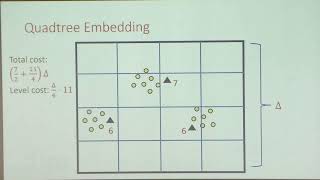
Fast Streaming Euclidean Clustering with Constant Space
Explore streaming algorithms for k-median and k-means clustering, achieving constant space complexity independent of data size and aspect ratio. Improve space and update time for approximate subspace embeddings.
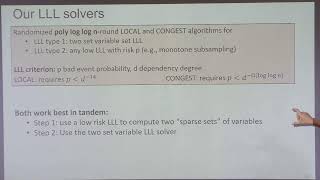
Sparsification for Communication-Efficient Distributed Symmetry-Breaking
Explore sparsification techniques for efficient distributed algorithms, focusing on local symmetry-breaking problems in graph theory and the CONGEST model.
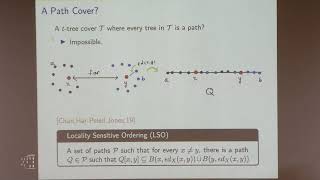
Recent Progress on Euclidean Spanners
Explore recent advancements in Euclidean spanners, including sparse, light, fault-tolerant, and dynamic variants, while discovering outstanding open problems in the field.
A Quasi-Monte Carlo Algorithm for Smooth Kernel Evaluation
Explore a novel data structure for density queries, combining discrepancy theory and LSH to build sparse coresets and enhance smooth kernel evaluation algorithms.
Parallel Algorithms for Local Problems in Sparse Graphs
Explore efficient parallel algorithms for locally checkable problems in sparse graphs, focusing on techniques beyond graph sparsification for improved performance in sublinear regimes.
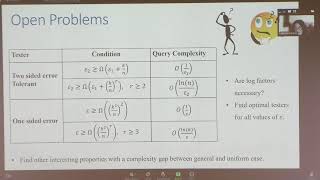
Testing Intersectingness of Uniform Families - How Dana and I Intersected
Explore efficient algorithms for testing intersecting k-uniform set families, including tolerant and one-sided error non-adaptive methods. Compare results to non-uniform families and discover optimal query complexities.
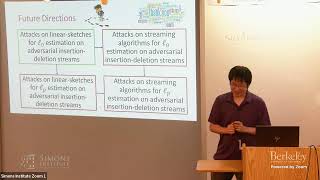
A Strong Separation for Adversarially Robust L0 Estimation for Linear Sketches
Explore adaptive attacks on linear sketches for L_0-estimation in turnstile streams, examining a novel approach that breaks sketches with high probability using ~O(r^8) queries.