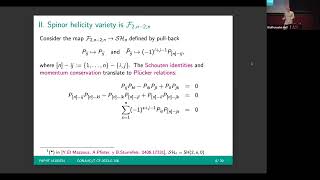
Cluster Structures on Kinematic Spaces
Delve into advanced mathematical concepts exploring cluster structures and their applications in kinematic spaces, focusing on combinatorial approaches in fundamental physics.
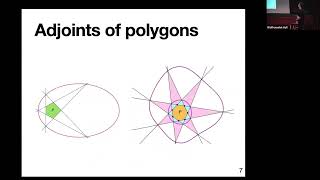
Adjoints and Canonical Differential Forms
Explore the mathematical foundations of adjoints and canonical differential forms through advanced combinatorial physics concepts and their applications in fundamental theory.
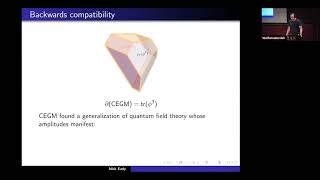
Adventures in Configuration Space
Explore advanced mathematical concepts in configuration space, focusing on combinatorial approaches to fundamental physics problems and their theoretical applications.
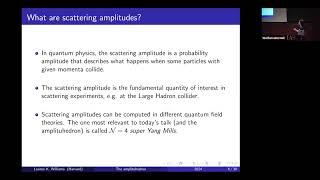
Combinatorics and Geometry of the Amplituhedron
Delve into the mathematical foundations of the amplituhedron, exploring its combinatorial structures and geometric properties through advanced theoretical physics concepts and applications.
Tidal Sculpting of Short-Period Exoplanets
Explore how tidal forces shape short-period exoplanets, their orbital patterns, and interior structures, with insights from JWST observations and explanations for demographic mysteries in planetary systems.
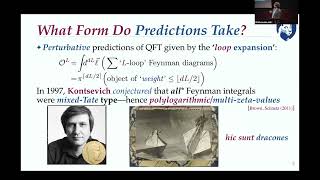
Loop Integration: Phenomenology, Polemics, and Prospects for Improvement
Delve into advanced loop integration concepts in fundamental physics, exploring phenomenology and future prospects with expert insights from theoretical physics research.
Combinatorics on Words in String Amplitudes
Delve into advanced string theory concepts and word combinatorics, exploring their applications in fundamental physics and string amplitude calculations through expert mathematical analysis.
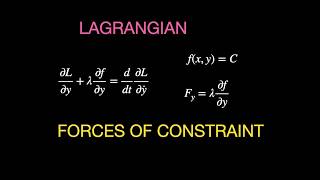
Lagrangian Mechanics - Using Lagrange Multipliers to Find Forces of Constraint
Explore how Lagrange multipliers determine constraint forces in mechanical systems, focusing on the Half Atwood Machine example and tension calculation methods.
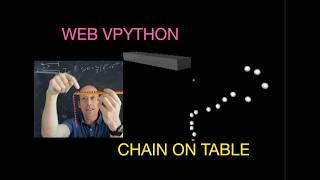
Python Physics: Numerical Modeling of a Chain Sliding Off a Table
Explore the physics of a sliding chain through numerical modeling in Python, demonstrating classical mechanics principles with practical code implementation and visualization.
Cognitive Collectives - Understanding Multi-Scale Collective Intelligence
Explore groundbreaking research on collective animal behavior and intelligence through Max Planck Institute's examination of cognitive systems and group decision-making dynamics.

New Tools for Analyzing Collective Behavior
Explore analytical frameworks for understanding how local agent interactions create large-scale collective behaviors, with applications in opinion dynamics, swarming, and coordinated movement.
Collective Behavior from Surprise Minimization
Explore how cognitive principles and probabilistic decision-making drive collective behavior in animal groups, offering new perspectives on emergent patterns in biological and engineered systems.

Dynamic Mechanical Phases in Active and Passive Fluids
Explore the microscopic origins of mechanical states in colloidal suspensions and active gels, examining stress distribution patterns and dynamic phase transitions under external stimuli.
Emerging Intelligence: From Neurons to Social Dynamics
Explore how internal psychological processes and social interactions shape collective behavior, from neural networks to group dynamics, through mathematical modeling and behavioral theory.

Negative Feedback as a Noise Suppression Mechanism in Collective Foraging
Explore how social insects use negative feedback signals in foraging behavior, examining their role in variance reduction and system robustness through stochastic dynamics analysis.

Metabolic Division of Labor Creates Organismal Cohesion
Explore how metabolic division of labor in ant colonies creates complex superorganisms, examining social transfers, resource allocation, and evolutionary implications for collective systems and organisms.

Does Life Compute? Understanding Protein Folding and Biomolecular Assembly
Explore the mathematical structures behind protein folding and biomolecular assembly, examining computational approaches and theoretical models that illuminate life's fundamental processes.
How Multiscale Collectives Collect Across Scales in Biological Systems
Explore groundbreaking research on how collective systems operate across different scales, from embryonic development to bioelectric patterns in brain formation, using minimal two-scale models and causal networks.

Broken Symmetries in Living Matter
Explore the fundamental principles of nonequilibrium living systems, focusing on broken symmetries, emergent behaviors, and the unique properties of active matter through experimental and theoretical frameworks.

In-Depth Guide to Making Perfect Gravy - From Stock to Final Adjustments
Master the art of perfect gravy making through detailed experiments and techniques, from choosing the right roux and thickeners to understanding stock basics and troubleshooting common issues like post-refrigeration thinning.
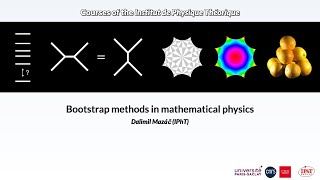
Bootstrap Methods in Mathematical Physics - Lecture 2
Delve into advanced bootstrap methods and their applications in mathematical physics, exploring theoretical frameworks and problem-solving techniques in quantum field theory.