The Future of Higher Education - Research Universities' Response to COVID-19
Explore how research universities are adapting to COVID-19, discussing solutions, medical center roles, and the pandemic's impact on higher education's future.
Absolute Continuity of the Robin Harmonic Measure on Rough Domains
Delve into advanced mathematical analysis exploring Robin harmonic measure's absolute continuity on rough domains, connecting to lung modeling and boundary value problems in physics.
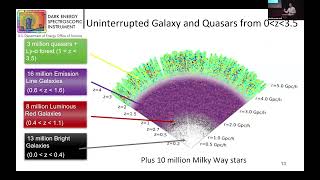
Cosmology from the First Year DESI BAO Measurements
Explore groundbreaking findings from DESI's first-year measurements of baryon acoustic oscillations, examining implications for dark energy, neutrino mass, and the Hubble Constant tension.

TIG Welding Techniques for Preventing Stainless Steel Nozzle Distortion
Master essential TIG welding techniques for stainless steel nozzles, from precise layout and fitting to preventing distortion through strategic welding sequences and proper temperature control.
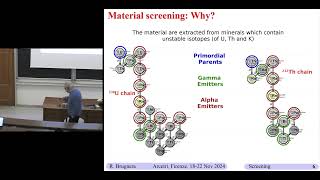
Methods to Measure Radioactivity - Lecture
Discover essential techniques and methodologies for measuring radioactivity, from fundamental principles to practical applications in scientific research and radiation detection.
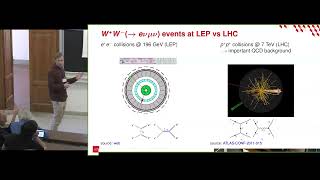
Heavy Neutrino Searches and Lepton Flavor Violation Searches at Colliders - Lecture 1
Explore advanced concepts in heavy neutrino detection and lepton flavor violation searches at particle colliders, focusing on experimental methods and theoretical frameworks.
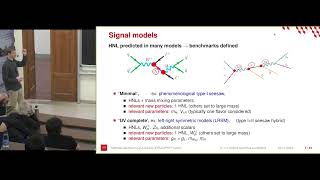
Heavy Neutrino Searches and Lepton Flavor Violation Searches at Colliders - Lecture 2
Delve into advanced concepts of heavy neutrino detection and lepton flavor violation searches at particle colliders, exploring experimental methods and latest research findings.

Guide to Scientific Research in Undergraduate Studies - From Lab Selection to Success
Discover a proven step-by-step approach to securing undergraduate research positions in labs, from identifying your interests and time commitment to successfully landing and maximizing research opportunities.

Why the US is Struggling to Return to the Moon
Explore the complex challenges and technological hurdles facing America's lunar return ambitions, from funding issues to engineering obstacles in modern space exploration.
Topology of Electronic Materials and Their Linear and Nonlinear Responses - Lecture 1
Delve into quantum physics concepts like Berry curvature and electron wavefunction geometry, exploring topological states and their applications in electronic materials through advanced theoretical frameworks and experimental observations.
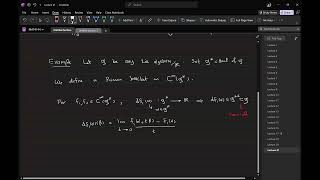
Lie Groups and Quantization - Lecture 21
Delve into advanced mathematical concepts exploring Lie groups and their applications in quantization theory through rigorous theoretical frameworks and practical examples.
Tipping Points in Cancer - Mathematical Oncology and Computational Biology
Explore the mathematical dynamics of cancer progression through computational analysis of fluid mechanics, biology, and critical transition points in tumor development.
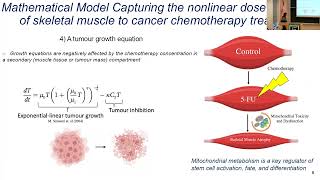
Chemotherapy-Induced Cachexia and Model-Informed Dosing to Preserve Lean Mass in Cancer Treatment
Explore mathematical modeling approaches for optimizing chemotherapy dosing to minimize muscle loss while maintaining effective cancer treatment strategies.
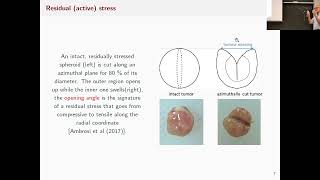
Stress and Growth in Tumor Spheroids
Explore the mathematical modeling of tumor growth dynamics, focusing on stress factors and spheroid development in oncological research and computational biology.
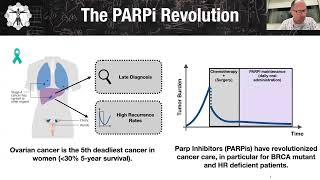
De-escalating PARP Inhibitor Maintenance Therapy in Ovarian Cancer Using Adaptive Therapy
Explore innovative approaches to PARP inhibitor maintenance therapy in ovarian cancer, focusing on adaptive treatment strategies and de-escalation methods for optimal patient outcomes.
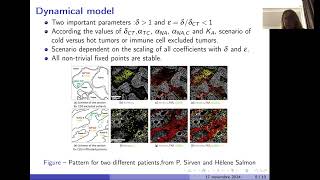
How Cancer-Associated Fibroblasts Promote T-Cell Exclusion in Human Lung Tumors: A Physical Perspective
Explore the physical mechanisms behind cancer-associated fibroblasts and their role in T-cell exclusion within lung tumors through mathematical and biological perspectives.
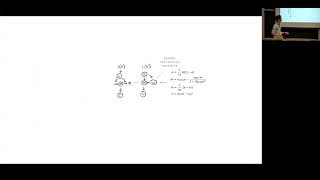
Balancing Interpretability and Predictive Accuracy in Mathematical Models of T Cell Activation
Explore mathematical modeling approaches for T cell activation, examining the trade-offs between model interpretability and accuracy in immunological systems.
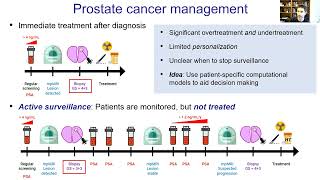
Prostate: Small Organ, Big Problems - Informing Clinical Decisions with Computational Models
Explore how computational models enhance clinical decision-making for prostate-related conditions through advanced mathematical and biological approaches.
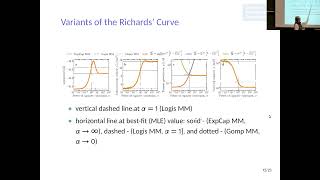
Practical Parameter Identifiability and Handling of Censored Data with Bayesian Inference in Models of Tumour Growth
Explore Bayesian inference techniques for tumor growth modeling, focusing on parameter identification and censored data analysis in mathematical oncology research.
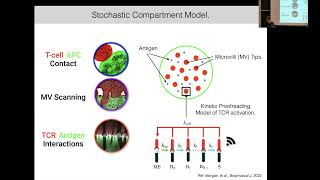
Applications of Extreme Statistics to Cellular Decision Making and Signaling
Explore how extreme statistics influence cellular behavior and decision-making processes, focusing on mathematical approaches in biological signaling systems.
Envisioning the Future of Atoms and Light
Explore groundbreaking theoretical physics concepts in atom-light interactions through an advanced discussion of future developments and emerging research directions in quantum optics.