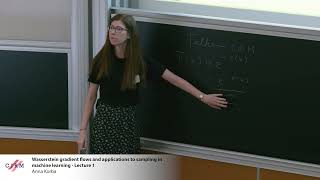
Wasserstein Gradient Flows and Applications to Sampling in Machine Learning - Lecture 1
Explore Wasserstein gradient flows and their applications to sampling in machine learning through an in-depth lecture by Anna Korba.
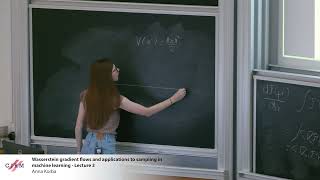
Wasserstein Gradient Flows and Applications to Sampling in Machine Learning - Lecture 3
Explore Wasserstein gradient flows and their applications to sampling in machine learning with Anna Korba's advanced lecture on this complex mathematical topic.
How to Survive on Mars
Explore Mars survival challenges and solutions with expert insights on microbial adaptation, methane detection, and sustainable habitation in extreme Martian conditions.
Soaring Through the Clouds of Titan with Dragonfly - NASA's Mission to Saturn's Moon
Explore Saturn's moon Titan with Dr. Elizabeth Turtle, lead scientist of NASA's Dragonfly mission. Learn about the unique methane-based environment and the rotorcraft lander designed to study this intriguing world.
Slow, Energy-Efficient, and Mysterious Life Deep Within Earth's Crust
Explore cutting-edge astrobiology research at AbGradCon 2023, featuring keynotes on deep Earth life and early universal biology, plus diverse sessions on exoplanets, biosignatures, and origins of life.
The Origin of Life and Unearthing a Treasure Trove of Fossils - Ask An Astrobiologist Episode 58
Explore ancient life forms and fossil discoveries with Dr. Mary Droser, uncovering insights into the Ediacaran period and the establishment of a new National Park in South Australia.
Mysterious Life Deep Within Earth's Crust
Explore mysterious life forms deep within Earth's crust with Dr. Karen Lloyd's keynote on microbial ecosystems and their implications for astrobiology and subsurface life detection.
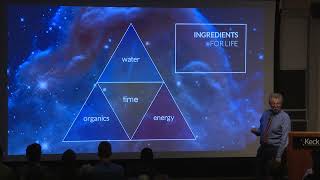
Origins and Evolution of Life in Space and Time
Explore the origins and evolution of life across space and time, from Earth's early days to potential habitable environments on other planets and moons in our solar system and beyond.
Journeys at Mars: Discoveries and Future Exploration
Explore Mars' 30-year journey through expert insights on key discoveries and future missions. Gain perspectives from international scientists and astronauts on Red Planet exploration.
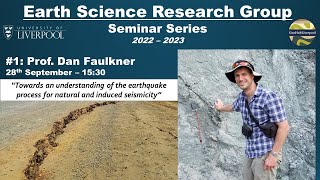
Towards an Understanding of the Earthquake Process for Natural and Induced Seismicity
Explore earthquake processes, linking fluid injection experiments to lab friction measurements for induced seismicity forecasting. Examine fault behavior models to understand earthquake patterns and implications for major fault systems.
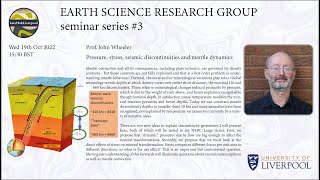
Pressure, Stress, Seismic Discontinuities and Mantle Dynamics
Explore mantle dynamics, seismic discontinuities, and new theories on mineral transformations affecting Earth's interior structure and convection processes.
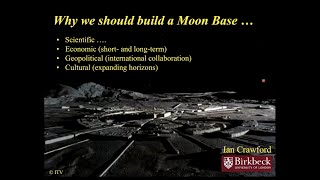
Why We Should Build a Moon Base
Explore the scientific rationale for lunar colonization, covering geology, exploration history, and potential benefits for various research fields.
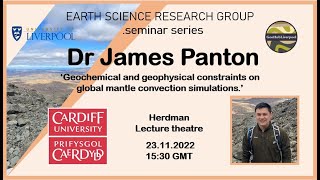
Geochemical and Geophysical Constraints on Global Mantle Convection Simulations
Explore geodynamic models to understand mantle processes, including Pb isotope cycling, Earth's heat budget, and seismically observed lower mantle features.
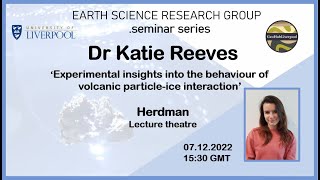
Experimental Insights into Volcanic Particle-Ice Interaction
Explore experimental insights into volcanic particle-ice interactions, examining particle properties, configurations, and their effects on ice systems through systematic research approaches.
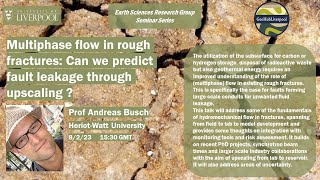
Predicting Fault Leakage Through Upscaling: From Lab to Reservoir
Explore hydromechanical flow in fractures, from lab to reservoir, for improved subsurface utilization in energy and waste storage applications.
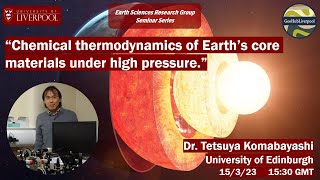
Chemical Thermodynamics of Earth's Core Materials Under High Pressure
Explore chemical thermodynamics of Earth's core materials, examining mixing properties of Fe-X liquids and developing thermodynamic models applicable to core pressure-temperature conditions.
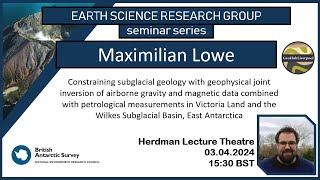
Constraining Subglacial Geology with Geophysical Joint Inversion in Antarctica
Explore geophysical joint inversion techniques to uncover subglacial geology in Antarctica, focusing on airborne gravity and magnetic data analysis in Victoria Land and Wilkes Subglacial Basin.
The Fictional Science of Science Fiction
Explore the intersection of science and science fiction with Dr. Rhett Allain, examining fictional scientific concepts in popular media and their real-world implications.
Exoplanets and the Search for Life in the Universe
Explore exoplanets and the quest for extraterrestrial life with Dr. Schwieterman, delving into cutting-edge astrobiology research and cosmic discoveries.
Heavy Metal: How the Smallest Galaxies Impact the Life Cycle of Elements in Our Universe
Explore the role of small galaxies in the cosmic metal cycle, examining their metal content and evolution over billions of years using deep space observations from Hubble and ground-based telescopes.
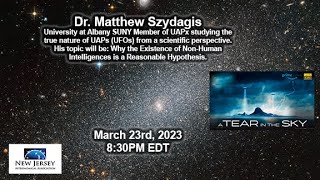
Why the Existence of Non-Human Intelligences is a Reasonable Hypothesis
Explore scientific perspectives on non-human intelligences and UAPs with Dr. Szydagis, examining evidence and hypotheses in this thought-provoking presentation.