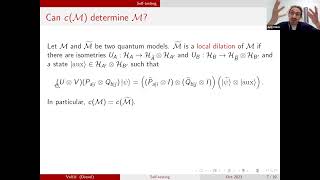
Constant-Sized Self-Tests for Maximally Entangled States and Single Projective Measurements
Explore self-testing in bipartite Bell scenarios, focusing on maximally entangled states and projective measurements. Learn about representation theory and spectral analysis in quantum systems.
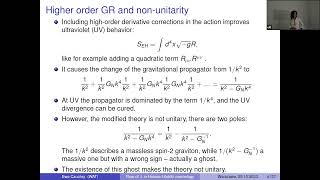
Energy Flow of λ in Hořava-Lifshitz Cosmology
Explore Hořava-Lifshitz cosmology, focusing on λ parameter's energy flow. Analyze two formulations using diverse datasets to bound cosmological parameters and compare with Einstein gravity.
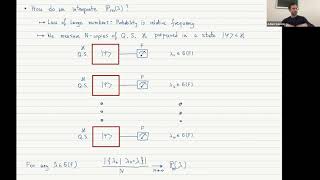
Geometry of Quantum Correlations
Explore the geometric description of quantum correlations using symplectic and algebraic tools. Gain insights into quantum entanglement and its unique features distinguishing quantum from classical systems.
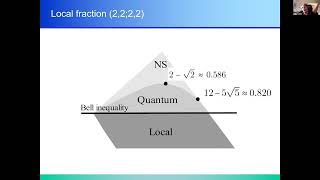
State-Independent Certification of Quantum Observables and Minimal Bipartite Full Nonlocality
Explore state-independent certification of quantum observables and minimal bipartite full nonlocality. Delve into recent findings on unique quantum observable sets and equivalences in quantum correlations.
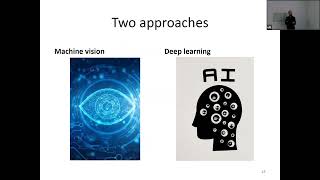
Machine Vision vs Deep Learning in Cancer Detection
Explore machine vision and deep learning applications in cancer diagnosis, comparing their strengths and limitations. Gain insights into innovative computer-aided methods for analyzing microscopic images of breast cancer tissue.
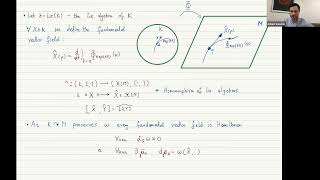
Geometry of Quantum Correlations - Part II
Explore quantum correlations using symplectic and algebraic geometry. Delve into entanglement, nonlocal properties, and the Einstein-Podolsky-Rosen analysis of quantum theory completeness.
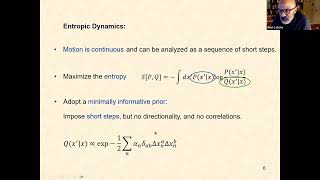
The Entropic Dynamics Approach to Quantum Mechanics
Explore the Entropic Dynamics framework for reconstructing Quantum Mechanics, focusing on ontic and epistemic variables, probability distributions, and the derivation of key quantum principles.
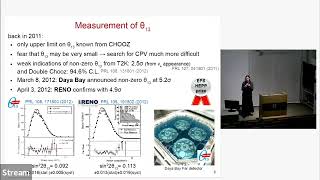
Neutrino Oscillations - Current Experimental Results
Explore neutrino oscillations: recent experimental findings, current knowledge, and future perspectives in particle physics research.
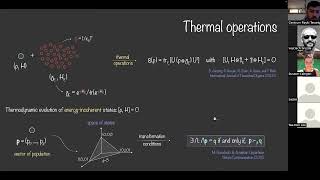
Geometric and Information-Theoretic Aspects of Quantum Thermodynamics
Explore geometric and information-theoretic aspects of quantum thermodynamics, focusing on state transformations, constraints, and practical applications of quantum catalysis in non-classical light generation.
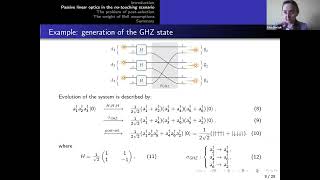
Generation of Entanglement in No-Touching Scenario: Causal Aspects and Protocols
Explore entanglement generation protocols, causal aspects, and quantum foundations. Delve into passive linear optical designs, post-selection issues, and Bell inequality violations in quantum information.
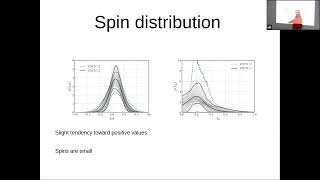
Where Do Merging Binary Black Holes Come From?
Explore the origins of merging binary black holes, examining LVK detections, formation models, and their comparison to observational data.
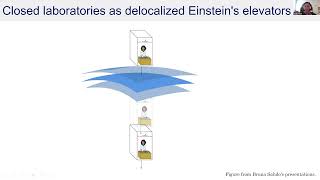
Indefinite Temporal Order on a Superposition of Spherical Shells
Explore indefinite temporal order in quantum theory through a new gravitational quantum switch protocol involving superposed spherical shells and entangled spacetime geometry.
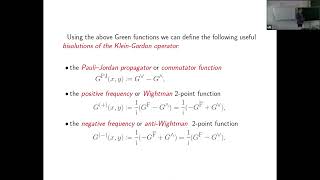
Feynman Propagator on Curved Spacetimes - Definitions and Examples
Explore the Feynman propagator in Quantum Field Theory, examining its definitions and applications across various spacetime models, including stationary, FLRW, and de Sitter.
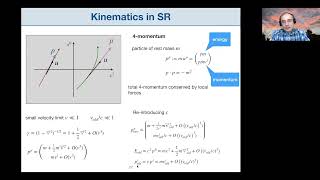
Kinematics in Special Relativity and Doppler Effect - Lecture 2
Explore kinematics in special relativity, relativistic velocity addition, Lorentz contraction, and the Doppler effect in this graduate-level physics lecture.
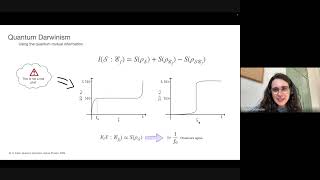
Distinguishing Between Redundancy and Consensus in Quantifying Quantum Objectivity
Explore rigorous definitions of "redundancy" and "consensus" in quantum objectivity, examining their distinct roles in the quantum-to-classical transition and implications for quantum Darwinism.
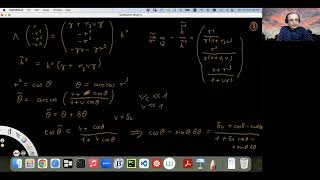
Special Relativity and Tensor Algebra - Lecture 3
Explore light aberration, tensor algebra, and relativistic objects in this graduate-level physics lecture. Practice tensor transformation laws through exercises.
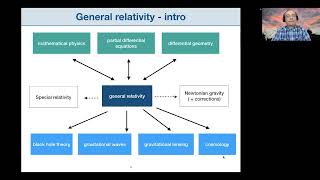
Introduction to Special Relativity and Einstein Summation Convention - Lecture 1
Zgłęb podstawy szczególnej teorii względności, kinematyki i konwencji sumacyjnej Einsteina w ramach kursu dla doktorantów z fizyki teoretycznej.
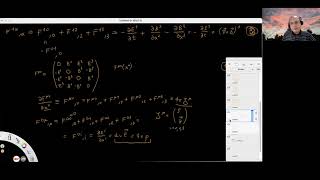
Special Relativity, Equivalence Principle, and Mach's Principle - Lecture 4
Explore special relativity, electromagnetism, stress-energy tensor, equivalence principle, and Mach's principle in this graduate-level physics lecture.
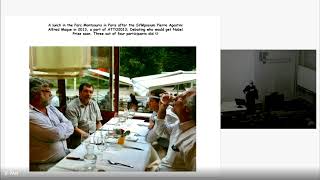
Attoscience, Nobel 2023 and Quantum Simulators
Explore attoscience, high harmonics generation, and quantum simulators. Delve into QED aspects and recent developments in the field, concluding with insights on Nobel 2023.
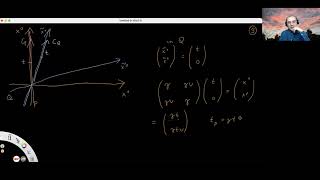
Coordinate Transformations, Connection, and Pseudo-Riemannian Manifolds - Lecture 6
Explore advanced concepts in relativistic physics, including velocity addition, time dilation, coordinate transformations, and pseudo-Riemannian manifolds.
Modular Many-Body Quantum Sensors
Explore modular approaches for enhancing quantum sensing precision through multiple phase transitions in many-body systems, achieving Heisenberg scaling at phase boundaries.