Techniques for Accurate Quantitative Analysis of C. elegans Behavior
Explore advanced techniques for precise C. elegans behavior analysis, including WormLab features, parameter optimization, and comprehensive analysis tools.
Python: Finding Frequency Solutions for Variable Star Light Curves
Learn to measure frequencies in variable star light curves using Python and Pyriod. Explore periodograms, significance testing, and iterative prewhitening for astronomical data analysis.
Visualizing MESA Models with TULIPS - How to Python
Learn to visualize MESA stellar evolution models using TULIPS Python package. Create plots and animations showing changes in stars over time. Enhance understanding of stellar structure and evolution.
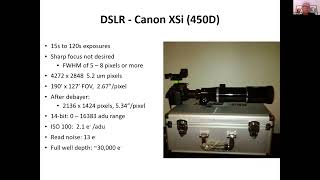
Comparing DSLR, CCD, and CMOS Cameras for Stellar Photometry
Compare DSLR, CCD, and CMOS cameras for stellar photometry. Analyze noise, resolution, and sensitivity using real-world examples. Gain practical insights for astrophotography and variable star observation.
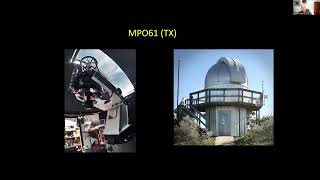
How to Use AAVSOnet to Remotely Observe Variable Stars
Learn to remotely observe variable stars using AAVSOnet's global telescope network. Explore exciting projects, precision photometry techniques, and expert insights for studying celestial objects brighter than 18th magnitude.
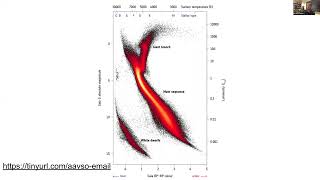
How to Model Isochrones Using Images of Star Clusters
Explore star cluster physics through image analysis. Learn to construct color images and model isochrones, revealing stellar evolution insights in this art-meets-science approach.
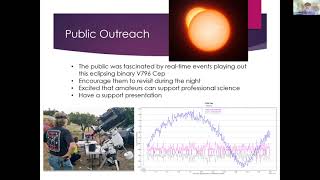
Variable Star Outreach: Real-time Photometry and Spectroscopy Demonstrations - Lecture 1
Explore real-time photometry demonstrations and hands-on spectroscopy techniques for engaging astronomy outreach. Learn to showcase variable stars and spectral classes to captivate public audiences.
AB Aur: Investigating a Potential Protoplanet - Special Webinar
Explore findings on AB Aur's variability and learn how to contribute to an ongoing protoplanet investigation through photometry and spectroscopy observations.
Urban Astronomy: How to Observe in the City
Discover urban astronomy techniques: overcome light pollution, find safe spots, navigate limited horizons, and explore smart telescopes for productive city stargazing.
Understanding Photometric Transforms and Filters
Explore photometric transforms and filters with Dr. Brian Kloppenborg. Learn about light's journey, standardizing measurements, and improving photometry quality through practical insights and Q&A.
Introduction to AAVSO's Solar, Eclipsing Binary, and Long Period Variable Sections
Explore AAVSO's Solar, Eclipsing Binary, and Long Period Variable Sections through expert presentations and Q&A. Gain insights into these astronomical phenomena and learn how to get involved in research.
Leveraging AI for Equitable Mental Health Screening and Addressing Inequities in Trainee Evaluations - 18 Oct 2023
Explore AI's role in equitable mental health screening and address inequities in medical trainee evaluations for underrepresented groups.
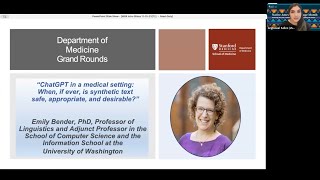
ChatGPT in a Medical Setting: Safety, Appropriateness, and Desirability - November 15, 2023
Explore the safety, appropriateness, and potential benefits of using ChatGPT in medical contexts with insights from linguistics and computer science experts.
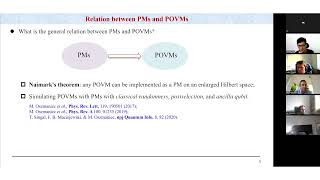
Asymptotics and Typicality of Sequential Generalized Measurements
Explore the relation between projective and generalized quantum measurements, proving how projective measurements arise from sequential generalized measurements in the asymptotic limit.
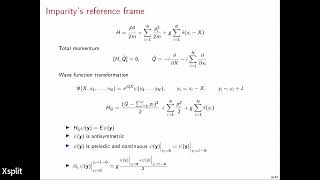
Exact Results for One-Dimensional Mobile Impurity
Explore integrable models of mobile impurities in one-dimensional fermion gases, examining nonperturbative solutions, Fredholm determinants, and phenomena like incomplete relaxation and momentum-dependent statistics.
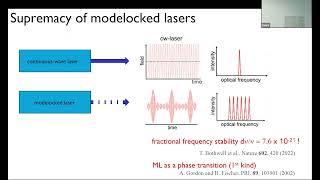
Time-Domain Approach to Quantum Optics
Explore time-domain quantum optics, focusing on subcycle sampling of vacuum states and its applications in quantum computing, communication, and sensing. Gain insights into mid-infrared technologies.
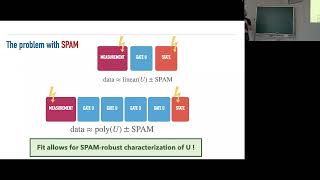
General Guarantees for Randomized Benchmarking with Random Quantum Circuits - Lecture
Explore general guarantees for randomized benchmarking using random quantum circuits, enhancing understanding of quantum information and computing concepts.
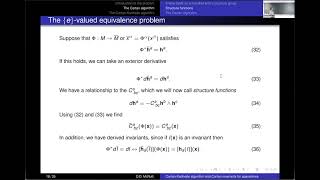
Cartan-Karlhede Algorithm and Cartan Invariants for Spacetimes
Explore the Cartan-Karlhede algorithm for classifying spacetime solutions in General Relativity, including its mathematical foundations and applications in geometry and gravity theories.
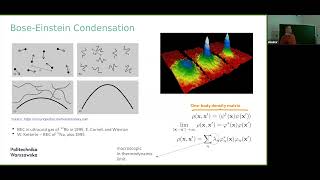
Mixtures of Superfluid Quantum Gases
Explore superfluid ultracold quantum gas mixtures, focusing on Fermi gases, Bose-Einstein condensates, and Bose-Fermi mixtures. Discover solitons, vortices, and quantum droplets in these systems.
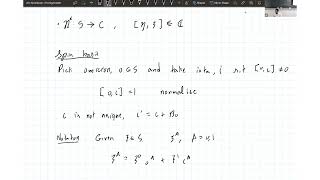
Cartan-Karlhede Algorithm and Cartan Invariants for Spacetimes - Part 2
Explore the Cartan-Karlhede algorithm for classifying spacetime solutions in General Relativity, including mathematical foundations and applications in geometry and gravity theories.
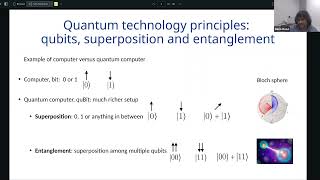
Quantum Technologies: The Case of Quantum Batteries
Explore quantum batteries as energy storage devices, their advantages over classical counterparts, and recent theoretical and experimental progress in quantum charging advantage.