
Nineteenth-Century Cities - Urban Growth and Social Change in Europe and America
Explore 19th-century urbanization, class segregation, and city development through the lens of European history, with a focus on Paris as a case study of urban transformation and social dynamics.
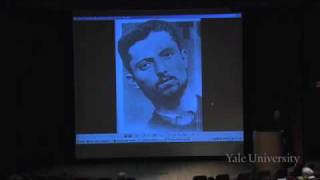
Radicals: Revolutionary Socialism, Syndicalism, and Anarchism in 19th Century Europe
Explorez les courants socialistes du 19e siècle, du réformisme au syndicalisme et à l'anarchisme, en examinant leurs idéologies et leurs tactiques, y compris les origines du terrorisme moderne.

Collaboration and Resistance in World War II Europe - Lecture 23
Explore myths and realities of collaboration and resistance in WWII Europe, examining motivations, actions, and lasting impacts on national memories and historical narratives.
The Origins of World War I - France Since 1871 - Lecture 13
Explore the diplomatic, imperial, and nationalist factors leading to World War I, including shifting alliances, British Empire's role, and mounting tensions in Europe.

Freeman's Top Five Tips for Studying the American Revolution
Discover five essential tips for studying the American Revolution, challenging common misconceptions and offering a fresh perspective on this pivotal historical period.

New Imperialism and the Origins of the Boy Scouts - European Civilization 1648-1945 - Lecture 15
Explore the New Imperialism era, examining religious, economic, and political motives behind European colonial expansion and its cultural impact, including the creation of the Boy Scouts movement.
The Collapse of Communism and Global Challenges - Lecture 24
Explore the fall of communism, its aftermath in Europe, and global challenges like nationalism, immigration, and human rights in this insightful lecture on post-Cold War developments.

Successor States of Eastern Europe after World War I - Lecture 20
Explore interwar Europe's political tensions, ethnic conflicts, and economic challenges that set the stage for World War II, focusing on revisionist powers and minority persecution.

The Coming of the Great War - Origins and Alliances in Early 20th Century Europe
Explore the complex alliances, rivalries, and geopolitical factors that led to World War I, including the formation of the Triple Entente and the Schlieffen Plan's impact on mobilization.

Nationalism in European Civilization - The Construction of National Identities
Explore the complex formation of national identities in Europe, examining language, ethnicity, and historical factors that shaped modern nations and influenced the fate of empires.

Immigration in Modern France - Challenges and Consequences
Explore France's challenges with EU integration, xenophobia, and suburban unrest. Examine threats to national identity and the struggle to uphold ideals of liberty, equality, and fraternity in modern France.
May 1968 Student Protests in France - Lecture 23
Analyse des manifestations étudiantes de mai 1968 en France, leurs causes, leur déroulement et leur impact sur la société française, dans le contexte international de l'époque.
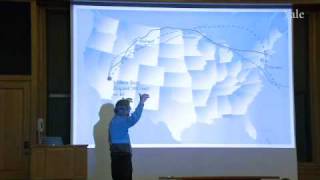
Nuclear Experiments and Environmental Impact - Environmental Politics and Law
Explores 1950s nuclear tests, examining the balance between national security, secrecy, and environmental impact. Discusses data collection, global radionuclide spread, and risk management challenges.
Weber's Theory of Class - Foundations of Modern Social Thought
Explore Weber's theory on the shift from status to class in determining life chances, comparing feudal and modern capitalist eras, and examining the interplay between class and status in society.
Weber on Traditional Authority - Foundations of Modern Social Thought
Explores Weber's concept of traditional authority, examining its forms, legitimacy basis, staff recruitment patterns, and historical evolution in relation to modern social thought.

Weber on Protestantism and Capitalism - Foundations of Modern Social Thought
Explore Weber's theory on the connection between Protestant ethics and capitalism's rise, examining religious influences on economic systems and societal development.

Marx's Theory of History - Foundations of Modern Social Thought
Explore Marx's evolving theory of historical change, focusing on property relations and multi-linear development as presented in the Grundrisse, challenging his earlier uni-linear view of history.
Marx's Theory of Historical Materialism - Lecture 11
Explore Marx's historical materialism, dialectics, and theories of truth. Examine the evolution of his ideas and their impact on understanding social structures and historical development.
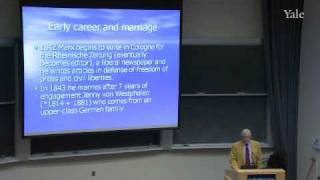
Marx's Theory of Alienation - Foundations of Modern Social Thought
Explore Marx's theory of alienation, its roots in Hegelian thought, and how material conditions shape social critique. Understand Marx's intellectual journey and its impact on revolutionary ideas.

The Division of Powers - Montesquieu's Theory of Separation of Powers
Explore Montesquieu's influential ideas on separation of powers, government classification, and the impact of environment on society in this Yale lecture on modern social thought foundations.
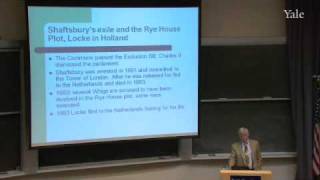
John Locke's Political Theory - Equality, Freedom, Property, and Dissent
Explore Locke's political philosophy, focusing on equality, freedom, property rights, and government by consent. Contrasts with Hobbes' views and examines separation of powers in state governance.